F-box/WD repeat-containing protein 7 (Archipelago homolog) (hAgo) (F-box and WD-40 domain-containing protein 7) (F-box protein FBX30) (SEL-10) (hCdc4)
1_MNQEL 6_ LSVGS 11_ KRRRT 16_ GGSLR 21_ GNPSS 26_ SQVDE 31_ EQMNR 36_ VVEEE 41_ QQQQL 46_ RQQEE 51_ EHTAR 56_ NGEVV 61_ GVEPR 66_ PGGQN 71_ DSQQG 76_ QLEEN 81_ NNRFI 86_ SVDED 91_ SSGNQ 96_ EEQEE 101_ DEEHA 106_ GEQDE 111_ EDEEE 116_ EEMDQ 121_ ESDDF 126_ DQSDD 131_ SSRED 136_ EHTHT 141_ NSVTN 146_ SSSIV 151_ DLPVH 156_ QLSSP 161_ FYTKT 166_ TKMKR 171_ KLDHG 176_ SEVRS 181_ FSLGK 186_ KPCKV 191_ SEYTS 196_ TTGLV 201_ PCSAT 206_ PTTFG 211_ DLRAA 216_ NGQGQ 221_ QRRRI 226_ TSVQP 231_ PTGLQ 236_ EWLKM 241_ FQSWS 246_ GPEKL 251_ LALDE 256_ LIDSC 261_ EPTQV 266_ KHMMQ 271_ VIEPQ 276_ FQRDF 281_ ISLLP 286_ KELAL 291_ YVLSF 296_ LEPKD 301_ LLQAA 306_ QTCRY 311_ WRILA 316_ EDNLL 321_ WREKC 326_ KEEGI 331_ DEPLH 336_ IKRRK 341_ VIKPG 346_ FIHSP 351_ WKSAY 356_ IRQHR 361_ IDTNW 366_ RRGEL 371_ KSPKV 376_ LKGHD 381_ DHVIT 386_ CLQFC 391_ GNRIV 396_ SGSDD 401_ NTLKV 406_ WSAVT 411_ GKCLR 416_ TLVGH 421_ TGGVW 426_ SSQMR 431_ DNIII 436_ SGSTD 441_ RTLKV 446_ WNAET 451_ GECIH 456_ TLYGH 461_ TSTVR 466_ CMHLH 471_ EKRVV 476_ SGSRD 481_ ATLRV 486_ WDIET 491_ GQCLH 496_ VLMGH 501_ VAAVR 506_ CVQYD 511_ GRRVV 516_ SGAYD 521_ FMVKV 526_ WDPET 531_ ETCLH 536_ TLQGH 541_ TNRVY 546_ SLQFD 551_ GIHVV 556_ SGSLD 561_ TSIRV 566_ WDVET 571_ GNCIH 576_ TLTGH 581_ QSLTS 586_ GMELK 591_ DNILV 596_ SGNAD 601_ STVKI 606_ WDIKT 611_ GQCLQ 616_ TLQGP 621_ NKHQS 626_ AVTCL 631_ QFNKN 636_ FVITS 641_ SDDGT 646_ VKLWD 651_ LKTGE 656_ FIRNL 661_ VTLES 666_ GGSGG 671_ VVWRI 676_ RASNT 681_ KLVCA 686_ VGSRN 691_ GTEET 696_ KLLVL 701_DFDVD
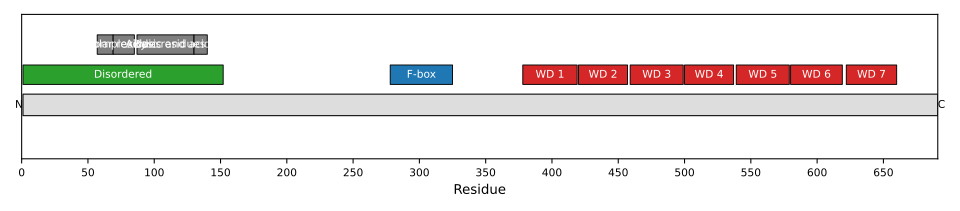
1: Substrate recognition component of a SCF (SKP1-CUL1-F-box protein) E3 ubiquitin-protein ligase complex which mediates the ubiquitination and subsequent proteasomal degradation of target proteins (PubMed:17434132, PubMed:22748924, PubMed:26976582, PubMed:28727686, PubMed:34741373, PubMed:35395208). Recognizes and binds phosphorylated sites/phosphodegrons within target proteins and thereafter brings them to the SCF complex for ubiquitination (PubMed:17434132, PubMed:22748924, PubMed:26774286, PubMed:26976582, PubMed:28727686, PubMed:34741373). Identified substrates include cyclin-E (CCNE1 or CCNE2), DISC1, JUN, MYC, NOTCH1 released notch intracellular domain (NICD), NFE2L1, NOTCH2, MCL1, MLST8, RICTOR, and probably PSEN1 (PubMed:11565034, PubMed:11585921, PubMed:12354302, PubMed:14739463, PubMed:15103331, PubMed:17558397, PubMed:17873522, PubMed:22608923, PubMed:22748924, PubMed:25775507, PubMed:25897075, PubMed:26976582, PubMed:28007894, PubMed:28727686, PubMed:29149593, PubMed:34102342). Acts as a negative regulator of JNK signaling by binding to phosphorylated JUN and promoting its ubiquitination and subsequent degradation (PubMed:14739463). Involved in bone homeostasis and negative regulation of osteoclast differentiation (PubMed:29149593). Regulates the amplitude of the cyclic expression of hepatic core clock genes and genes involved in lipid and glucose metabolism via ubiquitination and proteasomal degradation of their transcriptional repressor NR1D1; CDK1-dependent phosphorylation of NR1D1 is necessary for SCF(FBXW7)-mediated ubiquitination (PubMed:27238018). Also able to promote 'Lys-63'-linked ubiquitination in response to DNA damage (PubMed:26774286). The SCF(FBXW7) complex facilitates double-strand break repair following phosphorylation by ATM: phosphorylation promotes localization to sites of double-strand breaks and 'Lys-63'-linked ubiquitination of phosphorylated XRCC4, enhancing DNA non-homologous end joining (PubMed:26774286)