Protein TMEPAI (Prostate transmembrane protein androgen induced 1) (Solid tumor-associated 1 protein) (Transmembrane prostate androgen-induced protein)
1_MHRLM 6_ GVNST 11_ AAAAA 16_ GQPNV 21_ SCTCN 26_ CKRSL 31_ FQSME 36_ ITELE 41_ FVQII 46_ IIVVV 51_ MMVMV 56_ VVITC 61_ LLSHY 66_ KLSAR 71_ SFISR 76_ HSQGR 81_ RREDA 86_ LSSEG 91_ CLWPS 96_ ESTVS 101_ GNGIP 106_ EPQVY 111_ APPRP 116_ TDRLA 121_ VPPFA 126_ QRERF 131_ HRFQP 136_ TYPYL 141_ QHEID 146_ LPPTI 151_ SLSDG 156_ EEPPP 161_ YQGPC 166_ TLQLR 171_ DPEQQ 176_ LELNR 181_ ESVRA 186_ PPNRT 191_ IFDSD 196_ LMDSA 201_ RLGGP 206_ CPPSS 211_ NSGIS 216_ ATCYG 221_ SGGRM 226_ EGPPP 231_ TYSEV 236_ IGHYP 241_ GSSFQ 246_ HQQSS 251_ GPPSL 256_ LEGTR 261_ LHHTH 266_ IAPLE 271_ SAAIW 276_ SKEKD 281_KQKGH
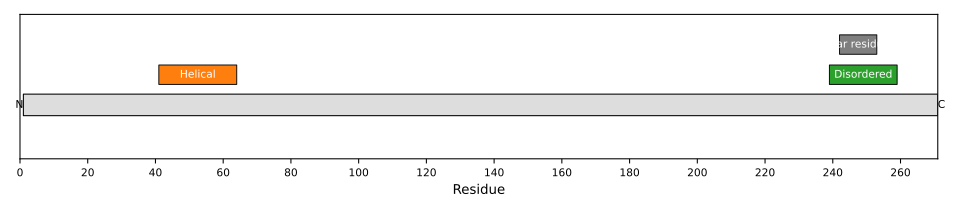
1: Functions as a negative regulator of TGF-beta signaling and thereby probably plays a role in cell proliferation, differentiation, apoptosis, motility, extracellular matrix production and immunosuppression. In the canonical TGF-beta pathway, ZFYVE9/SARA recruits the intracellular signal transducer and transcriptional modulators SMAD2 and SMAD3 to the TGF-beta receptor. Phosphorylated by the receptor, SMAD2 and SMAD3 then form a heteromeric complex with SMAD4 that translocates to the nucleus to regulate transcription. Through interaction with SMAD2 and SMAD3, LDLRAD4 may compete with ZFYVE9 and SMAD4 and prevent propagation of the intracellular signal (PubMed:20129061, PubMed:24627487). Also involved in down-regulation of the androgen receptor (AR), enhancing ubiquitination and proteasome-mediated degradation of AR, probably by recruiting NEDD4 (PubMed:18703514)