RAD51-associated protein 1 (HsRAD51AP1) (RAD51-interacting protein)
1_MVRPV 6_ RHKKP 11_ VNYSQ 16_ FDHSD 21_ SDDDF 26_ VSATV 31_ PLNKK 36_ SRTAP 41_ KELKQ 46_ DKPKP 51_ NLNNL 56_ RKEEI 61_ PVQEK 66_ TPKKR 71_ LPEGT 76_ FSIPA 81_ SAVPC 86_ TKMAL 91_ DDKLY 96_ QRDLE 101_ VALAL 106_ SVKEL 111_ PTVTT 116_ NVQNS 121_ QDKSI 126_ EKHGS 131_ SKIET 136_ MNKSP 141_ HISNC 146_ SVASD 151_ YLDLD 156_ KITVE 161_ DDVGG 166_ VQGKR 171_ KAASK 176_ AAAQQ 181_ RKILL 186_ EGSDG 191_ DSAND 196_ TEPDF 201_ APGED 206_ SEDDS 211_ DFCES 216_ EDNDE 221_ DFSMR 226_ KSKVK 231_ EIKKK 236_ EVKVK 241_ SPVEK 246_ KEKKS 251_ KSKCN 256_ ALVTS 261_ VDSAP 266_ AAVKS 271_ ESQSL 276_ PKKVS 281_ LSSDT 286_ TRKPL 291_ EIRSP 296_ SAESK 301_ KPKWV 306_ PPAAS 311_ GGSRS 316_ SSSPL 321_ VVVSV 326_ KSPNQ 331_ SLRLG 336_ LSRLA 341_ RVKPL 346_HPNAT
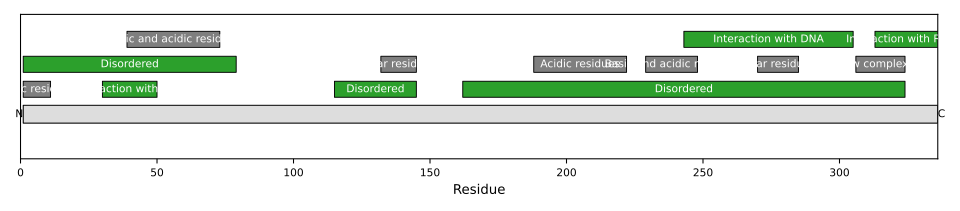
1: Structure-specific DNA-binding protein involved in DNA repair by promoting RAD51-mediated homologous recombination (PubMed:17996710, PubMed:17996711, PubMed:20871616, PubMed:25288561, PubMed:26323318). Acts by stimulating D-Loop formation by RAD51: specifically enhances joint molecule formation through its structure-specific DNA interaction and its interaction with RAD51 (PubMed:17996710, PubMed:17996711). Binds single-stranded DNA (ssDNA), double-stranded DNA (dsDNA) and secondary DNA structures, such as D-loop structures: has a strong preference for branched-DNA structures that are obligatory intermediates during joint molecule formation (PubMed:17996710, PubMed:17996711, PubMed:22375013, PubMed:9396801). Cooperates with WDR48/UAF1 to stimulate RAD51-mediated homologous recombination: both WDR48/UAF1 and RAD51AP1 have coordinated role in DNA-binding during homologous recombination and DNA repair (PubMed:27239033, PubMed:27463890, PubMed:32350107). WDR48/UAF1 and RAD51AP1 also have a coordinated role in DNA-binding to promote USP1-mediated deubiquitination of FANCD2 (PubMed:31253762). Also involved in meiosis by promoting DMC1-mediated homologous meiotic recombination (PubMed:21307306). Key mediator of alternative lengthening of telomeres (ALT) pathway, a homology-directed repair mechanism of telomere elongation that controls proliferation in aggressive cancers, by stimulating homologous recombination (PubMed:31400850). May also bind RNA; additional evidences are however required to confirm RNA-binding in vivo (PubMed:9396801)