Ubiquitin-conjugating enzyme E2 W (EC 2.3.2.23) (E2 ubiquitin-conjugating enzyme W) (N-terminal E2 ubiquitin-conjugating enzyme) (EC 2.3.2.25) (N-terminus-conjugating E2) (Ubiquitin carrier protein W) (Ubiquitin-conjugating enzyme 16) (UBC-16) (Ubiquitin-protein ligase W)
1_MASMQ 6_ KRLQK 11_ ELLAL 16_ QNDPP 21_ PGMTL 26_ NEKSV 31_ QNSIT 36_ QWIVD 41_ MEGAP 46_ GTLYE 51_ GEKFQ 56_ LLFKF 61_ SSRYP 66_ FDSPQ 71_ VMFTG 76_ ENIPV 81_ HPHVY 86_ SNGHI 91_ CLSIL 96_ TEDWS 101_ PALSV 106_ QSVCL 111_ SIISM 116_ LSSCK 121_ EKRRP 126_ PDNSF 131_ YVRTC 136_ NKNPK 141_ KTKWW 146_YHDDT
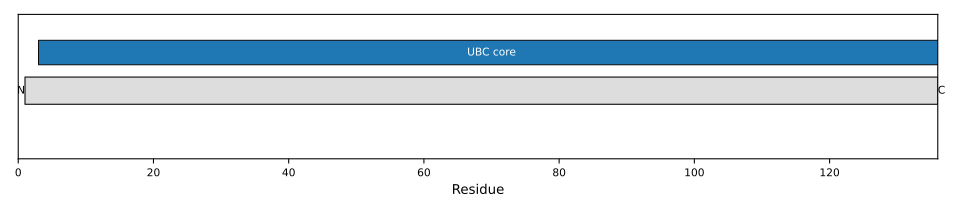
1: Accepts ubiquitin from the E1 complex and catalyzes its covalent attachment to other proteins (PubMed:20061386, PubMed:21229326). Specifically monoubiquitinates the N-terminus of various substrates, including ATXN3, MAPT/TAU, POLR2H/RPB8 and STUB1/CHIP, by recognizing backbone atoms of disordered N-termini (PubMed:23560854, PubMed:23696636, PubMed:25436519). Involved in degradation of misfolded chaperone substrates by mediating monoubiquitination of STUB1/CHIP, leading to recruitment of ATXN3 to monoubiquitinated STUB1/CHIP, and restriction of the length of ubiquitin chain attached to STUB1/CHIP substrates by ATXN3. After UV irradiation, but not after mitomycin-C (MMC) treatment, acts as a specific E2 ubiquitin-conjugating enzyme for the Fanconi anemia complex by associating with E3 ubiquitin-protein ligase FANCL and catalyzing monoubiquitination of FANCD2, a key step in the DNA damage pathway (PubMed:19111657, PubMed:21229326). In vitro catalyzes 'Lys-11'-linked polyubiquitination. UBE2W-catalyzed ubiquitination also occurs in the presence of inactive RING/U-box type E3s, i.e. lacking the active site cysteine residues to form thioester bonds with ubiquitin, or even in the absence of E3, albeit at a slower rate (PubMed:25436519)