ATP-dependent RNA helicase DHX58 (EC 3.6.4.13) (ATP-dependent helicase LGP2) (Protein D11Lgp2 homolog) (RIG-I-like receptor 3) (RLR-3) (RIG-I-like receptor LGP2) (RLR)
1_MELRS 6_ YQWEV 11_ IMPAL 16_ EGKNI 21_ IIWLP 26_ TGAGK 31_ TRAAA 36_ YVAKR 41_ HLETV 46_ DGAKV 51_ VVLVN 56_ RVHLV 61_ TQHGE 66_ EFRRM 71_ LDGRW 76_ TVTTL 81_ SGDMG 86_ PRAGF 91_ GHLAR 96_ CHDLL 101_ ICTAE 106_ LLQMA 111_ LTSPE 116_ EEEHV 121_ ELTVF 126_ SLIVV 131_ DECHH 136_ THKDT 141_ VYNVI 146_ MSQYL 151_ ELKLQ 156_ RAQPL 161_ PQVLG 166_ LTASP 171_ GTGGA 176_ SKLDG 181_ AINHV 186_ LQLCA 191_ NLDTW 196_ CIMSP 201_ QNCCP 206_ QLQEH 211_ SQQPC 216_ KQYNL 221_ CHRRS 226_ QDPFG 231_ DLLKK 236_ LMDQI 241_ HDHLE 246_ MPELS 251_ RKFGT 256_ QMYEQ 261_ QVVKL 266_ SEAAA 271_ LAGLQ 276_ EQRVY 281_ ALHLR 286_ RYNDA 291_ LLIHD 296_ TVRAV 301_ DALAA 306_ LQDFY 311_ HREHV 316_ TKTQI 321_ LCAER 326_ RLLAL 331_ FDDRK 336_ NELAH 341_ LATHG 346_ PENPK 351_ LEMLE 356_ KILQR 361_ QFSSS 366_ NSPRG 371_ IIFTR 376_ TRQSA 381_ HSLLL 386_ WLQQQ 391_ QGLQT 396_ VDIRA 401_ QLLIG 406_ AGNSS 411_ QSTHM 416_ TQRDQ 421_ QEVIQ 426_ KFQDG 431_ TLNLL 436_ VATSV 441_ AEEGL 446_ DIPHC 451_ NVVVR 456_ YGLLT 461_ NEISM 466_ VQARG 471_ RARAD 476_ QSVYA 481_ FVATE 486_ GSREL 491_ KRELI 496_ NEALE 501_ TLMEQ 506_ AVAAV 511_ QKMDQ 516_ AEYQA 521_ KIRDL 526_ QQAAL 531_ TKRAA 536_ QAAQR 541_ ENQRQ 546_ QFPVE 551_ HVQLL 556_ CINCM 561_ VAVGH 566_ GSDLR 571_ KVEGT 576_ HHVNV 581_ NPNFS 586_ NYYNV 591_ SRDPV 596_ VINKV 601_ FKDWK 606_ PGGVI 611_ SCRNC 616_ GEVWG 621_ LQMIY 626_ KSVKL 631_ PVLKV 636_ RSMLL 641_ ETPQG 646_ RIQAK 651_ KWSRV 656_ PFSVP 661_ DFDFL 666_ QHCAE 671_NLSDL
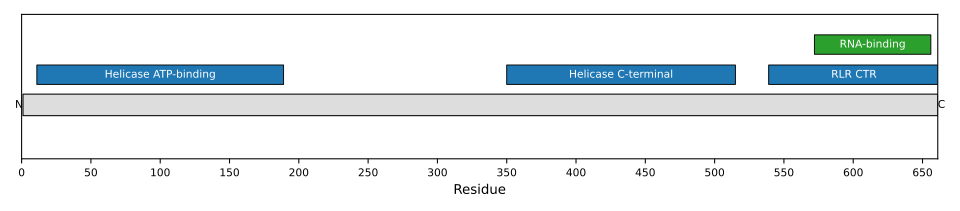
1: Acts as a regulator of RIGI and IFIH1/MDA5 mediated antiviral signaling. Cannot initiate antiviral signaling as it lacks the CARD domain required for activating MAVS/IPS1-dependent signaling events. Can have both negative and positive regulatory functions related to RIGI and IFIH1/MDA5 signaling and this role in regulating signaling may be complex and could probably depend on characteristics of the infecting virus or target cells, or both. Its inhibitory action on RIG-I signaling may involve the following mechanisms: competition with RIGI for binding to the viral RNA, binding to RIGI and inhibiting its dimerization and interaction with MAVS/IPS1, competing with IKBKE in its binding to MAVS/IPS1 thereby inhibiting activation of interferon regulatory factor 3 (IRF3). Its positive regulatory role may involve unwinding or stripping nucleoproteins of viral RNA thereby facilitating their recognition by RIGI and IFIH1/MDA5. Involved in the innate immune response to various RNA viruses and some DNA viruses such as poxviruses and coronavirus SARS-CoV-2, and also to the bacterial pathogen Listeria monocytogenes (PubMed:31256877). Can bind both ssRNA and dsRNA, with a higher affinity for dsRNA. Shows a preference to 5'-triphosphorylated RNA, although it can recognize RNA lacking a 5'-triphosphate