AP-2 complex subunit mu (AP-2 mu chain) (Adaptin-mu2) (Adaptor protein complex AP-2 subunit mu) (Adaptor-related protein complex 2 subunit mu) (Clathrin assembly protein complex 2 mu medium chain) (Clathrin coat assembly protein AP50) (Clathrin coat-associated protein AP50) (HA2 50 kDa subunit) (Plasma membrane adaptor AP-2 50 kDa protein)
1_MIGGL 6_ FIYNH 11_ KGEVL 16_ ISRVY 21_ RDDIG 26_ RNAVD 31_ AFRVN 36_ VIHAR 41_ QQVRS 46_ PVTNI 51_ ARTSF 56_ FHVKR 61_ SNIWL 66_ AAVTK 71_ QNVNA 76_ AMVFE 81_ FLYKM 86_ CDVMA 91_ AYFGK 96_ ISEEN 101_ IKNNF 106_ VLIYE 111_ LLDEI 116_ LDFGY 121_ PQNSE 126_ TGALK 131_ TFITQ 136_ QGIKS 141_ QHQTK 146_ EEQSQ 151_ ITSQV 156_ TGQIG 161_ WRREG 166_ IKYRR 171_ NELFL 176_ DVLES 181_ VNLLM 186_ SPQGQ 191_ VLSAH 196_ VSGRV 201_ VMKSY 206_ LSGMP 211_ ECKFG 216_ MNDKI 221_ VIEKQ 226_ GKGTA 231_ DETSK 236_ SGKQS 241_ IAIDD 246_ CTFHQ 251_ CVRLS 256_ KFDSE 261_ RSISF 266_ IPPDG 271_ EFELM 276_ RYRTT 281_ KDIIL 286_ PFRVI 291_ PLVRE 296_ VGRTK 301_ LEVKV 306_ VIKSN 311_ FKPSL 316_ LAQKI 321_ EVRIP 326_ TPLNT 331_ SGVQV 336_ ICMKG 341_ KAKYK 346_ ASENA 351_ IVWKI 356_ KRMAG 361_ MKESQ 366_ ISAEI 371_ ELLPT 376_ NDKKK 381_ WARPP 386_ ISMNF 391_ EVPFA 396_ PSGLK 401_ VRYLK 406_ VFEPK 411_ LNYSD 416_ HDVIK 421_ WVRYI 426_GRSGI
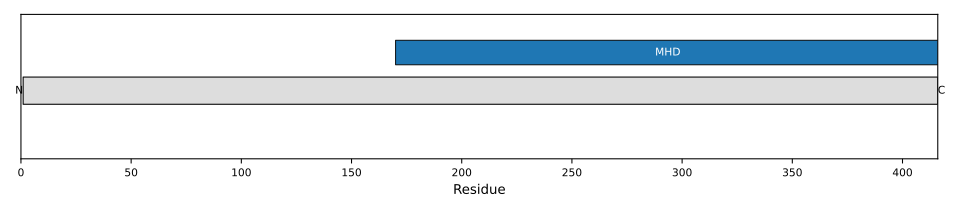
1: Component of the adaptor protein complex 2 (AP-2) (PubMed:12694563, PubMed:12952941, PubMed:14745134, PubMed:14985334, PubMed:15473838, PubMed:31104773). Adaptor protein complexes function in protein transport via transport vesicles in different membrane traffic pathways (PubMed:12694563, PubMed:12952941, PubMed:14745134, PubMed:14985334, PubMed:15473838, PubMed:31104773). Adaptor protein complexes are vesicle coat components and appear to be involved in cargo selection and vesicle formation (PubMed:12694563, PubMed:12952941, PubMed:14745134, PubMed:14985334, PubMed:15473838, PubMed:31104773). AP-2 is involved in clathrin-dependent endocytosis in which cargo proteins are incorporated into vesicles surrounded by clathrin (clathrin-coated vesicles, CCVs) which are destined for fusion with the early endosome (PubMed:12694563, PubMed:12952941, PubMed:14745134, PubMed:14985334, PubMed:15473838, PubMed:31104773). The clathrin lattice serves as a mechanical scaffold but is itself unable to bind directly to membrane components (PubMed:12694563, PubMed:12952941, PubMed:14745134, PubMed:14985334, PubMed:15473838, PubMed:31104773). Clathrin-associated adaptor protein (AP) complexes which can bind directly to both the clathrin lattice and to the lipid and protein components of membranes are considered to be the major clathrin adaptors contributing the CCV formation (PubMed:12694563, PubMed:12952941, PubMed:14745134, PubMed:14985334, PubMed:15473838, PubMed:31104773). AP-2 also serves as a cargo receptor to selectively sort the membrane proteins involved in receptor-mediated endocytosis (PubMed:16581796). AP-2 seems to play a role in the recycling of synaptic vesicle membranes from the presynaptic surface (PubMed:12694563, PubMed:12952941, PubMed:14745134, PubMed:14985334, PubMed:15473838, PubMed:31104773). AP-2 recognizes Y-X-X-[FILMV] (Y-X-X-Phi) and [ED]-X-X-X-L-[LI] endocytosis signal motifs within the cytosolic tails of transmembrane cargo molecules (By similarity). AP-2 may also play a role in maintaining normal post-endocytic trafficking through the ARF6-regulated, non-clathrin pathway (PubMed:19033387). During long-term potentiation in hippocampal neurons, AP-2 is responsible for the endocytosis of ADAM10 (PubMed:23676497). The AP-2 mu subunit binds to transmembrane cargo proteins; it recognizes the Y-X-X-Phi motifs (By similarity). The surface region interacting with to the Y-X-X-Phi motif is inaccessible in cytosolic AP-2, but becomes accessible through a conformational change following phosphorylation of AP-2 mu subunit at Thr-156 in membrane-associated AP-2 (PubMed:11877457). The membrane-specific phosphorylation event appears to involve assembled clathrin which activates the AP-2 mu kinase AAK1 (PubMed:11877457). Plays a role in endocytosis of frizzled family members upon Wnt signaling (By similarity)