SAGA-associated factor 29 (Coiled-coil domain-containing protein 101) (SAGA complex-associated factor 29)
1_MALVS 6_ ADSRI 11_ AELLT 16_ ELHQL 21_ IKQTQ 26_ EERSR 31_ SEHNL 36_ VNIQK 41_ THERM 46_ QTENK 51_ ISPYY 56_ RTKLR 61_ GLYTT 66_ AKADA 71_ EAECN 76_ ILRKA 81_ LDKIA 86_ EIKSL 91_ LEERR 96_ IAAKI 101_ AGLYN 106_ DSEPP 111_ RKTMR 116_ RGVLM 121_ TLLQQ 126_ SAMTL 131_ PLWIG 136_ KPGDK 141_ PPPLC 146_ GAIPA 151_ SGDYV 156_ ARPGD 161_ KVAAR 166_ VKAVD 171_ GDEQW 176_ ILAEV 181_ VSYSH 186_ ATNKY 191_ EVDDI 196_ DEEGK 201_ ERHTL 206_ SRRRV 211_ IPLPQ 216_ WKANP 221_ ETDPE 226_ ALFQK 231_ EQLVL 236_ ALYPQ 241_ TTCFY 246_ RALIH 251_ APPQR 256_ PQDDY 261_ SVLFE 266_ DTSYA 271_ DGYSP 276_ PLNVA 281_ QRYVV 286_ACKEP
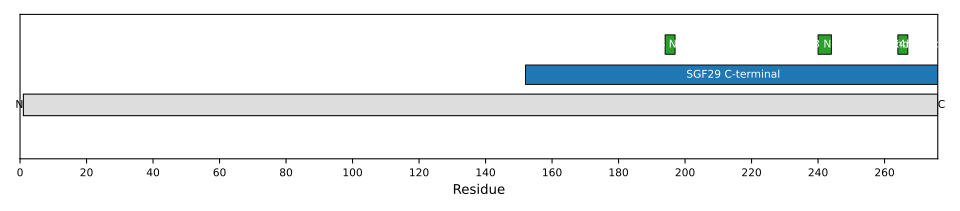
1: Chromatin reader component of some histone acetyltransferase (HAT) SAGA-type complexes like the TFTC-HAT, ATAC or STAGA complexes (PubMed:19103755, PubMed:20850016, PubMed:21685874, PubMed:26421618, PubMed:26578293). SGF29 specifically recognizes and binds methylated 'Lys-4' of histone H3 (H3K4me), with a preference for trimethylated form (H3K4me3) (PubMed:20850016, PubMed:21685874, PubMed:26421618, PubMed:26578293). In the SAGA-type complexes, SGF29 is required to recruit complexes to H3K4me (PubMed:20850016). Involved in the response to endoplasmic reticulum (ER) stress by recruiting the SAGA complex to H3K4me, thereby promoting histone H3 acetylation and cell survival (PubMed:23894581). Also binds non-histone proteins that are methylated on Lys residues: specifically recognizes and binds CGAS monomethylated on 'Lys-506' (By similarity)