Nuclear receptor-binding factor 2 (NRBF-2) (Comodulator of PPAR and RXR)
1_MEVME 6_ GPLNL 11_ AHQQS 16_ RRADR 21_ LLAAG 26_ KYEEA 31_ ISCHK 36_ KAAAY 41_ LSEAM 46_ KLTQS 51_ EQAHL 56_ SLELQ 61_ RDSHM 66_ KQLLL 71_ IQERW 76_ KRAQR 81_ EERLK 86_ AQQNT 91_ DKDAA 96_ AHLQT 101_ SHKPS 106_ AEDAE 111_ GQSPL 116_ SQKYS 121_ PSTEK 126_ CLPEI 131_ QGIFD 136_ RDPDT 141_ LLYLL 146_ QQKSE 151_ PAEPC 156_ IGSKA 161_ PKDDK 166_ TIIEE 171_ QATKI 176_ ADLKR 181_ HVEFL 186_ VAENE 191_ RLRKE 196_ NKQLK 201_ AEKAR 206_ LLKGP 211_ IEKEL 216_ DVDAD 221_ FVETS 226_ ELWSL 231_ PPHAE 236_ TATAS 241_ STWQK 246_ FAANT 251_ GKAKD 256_ IPIPN 261_ LPPLD 266_ FPSPE 271_ LPLME 276_ LSEDI 281_LKGFM
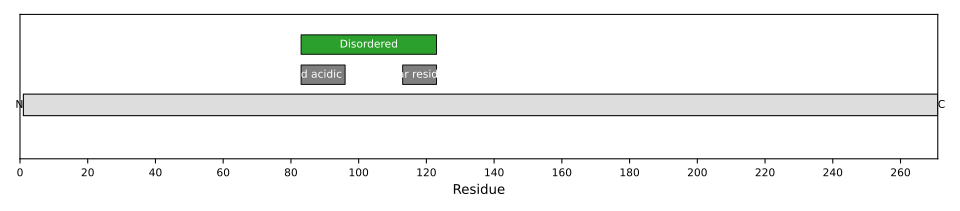
1: May modulate transcriptional activation by target nuclear receptors. Can act as transcriptional activator (in vitro)
2: Involved in starvation-induced autophagy probably by its association with PI3K complex I (PI3KC3-C1). However, effects has been described variably. Involved in the induction of starvation-induced autophagy (PubMed:24785657). Stabilizes PI3KC3-C1 assembly and enhances ATG14-linked lipid kinase activity of PIK3C3 (By similarity). Proposed to negatively regulate basal and starvation-induced autophagy and to inhibit PIK3C3 activity by modulating interactions in PI3KC3-C1 (PubMed:25086043). May be involved in autophagosome biogenesis (PubMed:25086043). May play a role in neural progenitor cell survival during differentiation (By similarity)