Aurora kinase B (EC 2.7.11.1) (Aurora 1) (Aurora- and IPL1-like midbody-associated protein 1) (AIM-1) (Aurora/IPL1-related kinase 2) (ARK-2) (Aurora-related kinase 2) (STK-1) (Serine/threonine-protein kinase 12) (Serine/threonine-protein kinase 5) (Serine/threonine-protein kinase aurora-B)
1_MAQKE 6_ NSYPW 11_ PYGRQ 16_ TAPSG 21_ LSTLP 26_ QRVLR 31_ KEPVT 36_ PSALV 41_ LMSRS 46_ NVQPT 51_ AAPGQ 56_ KVMEN 61_ SSGTP 66_ DILTR 71_ HFTID 76_ DFEIG 81_ RPLGK 86_ GKFGN 91_ VYLAR 96_ EKKSH 101_ FIVAL 106_ KVLFK 111_ SQIEK 116_ EGVEH 121_ QLRRE 126_ IEIQA 131_ HLHHP 136_ NILRL 141_ YNYFY 146_ DRRRI 151_ YLILE 156_ YAPRG 161_ ELYKE 166_ LQKSC 171_ TFDEQ 176_ RTATI 181_ MEELA 186_ DALMY 191_ CHGKK 196_ VIHRD 201_ IKPEN 206_ LLLGL 211_ KGELK 216_ IADFG 221_ WSVHA 226_ PSLRR 231_ KTMCG 236_ TLDYL 241_ PPEMI 246_ EGRMH 251_ NEKVD 256_ LWCIG 261_ VLCYE 266_ LLVGN 271_ PPFES 276_ ASHNE 281_ TYRRI 286_ VKVDL 291_ KFPAS 296_ VPMGA 301_ QDLIS 306_ KLLRH 311_ NPSER 316_ LPLAQ 321_ VSAHP 326_ WVRAN 331_ SRRVL 336_PPSAL
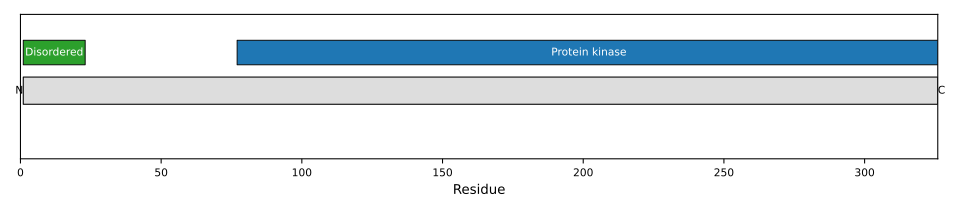
1: Serine/threonine-protein kinase component of the chromosomal passenger complex (CPC), a complex that acts as a key regulator of mitosis (PubMed:11516652, PubMed:12925766, PubMed:14610074, PubMed:14722118, PubMed:29449677). The CPC complex has essential functions at the centromere in ensuring correct chromosome alignment and segregation and is required for chromatin-induced microtubule stabilization and spindle assembly (PubMed:11516652, PubMed:12925766, PubMed:14610074, PubMed:14722118, PubMed:26829474). Involved in the bipolar attachment of spindle microtubules to kinetochores and is a key regulator for the onset of cytokinesis during mitosis (PubMed:15249581). Required for central/midzone spindle assembly and cleavage furrow formation (PubMed:12458200, PubMed:12686604). Key component of the cytokinesis checkpoint, a process required to delay abscission to prevent both premature resolution of intercellular chromosome bridges and accumulation of DNA damage: phosphorylates CHMP4C, leading to retain abscission-competent VPS4 (VPS4A and/or VPS4B) at the midbody ring until abscission checkpoint signaling is terminated at late cytokinesis (PubMed:22422861, PubMed:24814515). AURKB phosphorylates the CPC complex subunits BIRC5/survivin, CDCA8/borealin and INCENP (PubMed:11516652, PubMed:12925766, PubMed:14610074). Phosphorylation of INCENP leads to increased AURKB activity (PubMed:11516652, PubMed:12925766, PubMed:14610074). Other known AURKB substrates involved in centromeric functions and mitosis are CENPA, DES/desmin, GPAF, KIF2C, NSUN2, RACGAP1, SEPTIN1, VIM/vimentin, HASPIN, and histone H3 (PubMed:11756469, PubMed:11784863, PubMed:11856369, PubMed:12689593, PubMed:14602875, PubMed:16103226, PubMed:21658950). A positive feedback loop involving HASPIN and AURKB contributes to localization of CPC to centromeres (PubMed:21658950). Phosphorylation of VIM controls vimentin filament segregation in cytokinetic process, whereas histone H3 is phosphorylated at 'Ser-10' and 'Ser-28' during mitosis (H3S10ph and H3S28ph, respectively) (PubMed:11784863, PubMed:11856369). AURKB is also required for kinetochore localization of BUB1 and SGO1 (PubMed:15020684, PubMed:17617734). Phosphorylation of p53/TP53 negatively regulates its transcriptional activity (PubMed:20959462). Key regulator of active promoters in resting B- and T-lymphocytes: acts by mediating phosphorylation of H3S28ph at active promoters in resting B-cells, inhibiting RNF2/RING1B-mediated ubiquitination of histone H2A and enhancing binding and activity of the USP16 deubiquitinase at transcribed genes (By similarity). Acts as an inhibitor of CGAS during mitosis: catalyzes phosphorylation of the N-terminus of CGAS during the G2-M transition, blocking CGAS liquid phase separation and activation, and thereby preventing CGAS-induced autoimmunity (PubMed:33542149). Phosphorylates KRT5 during anaphase and telophase (By similarity). Phosphorylates ATXN10 which promotes phosphorylation of ATXN10 by PLK1 and may play a role in the regulation of cytokinesis and stimulating the proteasomal degradation of ATXN10 (PubMed:25666058)