T-cell immunoglobulin and mucin domain-containing protein 4 (TIMD-4) (T-cell immunoglobulin mucin receptor 4) (TIM-4) (T-cell membrane protein 4)
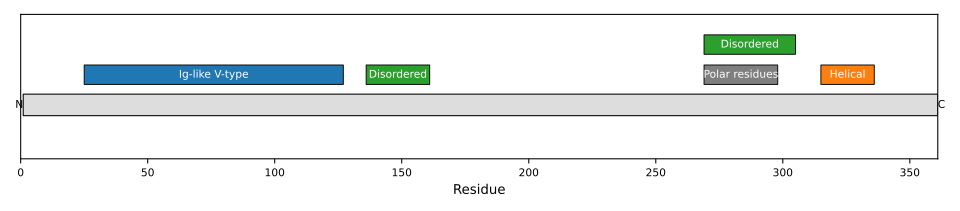
1_MSKEP 6_ LILWL 11_ MIEFW 16_ WLYLT 21_ PVTSE 26_ TVVTE 31_ VLGHR 36_ VTLPC 41_ LYSSW 46_ SHNSN 51_ SMCWG 56_ KDQCP 61_ YSGCK 66_ EALIR 71_ TDGMR 76_ VTSRK 81_ SAKYR 86_ LQGTI 91_ PRGDV 96_ SLTIL 101_ NPSES 106_ DSGVY 111_ CCRIE 116_ VPGWF 121_ NDVKI 126_ NVRLN 131_ LQRAS 136_ TTTHR 141_ TATTT 146_ TRRTT 151_ TTSPT 156_ TTRQM 161_ TTTPA 166_ ALPTT 171_ VVTTP 176_ DLTTG 181_ TPLQM 186_ TTIAV 191_ FTTAN 196_ TCLSL 201_ TPSTL 206_ PEEAT 211_ GLLTP 216_ EPSKE 221_ GPILT 226_ AESET 231_ VLPSD 236_ SWSSV 241_ ESTSA 246_ DTVLL 251_ TSKES 256_ KVWDL 261_ PSTSH 266_ VSMWK 271_ TSDSV 276_ SSPQP 281_ GASDT 286_ AVPEQ 291_ NKTTK 296_ TGQMD 301_ GIPMS 306_ MKNEM 311_ PISQL 316_ LMIIA 321_ PSLGF 326_ VLFAL 331_ FVAFL 336_ LRGKL 341_ METYC 346_ SQKHT 351_ RLDYI 356_ GDSKN 361_ VLNDV 366_ QHGRE 371_DEDGL
1: Phosphatidylserine receptor that plays different role in immune response including phagocytosis of apoptotic cells and T-cell regulation. Controls T-cell activation in a bimodal fashion, decreasing the activation of naive T-cells by inducing cell cycle arrest, while increasing proliferation of activated T-cells by activating AKT1 and ERK1/2 phosphorylations and subsequent signaling pathways (By similarity). Also plays a role in efferocytosis which is the process by which apoptotic cells are removed by phagocytic cells (PubMed:32703939, PubMed:34067457). Mechanistically, promotes the engulfment of apoptotic cells or exogenous particles by securing them to phagocytes through direct binding to phosphatidylserine present on apoptotic cells, while other engulfment receptors such as MERTK efficiently recognize apoptotic cells and mediate their ingestion (PubMed:32640697). Additionally, promotes autophagy process by suppressing NLRP3 inflammasome activity via activation of LKB1/PRKAA1 pathway in a phosphatidylserine-dependent mechanism (By similarity)
2: (Microbial infection) Plays a positive role in exosome-mediated trafficking of HIV-1 virus and its entry into immune cells