Cytochrome c oxidase subunit 4 isoform 2, mitochondrial (Cytochrome c oxidase subunit IV isoform 2) (COX IV-2)
1_MLPRA 6_ AWSLV 11_ LRKGG 16_ GGRRG 21_ MHSSE 26_ GTTRG 31_ GGKMS 36_ PYTNC 41_ YAQRY 46_ YPMPE 51_ EPFCT 56_ ELNAE 61_ EQALK 66_ EKEKG 71_ SWTQL 76_ THAEK 81_ VALYR 86_ LQFNE 91_ TFAEM 96_ NRRSN 101_ EWKTV 106_ MGCVF 111_ FFIGF 116_ AALVI 121_ WWQRV 126_ YVFPP 131_ KPITL 136_ TDERK 141_ AQQLQ 146_ RMLDM 151_ KVNPV 156_ QGLAS 161_ RWDYE 166_KKQWK
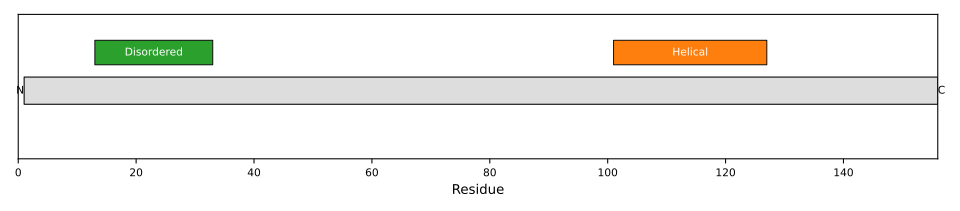
1: Component of the cytochrome c oxidase, the last enzyme in the mitochondrial electron transport chain which drives oxidative phosphorylation. The respiratory chain contains 3 multisubunit complexes succinate dehydrogenase (complex II, CII), ubiquinol-cytochrome c oxidoreductase (cytochrome b-c1 complex, complex III, CIII) and cytochrome c oxidase (complex IV, CIV), that cooperate to transfer electrons derived from NADH and succinate to molecular oxygen, creating an electrochemical gradient over the inner membrane that drives transmembrane transport and the ATP synthase. Cytochrome c oxidase is the component of the respiratory chain that catalyzes the reduction of oxygen to water. Electrons originating from reduced cytochrome c in the intermembrane space (IMS) are transferred via the dinuclear copper A center (CU(A)) of subunit 2 and heme A of subunit 1 to the active site in subunit 1, a binuclear center (BNC) formed by heme A3 and copper B (CU(B)). The BNC reduces molecular oxygen to 2 water molecules using 4 electrons from cytochrome c in the IMS and 4 protons from the mitochondrial matrix