Prolyl hydroxylase EGLN2 (EC 1.14.11.-) (Egl nine homolog 2) (EC 1.14.11.29) (Estrogen-induced tag 6) (EIT-6) (HPH-3) (Hypoxia-inducible factor prolyl hydroxylase 1) (HIF-PH1) (HIF-prolyl hydroxylase 1) (HPH-1) (Prolyl hydroxylase domain-containing protein 1) (PHD1)
1_MDSPC 6_ QPQPL 11_ SQALP 16_ QLPGS 21_ SSEPL 26_ EPEPG 31_ RARMG 36_ VESYL 41_ PCPLL 46_ PSYHC 51_ PGVPS 56_ EASAG 61_ SGTPR 66_ ATATS 71_ TTASP 76_ LRDGF 81_ GGQDG 86_ GELRP 91_ LQSEG 96_ AAALV 101_ TKGCQ 106_ RLAAQ 111_ GARPE 116_ APKRK 121_ WAEDG 126_ GDAPS 131_ PSKRP 136_ WARQE 141_ NQEAE 146_ REGGM 151_ SCSCS 156_ SGSGE 161_ ASAGL 166_ MEEAL 171_ PSAPE 176_ RLALD 181_ YIVPC 186_ MRYYG 191_ ICVKD 196_ SFLGA 201_ ALGGR 206_ VLAEV 211_ EALKR 216_ GGRLR 221_ DGQLV 226_ SQRAI 231_ PPRSI 236_ RGDQI 241_ AWVEG 246_ HEPGC 251_ RSIGA 256_ LMAHV 261_ DAVIR 266_ HCAGR 271_ LGSYV 276_ INGRT 281_ KAMVA 286_ CYPGN 291_ GLGYV 296_ RHVDN 301_ PHGDG 306_ RCITC 311_ IYYLN 316_ QNWDV 321_ KVHGG 326_ LLQIF 331_ PEGRP 336_ VVANI 341_ EPLFD 346_ RLLIF 351_ WSDRR 356_ NPHEV 361_ KPAYA 366_ TRYAI 371_ TVWYF 376_ DAKER 381_ AAAKD 386_ KYQLA 391_ SGQKG 396_ VQVPV 401_SQPPT
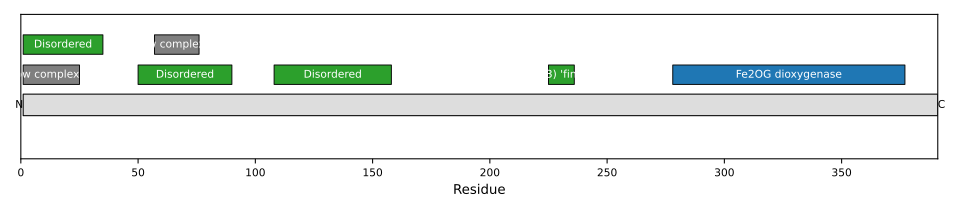
1: Prolyl hydroxylase that mediates hydroxylation of proline residues in target proteins, such as ATF4, IKBKB, CEP192 and HIF1A (PubMed:11595184, PubMed:12039559, PubMed:15925519, PubMed:16509823, PubMed:17114296, PubMed:23932902). Target proteins are preferentially recognized via a LXXLAP motif (PubMed:11595184, PubMed:12039559, PubMed:15925519). Cellular oxygen sensor that catalyzes, under normoxic conditions, the post-translational formation of 4-hydroxyproline in hypoxia-inducible factor (HIF) alpha proteins (PubMed:11595184, PubMed:12039559, PubMed:12181324, PubMed:15925519, PubMed:19339211). Hydroxylates a specific proline found in each of the oxygen-dependent degradation (ODD) domains (N-terminal, NODD, and C-terminal, CODD) of HIF1A (PubMed:11595184, PubMed:12039559, PubMed:12181324, PubMed:15925519). Also hydroxylates HIF2A (PubMed:11595184, PubMed:12039559, PubMed:15925519). Has a preference for the CODD site for both HIF1A and HIF2A (PubMed:11595184, PubMed:12039559, PubMed:15925519). Hydroxylated HIFs are then targeted for proteasomal degradation via the von Hippel-Lindau ubiquitination complex (PubMed:11595184, PubMed:12039559, PubMed:15925519). Under hypoxic conditions, the hydroxylation reaction is attenuated allowing HIFs to escape degradation resulting in their translocation to the nucleus, heterodimerization with HIF1B, and increased expression of hypoxy-inducible genes (PubMed:11595184, PubMed:12039559, PubMed:15925519). EGLN2 is involved in regulating hypoxia tolerance and apoptosis in cardiac and skeletal muscle (PubMed:11595184, PubMed:12039559, PubMed:15925519). Also regulates susceptibility to normoxic oxidative neuronal death (PubMed:11595184, PubMed:12039559, PubMed:15925519). Links oxygen sensing to cell cycle and primary cilia formation by hydroxylating the critical centrosome component CEP192 which promotes its ubiquitination and subsequent proteasomal degradation (PubMed:23932902). Hydroxylates IKBKB, mediating NF-kappa-B activation in hypoxic conditions (PubMed:17114296). Also mediates hydroxylation of ATF4, leading to decreased protein stability of ATF4 (By similarity)