Sialic acid-binding Ig-like lectin 10 (Siglec-10) (Siglec-like protein 2)
1_MLLPL 6_ LLSSL 11_ LGGSQ 16_ AMDGR 21_ FWIRV 26_ QESVM 31_ VPEGL 36_ CISVP 41_ CSFSY 46_ PRQDW 51_ TGSTP 56_ AYGYW 61_ FKAVT 66_ ETTKG 71_ APVAT 76_ NHQSR 81_ EVEMS 86_ TRGRF 91_ QLTGD 96_ PAKGN 101_ CSLVI 106_ RDAQM 111_ QDESQ 116_ YFFRV 121_ ERGSY 126_ VRYNF 131_ MNDGF 136_ FLKVT 141_ ALTQK 146_ PDVYI 151_ PETLE 156_ PGQPV 161_ TVICV 166_ FNWAF 171_ EECPP 176_ PSFSW 181_ TGAAL 186_ SSQGT 191_ KPTTS 196_ HFSVL 201_ SFTPR 206_ PQDHN 211_ TDLTC 216_ HVDFS 221_ RKGVS 226_ AQRTV 231_ RLRVA 236_ YAPRD 241_ LVISI 246_ SRDNT 251_ PALEP 256_ QPQGN 261_ VPYLE 266_ AQKGQ 271_ FLRLL 276_ CAADS 281_ QPPAT 286_ LSWVL 291_ QNRVL 296_ SSSHP 301_ WGPRP 306_ LGLEL 311_ PGVKA 316_ GDSGR 321_ YTCRA 326_ ENRLG 331_ SQQRA 336_ LDLSV 341_ QYPPE 346_ NLRVM 351_ VSQAN 356_ RTVLE 361_ NLGNG 366_ TSLPV 371_ LEGQS 376_ LCLVC 381_ VTHSS 386_ PPARL 391_ SWTQR 396_ GQVLS 401_ PSQPS 406_ DPGVL 411_ ELPRV 416_ QVEHE 421_ GEFTC 426_ HARHP 431_ LGSQH 436_ VSLSL 441_ SVHYS 446_ PKLLG 451_ PSCSW 456_ EAEGL 461_ HCSCS 466_ SQASP 471_ APSLR 476_ WWLGE 481_ ELLEG 486_ NSSQD 491_ SFEVT 496_ PSSAG 501_ PWANS 506_ SLSLH 511_ GGLSS 516_ GLRLR 521_ CEAWN 526_ VHGAQ 531_ SGSIL 536_ QLPDK 541_ KGLIS 546_ TAFSN 551_ GAFLG 556_ IGITA 561_ LLFLC 566_ LALII 571_ MKILP 576_ KRRTQ 581_ TETPR 586_ PRFSR 591_ HSTIL 596_ DYINV 601_ VPTAG 606_ PLAQK 611_ RNQKA 616_ TPNSP 621_ RTPLP 626_ PGAPS 631_ PESKK 636_ NQKKQ 641_ YQLPS 646_ FPEPK 651_ SSTQA 656_ PESQE 661_ SQEEL 666_ HYATL 671_ NFPGV 676_ RPRPE 681_ ARMPK 686_ GTQAD 691_YAEVK
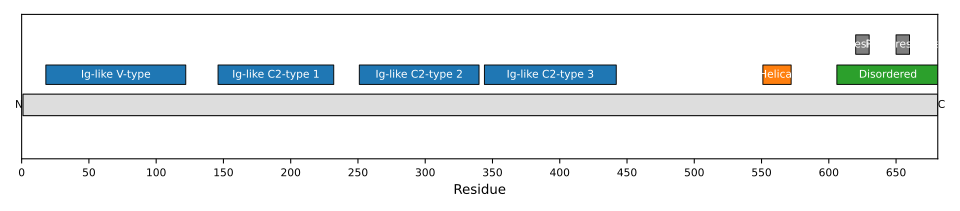
1: Putative adhesion molecule that mediates sialic-acid dependent binding to cells. Preferentially binds to alpha-2,3- or alpha-2,6-linked sialic acid (By similarity). The sialic acid recognition site may be masked by cis interactions with sialic acids on the same cell surface. In the immune response, seems to act as an inhibitory receptor upon ligand induced tyrosine phosphorylation by recruiting cytoplasmic phosphatase(s) via their SH2 domain(s) that block signal transduction through dephosphorylation of signaling molecules (PubMed:11284738, PubMed:12163025). Involved in negative regulation of B-cell antigen receptor signaling. The inhibition of B cell activation is dependent on PTPN6/SHP-1 (By similarity). In association with CD24 may be involved in the selective suppression of the immune response to danger-associated molecular patterns (DAMPs) such as HMGB1, HSP70 and HSP90 (By similarity). In association with CD24 may regulate the immune repsonse of natural killer (NK) cells (PubMed:25450598). Plays a role in the control of autoimmunity (By similarity). During initiation of adaptive immune responses by CD8-alpha(+) dendritic cells inhibits cross-presentation by impairing the formation of MHC class I-peptide complexes. The function seems to implicate recruitment of PTPN6/SHP-1, which dephosphorylates NCF1 of the NADPH oxidase complex consequently promoting phagosomal acidification (By similarity)