DNA-directed primase/polymerase protein (hPrimpol1) (EC 2.7.7.-) (Coiled-coil domain-containing protein 111)
1_MNRKW 6_ EAKLK 11_ QIEER 16_ ASHYE 21_ RKPLS 26_ SVYRP 31_ RLSKP 36_ EEPPS 41_ IWRLF 46_ HRQAQ 51_ AFNFV 56_ KSCKE 61_ DVHVF 66_ ALECK 71_ VGDGQ 76_ RIYLV 81_ TTYAE 86_ FWFYY 91_ KSRKN 96_ LLHCY 101_ EVIPE 106_ NAVCK 111_ LYFDL 116_ EFNKP 121_ ANPGA 126_ DGKKM 131_ VALLI 136_ EYVCK 141_ ALQEL 146_ YGVNC 151_ SAEDV 156_ LNLDS 161_ STDEK 166_ FSRHL 171_ IFQLH 176_ DVAFK 181_ DNIHV 186_ GNFLR 191_ KILQP 196_ ALDLL 201_ GSEDD 206_ DSAPE 211_ TTGHG 216_ FPHFS 221_ EAPAR 226_ QGFSF 231_ NKMFT 236_ EKATE 241_ ESWTS 246_ NSKKL 251_ ERLGS 256_ AEQSS 261_ PDLSF 266_ LVVKN 271_ NMGEK 276_ HLFVD 281_ LGVYT 286_ RNRNF 291_ RLYKS 296_ SKIGK 301_ RVALE 306_ VTEDN 311_ KFFPI 316_ QSKDV 321_ SDEYQ 326_ YFLSS 331_ LVSNV 336_ RFSDT 341_ LRILT 346_ CEPSQ 351_ NKQKG 356_ VGYFN 361_ SIGTS 366_ VETIE 371_ GFQCS 376_ PYPEV 381_ DHFVL 386_ SLVNK 391_ DGIKG 396_ GIRRW 401_ NYFFP 406_ EELLV 411_ YDICK 416_ YRWCE 421_ NIGRA 426_ HKSNN 431_ IMILV 436_ DLKNE 441_ VWYQK 446_ CHDPV 451_ CKAEN 456_ FKSDC 461_ FPLPA 466_ EVCLL 471_ FLFKE 476_ EEEFT 481_ TDEAD 486_ ETRSN 491_ ETQNP 496_ HKPSP 501_ SRLST 506_ GASAD 511_ AVWDN 516_ GIDDA 521_ YFLEA 526_ TEDAE 531_ LAEAA 536_ ENSLL 541_ SYNSE 546_ VDEIP 551_DELII
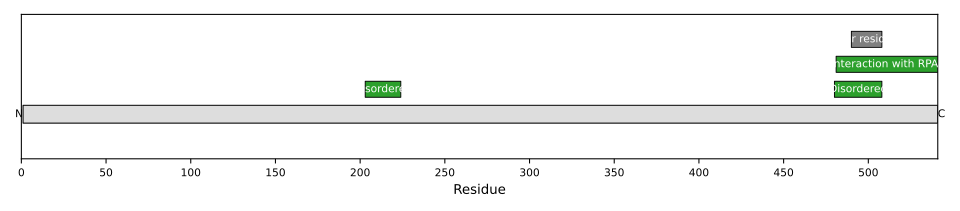
1: DNA primase and DNA polymerase required to tolerate replication-stalling lesions by bypassing them (PubMed:24126761, PubMed:24207056, PubMed:24240614, PubMed:24267451, PubMed:24682820, PubMed:25255211, PubMed:25262353, PubMed:25550423, PubMed:25746449, PubMed:27989484, PubMed:28534480, PubMed:29608762, PubMed:30889508, PubMed:31676232). Required to facilitate mitochondrial and nuclear replication fork progression by initiating de novo DNA synthesis using dNTPs and acting as an error-prone DNA polymerase able to bypass certain DNA lesions (PubMed:24126761, PubMed:24207056, PubMed:24240614, PubMed:24267451, PubMed:24682820, PubMed:25255211, PubMed:25262353, PubMed:25550423, PubMed:25746449, PubMed:27989484, PubMed:28534480, PubMed:29608762, PubMed:30633872, PubMed:30889508). Shows a high capacity to tolerate DNA damage lesions such as 8oxoG and abasic sites in DNA (PubMed:24126761, PubMed:24207056, PubMed:24240614, PubMed:24267451, PubMed:25746449). Provides different translesion synthesis alternatives when DNA replication is stalled: able to synthesize DNA primers downstream of lesions, such as ultraviolet (UV) lesions, R-loops and G-quadruplexes, to allow DNA replication to continue (PubMed:24240614, PubMed:26626482, PubMed:28534480, PubMed:30478192). Can also realign primers ahead of 'unreadable lesions' such as abasic sites and 6-4 photoproduct (6-4 pyrimidine-pyrimidinone), thereby skipping the lesion. Repriming avoids fork degradation while leading to accumulation of internal ssDNA gaps behind the forks (PubMed:24240614, PubMed:25746449, PubMed:31676232). Also able to incorporate nucleotides opposite DNA lesions such as 8oxoG, like a regular translesion synthesis DNA polymerase (PubMed:24207056, PubMed:25255211, PubMed:25746449). Also required for reinitiating stalled forks after UV damage during nuclear DNA replication (PubMed:24240614). Required for mitochondrial DNA (mtDNA) synthesis and replication, by reinitiating synthesis after UV damage or in the presence of chain-terminating nucleotides (PubMed:24207056). Prevents APOBEC family-mediated DNA mutagenesis by repriming downstream of abasic site to prohibit error-prone translesion synthesis (By similarity). Has non-overlapping function with POLH (PubMed:24240614). In addition to its role in DNA damage response, also required to maintain efficient nuclear and mitochondrial DNA replication in unperturbed cells (PubMed:30715459)