SH3 and cysteine-rich domain-containing protein 3
1_MTEKE 6_ VLESP 11_ KPSFP 16_ AETRQ 21_ SGLQR 26_ LKQLL 31_ RKGST 36_ GTKEM 41_ ELPPE 46_ PQANG 51_ EAVGA 56_ GGGPI 61_ YYIYE 66_ EEEEE 71_ EEEEE 76_ EPPPE 81_ PPKLV 86_ NDKPH 91_ KFKDH 96_ FFKKP 101_ KFCDV 106_ CARMI 111_ VLNNK 116_ FGLRC 121_ KNCKT 126_ NIHEH 131_ CQSYV 136_ EMQRC 141_ FGKIP 146_ PGFHR 151_ AYSSP 156_ LYSNQ 161_ QYACV 166_ KDLSA 171_ ANRND 176_ PVFET 181_ LRTGV 186_ IMANK 191_ ERKKG 196_ QADKK 201_ NPVAA 206_ MMEEE 211_ PESAR 216_ PEEGK 221_ PQDGN 226_ PEGDK 231_ KAEKK 236_ TPDDK 241_ HKQPG 246_ FQQSH 251_ YFVAL 256_ YRFKA 261_ LEKDD 266_ LDFPP 271_ GEKIT 276_ VIDDS 281_ NEEWW 286_ RGKIG 291_ EKVGF 296_ FPPNF 301_ IIRVR 306_ AGERV 311_ HRVTR 316_ SFVGN 321_ REIGQ 326_ ITLKK 331_ DQIVV 336_ QKGDE 341_ AGGYV 346_ KVYTG 351_ RKVGL 356_FPTDF
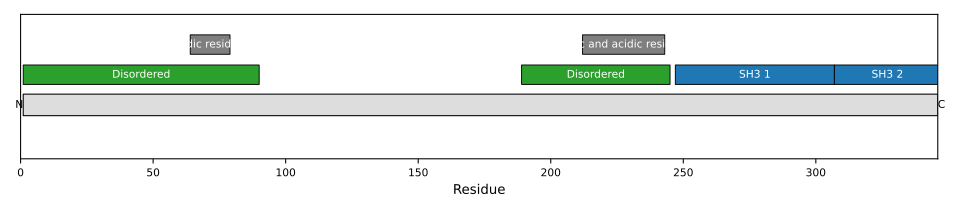
1: Required for normal excitation-contraction coupling in skeletal muscle and for normal muscle contraction in response to membrane depolarization. Required for normal Ca(2+) release from the sarcplasmic reticulum, which ultimately leads to muscle contraction. Probably functions via its effects on muscle calcium channels (PubMed:23736855, PubMed:29078335). Increases CACNA1S channel activity, in addition to its role in enhancing the expression of CACNA1S at the cell membrane. Has a redundant role in promoting the expression of the calcium channel CACNA1S at the cell membrane (By similarity). Slows down the inactivation rate of the calcium channel CACNA1C (PubMed:29078335)