YTH domain-containing protein 1 (Splicing factor YT521) (YT521-B)
1_MAADS 6_ REEKD 11_ GELNV 16_ LDDIL 21_ TEVPE 26_ QDDEL 31_ YNPES 36_ EQDKN 41_ EKKGS 46_ KRKSD 51_ RMEST 56_ DTKRQ 61_ KPSVH 66_ SRQLV 71_ SKPLS 76_ SSVSN 81_ NKRIV 86_ STKGK 91_ SATEY 96_ KNEEY 101_ QRSER 106_ NKRLD 111_ ADRKI 116_ RLSSS 121_ ASREP 126_ YKNQP 131_ EKTCV 136_ RKRDP 141_ ERRAK 146_ SPTPD 151_ GSERI 156_ GLEVD 161_ RRASR 166_ SSQSS 171_ KEEVN 176_ SEEYG 181_ SDHET 186_ GSSGS 191_ SDEQG 196_ NNTEN 201_ EEEGV 206_ EEDVE 211_ EDEEV 216_ EEDAE 221_ EDEEV 226_ DEDGE 231_ EEEEE 236_ EEEEE 241_ EEEEE 246_ EEEEY 251_ EQDER 256_ DQKEE 261_ GNDYD 266_ TRSEA 271_ SDSGS 276_ ESVSF 281_ TDGSV 286_ RSGSG 291_ TDGSD 296_ EKKKE 301_ RKRAR 306_ GISPI 311_ VFDRS 316_ GSSAS 321_ ESYAG 326_ SEKKH 331_ EKLSS 336_ SVRAV 341_ RKDQT 346_ SKLKY 351_ VLQDA 356_ RFFLI 361_ KSNNH 366_ ENVSL 371_ AKAKG 376_ VWSTL 381_ PVNEK 386_ KLNLA 391_ FRSAR 396_ SVILI 401_ FSVRE 406_ SGKFQ 411_ GFARL 416_ SSESH 421_ HGGSP 426_ IHWVL 431_ PAGMS 436_ AKMLG 441_ GVFKI 446_ DWICR 451_ RELPF 456_ TKSAH 461_ LTNPW 466_ NEHKP 471_ VKIGR 476_ DGQEI 481_ ELECG 486_ TQLCL 491_ LFPPD 496_ ESIDL 501_ YQVIH 506_ KMRHK 511_ RRMHS 516_ QPRSR 521_ GRPSR 526_ REPVR 531_ DVGRR 536_ RPEDY 541_ DIHNS 546_ RKKPR 551_ IDYPP 556_ EFHQR 561_ PGYLK 566_ DPRYQ 571_ EVDRR 576_ FSGVR 581_ RDVFL 586_ NGSYN 591_ DYVRE 596_ FHNMG 601_ PPPPW 606_ QGMPP 611_ YPGME 616_ QPPHH 621_ PYYQH 626_ HAPPP 631_ QAHPP 636_ YSGHH 641_ PVPHE 646_ ARYRD 651_ KRVHD 656_ YDMRV 661_ DDFLR 666_ RTQAV 671_ VSGRR 676_ SRPRE 681_ RDRER 686_ ERDRP 691_ RDNRR 696_ DRERD 701_ RGRDR 706_ ERERE 711_ RLCDR 716_ DRDRG 721_ERGRY
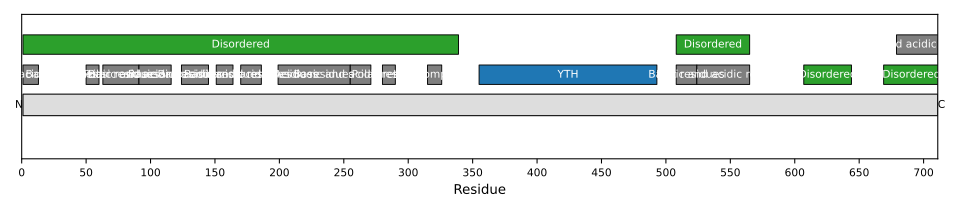
1: Regulator of alternative splicing that specifically recognizes and binds N6-methyladenosine (m6A)-containing RNAs (PubMed:25242552, PubMed:26318451, PubMed:26876937, PubMed:28984244). M6A is a modification present at internal sites of mRNAs and some non-coding RNAs and plays a role in the efficiency of mRNA splicing, processing and stability (PubMed:25242552, PubMed:26318451). Acts as a key regulator of exon-inclusion or exon-skipping during alternative splicing via interaction with mRNA splicing factors SRSF3 and SRSF10 (PubMed:26876937). Specifically binds m6A-containing mRNAs and promotes recruitment of SRSF3 to its mRNA-binding elements adjacent to m6A sites, leading to exon-inclusion during alternative splicing (PubMed:26876937). In contrast, interaction with SRSF3 prevents interaction with SRSF10, a splicing factor that promotes exon skipping: this prevents SRSF10 from binding to its mRNA-binding sites close to m6A-containing regions, leading to inhibit exon skipping during alternative splicing (PubMed:26876937). May also regulate alternative splice site selection (PubMed:20167602). Also involved in nuclear export of m6A-containing mRNAs via interaction with SRSF3: interaction with SRSF3 facilitates m6A-containing mRNA-binding to both SRSF3 and NXF1, promoting mRNA nuclear export (PubMed:28984244). Involved in S-adenosyl-L-methionine homeostasis by regulating expression of MAT2A transcripts, probably by binding m6A-containing MAT2A mRNAs (By similarity). Also recognizes and binds m6A on other RNA molecules (PubMed:27602518). Involved in random X inactivation mediated by Xist RNA: recognizes and binds m6A-containing Xist and promotes transcription repression activity of Xist (PubMed:27602518). Also recognizes and binds m6A-containing single-stranded DNA (PubMed:32663306). Involved in germline development: required for spermatogonial development in males and oocyte growth and maturation in females, probably via its role in alternative splicing (By similarity)