Crossover junction endonuclease MUS81 (EC 3.1.22.-)
1_MAAPV 6_ RLGRK 11_ RPLPA 16_ CPNPL 21_ FVRWL 26_ TEWRD 31_ EATRS 36_ RRRTR 41_ FVFQK 46_ ALRSL 51_ RRYPL 56_ PLRSG 61_ KEAKI 66_ LQHFG 71_ DGLCR 76_ MLDER 81_ LQRHR 86_ TSGGD 91_ HAPDS 96_ PSGEN 101_ SPAPQ 106_ GRLAE 111_ VQDSS 116_ MPVPA 121_ QPKAG 126_ GSGSY 131_ WPARH 136_ SGARV 141_ ILLVL 146_ YREHL 151_ NPNGH 156_ HFLTK 161_ EELLQ 166_ RCAQK 171_ SPRVA 176_ PGSAR 181_ PWPAL 186_ RSLLH 191_ RNLVL 196_ RTHQP 201_ ARYSL 206_ TPEGL 211_ ELAQK 216_ LAESE 221_ GLSLL 226_ NVGIG 231_ PKEPP 236_ GEETA 241_ VPGAA 246_ SAELA 251_ SEAGV 256_ QQQPL 261_ ELRPG 266_ EYRVL 271_ LCVDI 276_ GETRG 281_ GGHRP 286_ ELLRE 291_ LQRLH 296_ VTHTV 301_ RKLHV 306_ GDFVW 311_ VAQET 316_ NPRDP 321_ ANPGE 326_ LVLDH 331_ IVERK 336_ RLDDL 341_ CSSII 346_ DGRFR 351_ EQKFR 356_ LKRCG 361_ LERRV 366_ YLVEE 371_ HGSVH 376_ NLSLP 381_ ESTLL 386_ QAVTN 391_ TQVID 396_ GFFVK 401_ RTADI 406_ KESAA 411_ YLALL 416_ TRGLQ 421_ RLYQG 426_ HTLRS 431_ RPWGT 436_ PGNPE 441_ SGAMT 446_ SPNPL 451_ CSLLT 456_ FSDFN 461_ AGAIK 466_ NKAQS 471_ VREVF 476_ ARQLM 481_ QVRGV 486_ SGEKA 491_ AALVD 496_ RYSTP 501_ ASLLA 506_ AYDAC 511_ ATPKE 516_ QETLL 521_ STIKC 526_ GRLQR 531_ NLGPA 536_ LSRTL 541_ SQLYC 546_SYGPL
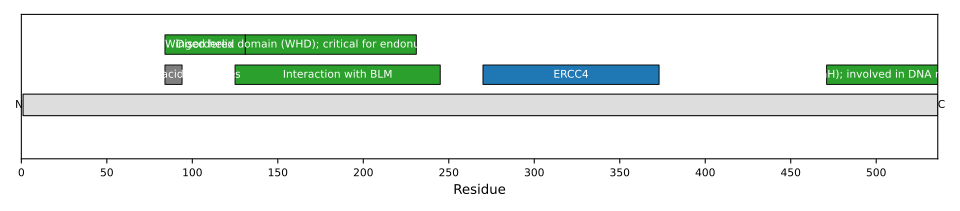
1: Catalytic subunit of two functionally distinct, structure-specific, heterodimeric DNA endonucleases MUS81-EME1 and MUS81-EME2 that are involved in the maintenance of genome stability (PubMed:11741546, PubMed:12374758, PubMed:12686547, PubMed:12721304, PubMed:24371268, PubMed:24733841, PubMed:24813886, PubMed:35290797, PubMed:39015284). Both endonucleases have essentially the same substrate specificity though MUS81-EME2 is more active than its MUS81-EME1 counterpart. Both cleave 3'-flaps and nicked Holliday junctions, and exhibit limited endonuclease activity with 5' flaps and nicked double-stranded DNAs (PubMed:24371268, PubMed:24733841, PubMed:35290797). MUS81-EME2 which is active during the replication of DNA is more specifically involved in replication fork processing (PubMed:24813886). Replication forks frequently encounter obstacles to their passage, including DNA base lesions, DNA interstrand cross-links, difficult-to-replicate sequences, transcription bubbles, or tightly bound proteins. One mechanism for the restart of a stalled replication fork involves nucleolytic cleavage mediated by the MUS81-EME2 endonuclease. By acting upon the stalled fork, MUS81-EME2 generates a DNA double-strand break (DSB) that can be repaired by homologous recombination, leading to the restoration of an active fork (PubMed:24813886). MUS81-EME2 could also function in telomere maintenance (PubMed:24813886). MUS81-EME1, on the other hand, is active later in the cell cycle and functions in the resolution of mitotic recombination intermediates including the Holliday junctions, the four-way DNA intermediates that form during homologous recombination (PubMed:11741546, PubMed:12374758, PubMed:14617801, PubMed:15805243, PubMed:24813886)