Fc receptor-like protein 3 (FcR-like protein 3) (FcRL3) (Fc receptor homolog 3) (FcRH3) (IFGP family protein 3) (hIFGP3) (Immune receptor translocation-associated protein 3) (SH2 domain-containing phosphatase anchor protein 2) (CD antigen CD307c)
1_MLLWL 6_ LLLIL 11_ TPGRE 16_ QSGVA 21_ PKAVL 26_ LLNPP 31_ WSTAF 36_ KGEKV 41_ ALICS 46_ SISHS 51_ LAQGD 56_ TYWYH 61_ DEKLL 66_ KIKHD 71_ KIQIT 76_ EPGNY 81_ QCKTR 86_ GSSLS 91_ DAVHV 96_ EFSPD 101_ WLILQ 106_ ALHPV 111_ FEGDN 116_ VILRC 121_ QGKDN 126_ KNTHQ 131_ KVYYK 136_ DGKQL 141_ PNSYN 146_ LEKIT 151_ VNSVS 156_ RDNSK 161_ YHCTA 166_ YRKFY 171_ ILDIE 176_ VTSKP 181_ LNIQV 186_ QELFL 191_ HPVLR 196_ ASSST 201_ PIEGS 206_ PMTLT 211_ CETQL 216_ SPQRP 221_ DVQLQ 226_ FSLFR 231_ DSQTL 236_ GLGWS 241_ RSPRL 246_ QIPAM 251_ WTEDS 256_ GSYWC 261_ EVETV 266_ THSIK 271_ KRSLR 276_ SQIRV 281_ QRVPV 286_ SNVNL 291_ EIRPT 296_ GGQLI 301_ EGENM 306_ VLICS 311_ VAQGS 316_ GTVTF 321_ SWHKE 326_ GRVRS 331_ LGRKT 336_ QRSLL 341_ AELHV 346_ LTVKE 351_ SDAGR 356_ YYCAA 361_ DNVHS 366_ PILST 371_ WIRVT 376_ VRIPV 381_ SHPVL 386_ TFRAP 391_ RAHTV 396_ VGDLL 401_ ELHCE 406_ SLRGS 411_ PPILY 416_ RFYHE 421_ DVTLG 426_ NSSAP 431_ SGGGA 436_ SFNLS 441_ LTAEH 446_ SGNYS 451_ CDADN 456_ GLGAQ 461_ HSHGV 466_ SLRVT 471_ VPVSR 476_ PVLTL 481_ RAPGA 486_ QAVVG 491_ DLLEL 496_ HCESL 501_ RGSFP 506_ ILYWF 511_ YHEDD 516_ TLGNI 521_ SAHSG 526_ GGASF 531_ NLSLT 536_ TEHSG 541_ NYSCE 546_ ADNGL 551_ GAQHS 556_ KVVTL 561_ NVTGT 566_ SRNRT 571_ GLTAA 576_ GITGL 581_ VLSIL 586_ VLAAA 591_ AALLH 596_ YARAR 601_ RKPGG 606_ LSATG 611_ TSSHS 616_ PSECQ 621_ EPSSS 626_ RPSRI 631_ DPQEP 636_ THSKP 641_ LAPME 646_ LEPMY 651_ SNVNP 656_ GDSNP 661_ IYSQI 666_ WSIQH 671_ TKENS 676_ ANCPM 681_ MHQEH 686_ EELTV 691_ LYSEL 696_ KKTHP 701_ DDSAG 706_ EASSR 711_ GRAHE 716_ EDDEE 721_ NYENV 726_PRVLL
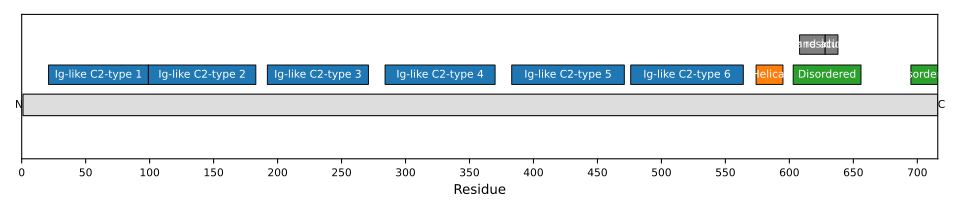
1: Promotes TLR9-induced B-cell proliferation, activation and survival but inhibits antibody production and suppresses plasma cell differentiation. Enhances activation of NF-kappa-B and MAPK signaling pathways in TLR9 stimulated B-cells (PubMed:23857366). Has inhibitory potentional on B-cell receptor (BCR)-mediated signaling, possibly through association with SH2 domain-containing phosphatases. Inhibits cell tyrosine phosphorylation, calcium mobilization and activation-induced cell death induced through BCR signaling (PubMed:19843936). Regulatory T-cells expressing FCRL3 exhibit a memory phenotype, are relatively nonresponsive to antigenic stimulation in presence of IL2 and have reduced capacity to suppress the proliferation of effector T-cells (PubMed:19494275, PubMed:20190142). Acts as a human-specific epitope on the cell surface of oocytes (oolemma) and plays a role during sperm-egg adhesion and fusion (PubMed:36070373). Interacts with the IZUMO1-IZUMO1R/JUNO sperm-egg complex and replaces IZUMO1R/JUNO as IZUMO1 receptor during fertilization, thereby permitting species-specific gamete fusion (PubMed:36070373)