Potassium voltage-gated channel subfamily C member 2 (Shaw-like potassium channel) (Voltage-gated potassium channel Kv3.2)
1_MGKIE 6_ NNERV 11_ ILNVG 16_ GTRHE 21_ TYRST 26_ LKTLP 31_ GTRLA 36_ LLASS 41_ EPPGD 46_ CLTTA 51_ GDKLQ 56_ PSPPP 61_ LSPPP 66_ RAPPL 71_ SPGPG 76_ GCFEG 81_ GAGNC 86_ SSRGG 91_ RASDH 96_ PGGGR 101_ EFFFD 106_ RHPGV 111_ FAYVL 116_ NYYRT 121_ GKLHC 126_ PADVC 131_ GPLFE 136_ EELAF 141_ WGIDE 146_ TDVEP 151_ CCWMT 156_ YRQHR 161_ DAEEA 166_ LDIFE 171_ TPDLI 176_ GGDPG 181_ DDEDL 186_ AAKRL 191_ GIEDA 196_ AGLGG 201_ PDGKS 206_ GRWRR 211_ LQPRM 216_ WALFE 221_ DPYSS 226_ RAARF 231_ IAFAS 236_ LFFIL 241_ VSITT 246_ FCLET 251_ HEAFN 256_ IVKNK 261_ TEPVI 266_ NGTSV 271_ VLQYE 276_ IETDP 281_ ALTYV 286_ EGVCV 291_ VWFTF 296_ EFLVR 301_ IVFSP 306_ NKLEF 311_ IKNLL 316_ NIIDF 321_ VAILP 326_ FYLEV 331_ GLSGL 336_ SSKAA 341_ KDVLG 346_ FLRVV 351_ RFVRI 356_ LRIFK 361_ LTRHF 366_ VGLRV 371_ LGHTL 376_ RASTN 381_ EFLLL 386_ IIFLA 391_ LGVLI 396_ FATMI 401_ YYAER 406_ VGAQP 411_ NDPSA 416_ SEHTQ 421_ FKNIP 426_ IGFWW 431_ AVVTM 436_ TTLGY 441_ GDMYP 446_ QTWSG 451_ MLVGA 456_ LCALA 461_ GVLTI 466_ AMPVP 471_ VIVNN 476_ FGMYY 481_ SLAMA 486_ KQKLP 491_ RKRKK 496_ HIPPA 501_ PQASS 506_ PTFCK 511_ TELNM 516_ ACNST 521_ QSDTC 526_ LGKDN 531_ RLLEH 536_ NRSVL 541_ SGDDS 546_ TGSEP 551_ PLSPP 556_ ERLPI 561_ RRSST 566_ RDKNR 571_ RGETC 576_ FLLTT 581_ GDYTC 586_ ASDGG 591_ IRKGY 596_ EKSRS 601_ LNNIA 606_ GLAGN 611_ ALRLS 616_ PVTSP 621_ YNSPC 626_ PLRRS 631_RSPIP
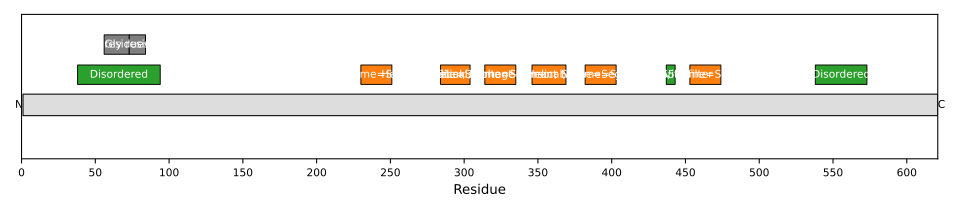
1: Voltage-gated potassium channel that mediates transmembrane potassium transport in excitable membranes, primarily in the brain. Contributes to the regulation of the fast action potential repolarization and in sustained high-frequency firing in neurons of the central nervous system. Homotetramer channels mediate delayed-rectifier voltage-dependent potassium currents that activate rapidly at high-threshold voltages and inactivate slowly. Forms tetrameric channels through which potassium ions pass in accordance with their electrochemical gradient. The channel alternates between opened and closed conformations in response to the voltage difference across the membrane (Probable) (PubMed:15709110, PubMed:35314505, PubMed:36090251). Can form functional homotetrameric and heterotetrameric channels that contain variable proportions of KCNC1, and possibly other family members as well; channel properties depend on the type of alpha subunits that are part of the channel. Channel properties may be modulated either by the association with ancillary subunits, such as KCNE1, KCNE2 or KCNE3 or indirectly by nitric oxide (NO) through a cGMP- and PKG-mediated signaling cascade, slowing channel activation and deactivation of delayed rectifier potassium channels (By similarity). Contributes to fire sustained trains of very brief action potentials at high frequency in retinal ganglion cells, thalamocortical and suprachiasmatic nucleus (SCN) neurons and in hippocampal and neocortical interneurons (PubMed:15709110). Sustained maximal action potential firing frequency in inhibitory hippocampal interneurons is negatively modulated by histamine H2 receptor activation in a cAMP- and protein kinase (PKA) phosphorylation-dependent manner. Plays a role in maintaining the fidelity of synaptic transmission in neocortical GABAergic interneurons by generating action potential (AP) repolarization at nerve terminals, thus reducing spike-evoked calcium influx and GABA neurotransmitter release. Required for long-range synchronization of gamma oscillations over distance in the neocortex. Contributes to the modulation of the circadian rhythm of spontaneous action potential firing in suprachiasmatic nucleus (SCN) neurons in a light-dependent manner (By similarity)