Protein quaking (Hqk) (HqkI)
1_MVGEM 6_ ETKEK 11_ PKPTP 16_ DYLMQ 21_ LMNDK 26_ KLMSS 31_ LPNFC 36_ GIFNH 41_ LERLL 46_ DEEIS 51_ RVRKD 56_ MYNDT 61_ LNGST 66_ EKRSA 71_ ELPDA 76_ VGPIV 81_ QLQEK 86_ LYVPV 91_ KEYPD 96_ FNFVG 101_ RILGP 106_ RGLTA 111_ KQLEA 116_ ETGCK 121_ IMVRG 126_ KGSMR 131_ DKKKE 136_ EQNRG 141_ KPNWE 146_ HLNED 151_ LHVLI 156_ TVEDA 161_ QNRAE 166_ IKLKR 171_ AVEEV 176_ KKLLV 181_ PAAEG 186_ EDSLK 191_ KMQLM 196_ ELAIL 201_ NGTYR 206_ DANIK 211_ SPALA 216_ FSLAA 221_ TAQAA 226_ PRIIT 231_ GPAPV 236_ LPPAA 241_ LRTPT 246_ PAGPT 251_ IMPLI 256_ RQIQT 261_ AVMPN 266_ GTPHP 271_ TAAIV 276_ PPGPE 281_ AGLIY 286_ TPYEY 291_ PYTLA 296_ PATSI 301_ LEYPI 306_ EPSGV 311_ LGAVA 316_ TKVRR 321_ HDMRV 326_ HPYQR 331_ IVTAD 336_RAATG
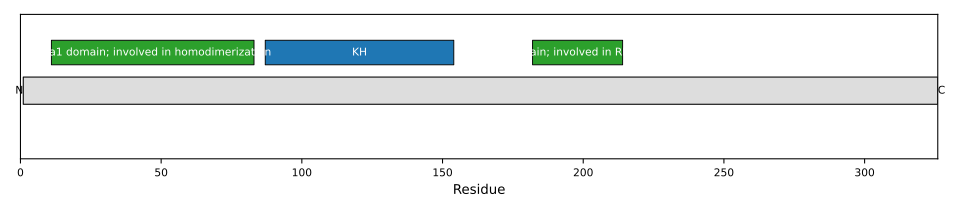
1: RNA reader protein, which recognizes and binds specific RNAs, thereby regulating RNA metabolic processes, such as pre-mRNA splicing, circular RNA (circRNA) formation, mRNA export, mRNA stability and/or translation (PubMed:22398723, PubMed:23630077, PubMed:25768908, PubMed:27029405, PubMed:31331967, PubMed:37379838). Involved in various cellular processes, such as mRNA storage into stress granules, apoptosis, lipid deposition, interferon response, glial cell fate and development (PubMed:25768908, PubMed:31829086, PubMed:34428287, PubMed:37379838). Binds to the 5'-NACUAAY-N(1,20)-UAAY-3' RNA core sequence (PubMed:23630077). Acts as a mRNA modification reader that specifically recognizes and binds mRNA transcripts modified by internal N(7)-methylguanine (m7G) (PubMed:37379838). Promotes the formation of circular RNAs (circRNAs) during the epithelial to mesenchymal transition and in cardiomyocytes: acts by binding to sites flanking circRNA-forming exons (PubMed:25768908). CircRNAs are produced by back-splicing circularization of pre-mRNAs (PubMed:25768908). Plays a central role in myelinization via 3 distinct mechanisms (PubMed:16641098). First, acts by protecting and promoting stability of target mRNAs such as MBP, SIRT2 and CDKN1B, which promotes oligodendrocyte differentiation (By similarity). Second, participates in mRNA transport by regulating the nuclear export of MBP mRNA (By similarity). Finally, indirectly regulates mRNA splicing of MAG pre-mRNA during oligodendrocyte differentiation by acting as a negative regulator of MAG exon 12 alternative splicing: acts by binding to HNRNPA1 mRNA splicing factor, preventing its translation (By similarity). Involved in microglia differentiation and remyelination by regulating microexon alternative splicing of the Rho GTPase pathway (By similarity). Involved in macrophage differentiation: promotes monocyte differentiation by regulating pre-mRNA splicing in naive peripheral blood monocytes (PubMed:27029405). Acts as an important regulator of muscle development: required for the contractile function of cardiomyocytes by regulating alternative splicing of cardiomyocyte transcripts (By similarity). Acts as a negative regulator of thermogenesis by decreasing stability, nuclear export and translation of mRNAs encoding PPARGC1A and UCP1 (By similarity). Also required for visceral endoderm function and blood vessel development (By similarity). May also play a role in smooth muscle development (PubMed:31331967). In addition to its RNA-binding activity, also acts as a nuclear transcription coactivator for SREBF2/SREBP2 (By similarity)
2: Nuclear isoform that acts as an indirect regulator of mRNA splicing (By similarity). Regulates mRNA splicing of MAG pre-mRNA by inhibiting translation of HNRNPA1 mRNA, thereby preventing MAG exon 12 alternative splicing (By similarity). Involved in oligodendrocyte differentiation by promoting stabilization of SIRT2 mRNA (By similarity). Acts as a negative regulator of the interferon response by binding to MAVS mRNA, downregulating its expression (PubMed:31829086). Also inhibits the interferon response by binding to fibrinectin FN1 pre-mRNA, repressing EDA exon inclusion in FN1 (PubMed:34428287). Delays macrophage differentiation by binding to CSF1R mRNA, promoting its degradation (PubMed:22398723). In addition to its RNA-binding activity, also acts as a nuclear transcription coactivator for SREBF2/SREBP2, promoting SREBF2/SREBP2-dependent cholesterol biosynthesis (By similarity). SREBF2/SREBP2-dependent cholesterol biosynthesis participates to myelinization and is required for eye lens transparency (By similarity)
3: Cytosolic isoform that specifically recognizes and binds mRNA transcripts modified by internal N(7)-methylguanine (m7G) (PubMed:37379838). Interaction with G3BP1 promotes localization of m7G-containing mRNAs into stress granules in response to stress, thereby suppressing their translation (PubMed:37379838). Acts as a translational repressor for HNRNPA1 and GLI1 (By similarity). Translation inhibition of HNRNPA1 during oligodendrocyte differentiation prevents inclusion of exon 12 in MAG pre-mRNA splicing (By similarity). Involved in astrocyte differentiation by regulating translation of target mRNAs (By similarity)
4: Cytosolic isoform that specifically recognizes and binds mRNA transcripts modified by internal N(7)-methylguanine (m7G) (PubMed:37379838). Interaction with G3BP1 promotes localization of m7G-containing mRNAs into stress granules in response to stress, thereby suppressing their translation (PubMed:37379838). Acts as a negative regulator of angiogenesis by binding to mRNAs encoding CDH5, NLGN1 and TNFAIP6, promoting their degradation (PubMed:32732889). Can also induce apoptosis in the cytoplasm (By similarity). Heterodimerization with other isoforms results in nuclear translocation of isoform QKI7 and suppression of apoptosis (By similarity). Also binds some microRNAs: promotes stabilitation of miR-122 by mediating recruitment of poly(A) RNA polymerase TENT2, leading to 3' adenylation and stabilization of miR-122 (PubMed:31792053)