Trace amine-associated receptor 9 (TaR-9) (Trace amine receptor 9) (Trace amine receptor 3) (TaR-3)
1_MVNNF 6_ SQAEA 11_ VELCY 16_ KNVNE 21_ SCIKT 26_ PYSPG 31_ PRSIL 36_ YAVLG 41_ FGAVL 46_ AAFGN 51_ LLVMI 56_ AILHF 61_ KQLHT 66_ PTNFL 71_ IASLA 76_ CADFL 81_ VGVTV 86_ MPFST 91_ VRSVE 96_ SCWYF 101_ GDSYC 106_ KFHTC 111_ FDTSF 116_ CFASL 121_ FHLCC 126_ ISVDR 131_ YIAVT 136_ DPLTY 141_ PTKFT 146_ VSVSG 151_ ICIVL 156_ SWFFS 161_ VTYSF 166_ SIFYT 171_ GANEE 176_ GIEEL 181_ VVALT 186_ CVGGC 191_ QAPLN 196_ QNWVL 201_ LCFLL 206_ FFIPN 211_ VAMVF 216_ IYSKI 221_ FLVAK 226_ HQARK 231_ IESTA 236_ SQAQS 241_ SSESY 246_ KERVA 251_ KRERK 256_ AAKTL 261_ GIAMA 266_ AFLVS 271_ WLPYL 276_ VDAVI 281_ DAYMN 286_ FITPP 291_ YVYEI 296_ LVWCV 301_ YYNSA 306_ MNPLI 311_ YAFFY 316_ QWFGK 321_ AIKLI 326_ VSGKV 331_ LRTDS 336_ STTNL 341_FSEEV
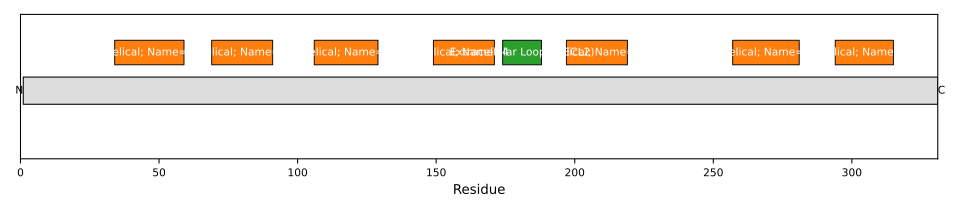
1: Olfactory receptor specific for trace amines, such as N,N-dimethylcyclohexylamine (DMCHA) and beta-phenylethylamine (beta-PEA) (By similarity). In contrast to mouse and rat orthologs, not activated by triethylamine, cadaverine (CAD) or spermidine (PubMed:34600890). Trace amine compounds are enriched in animal body fluids and act on trace amine-associated receptors (TAARs) to elicit both intraspecific and interspecific innate behaviors (By similarity). Trace amine-binding causes a conformation change that triggers signaling via G(s)-class of G alpha proteins (GNAL or GNAS) (By similarity). In mature olfactory sensory neurons, TAAR9 is coupled with GNAL/G(olf)G alpha protein and mediates activation of adenylate cyclase activity to activate cAMP signaling and eventually transmit odorant signals to achieve membrane depolarization (By similarity). In immature olfactory sensory neurons, TAAR9 is coupled with GNAS/G(s) G alpha proteins (By similarity)