Trace amine-associated receptor 1 (TaR-1) (Trace amine receptor 1)
1_MMPFC 6_ HNIIN 11_ ISCVK 16_ NNWSN 21_ DVRAS 26_ LYSLM 31_ VLIIL 36_ TTLVG 41_ NLIVI 46_ VSISH 51_ FKQLH 56_ TPTNW 61_ LIHSM 66_ ATVDF 71_ LLGCL 76_ VMPYS 81_ MVRSA 86_ EHCWY 91_ FGEVF 96_ CKIHT 101_ STDIM 106_ LSSAS 111_ IFHLS 116_ FISID 121_ RYYAV 126_ CDPLR 131_ YKAKM 136_ NILVI 141_ CVMIF 146_ ISWSV 151_ PAVFA 156_ FGMIF 161_ LELNF 166_ KGAEE 171_ IYYKH 176_ VHCRG 181_ GCSVF 186_ FSKIS 191_ GVLTF 196_ MTSFY 201_ IPGSI 206_ MLCVY 211_ YRIYL 216_ IAKEQ 221_ ARLIS 226_ DANQK 231_ LQIGL 236_ EMKNG 241_ ISQSK 246_ ERKAV 251_ KTLGI 256_ VMGVF 261_ LICWC 266_ PFFIC 271_ TVMDP 276_ FLHYI 281_ IPPTL 286_ NDVLI 291_ WFGYL 296_ NSTFN 301_ PMVYA 306_ FFYPW 311_ FRKAL 316_ KMMLF 321_ GKIFQ 326_ KDSSR 331_CKLFL
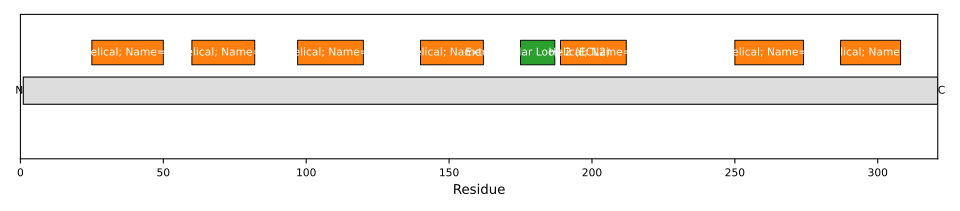
1: Intracellular G-protein coupled receptor for trace amines, which recognizes endogenous amine-containing metabolites such as beta-phenylethylamine (beta-PEA), 3-iodothyronamine (T1AM), isoamylamine (IAA), cadaverine (CAD), cyclohexylamine (CHA), p-tyramine (p-TYR), trimethylamine (TMA), octopamine and tryptamine (PubMed:11459929, PubMed:11723224, PubMed:15718104, PubMed:31399635, PubMed:36100653, PubMed:37935376, PubMed:37935377, PubMed:37963465, PubMed:38168118). Also functions as a receptor for various drugs and psychoactive substances, such as amphetamine and methamphetamine (PubMed:31399635, PubMed:37935376, PubMed:37935377). Unresponsive to classical biogenic amines, such as epinephrine and histamine and only partially activated by dopamine and serotonin (PubMed:11459929, PubMed:11723224). Expressed in both the central and peripheral nervous system: TAAR1 activation regulates the activity of several neurotransmitter signaling pathways by (1) decreasing the basal firing rates of the neurons involved and by (2) lowering the sensitivity of receptors to neurotransmitters (PubMed:37935376, PubMed:37935377, PubMed:37963465, PubMed:38168118). Ligand binding causes a conformation change that triggers signaling via guanine nucleotide-binding proteins (G proteins) and modulates the activity of downstream effectors (PubMed:31399635, PubMed:37935376, PubMed:37963465). TAAR1 is coupled with different G(i)/G(o)-, G(s)- or G(q)/G(11) classes of G alpha proteins depending on the ligand (PubMed:31399635, PubMed:37935376, PubMed:37963465). CAD-binding is coupled to G(i)/G(o) G alpha proteins and mediates inhibition of adenylate cyclase activity (PubMed:37935376, PubMed:37963465). T1AM- or beta-PEA-binding is coupled to G(s) G alpha proteins and mediates activation of adenylate cyclase activity (PubMed:37935376, PubMed:37963465). CHA- or IAA-binding is coupled to G(q)/G(11) G alpha proteins and activates phospholipase C-beta, releasing diacylglycerol (DAG) and inositol 1,4,5-trisphosphate (IP3) second messengers (PubMed:37935376, PubMed:37963465). TMA-binding is coupled with all three G(i)/G(o)-, G(s)- or G(q)/G(11) G alpha protein subtypes (PubMed:37935376, PubMed:37963465). Amphetamine-binding is coupled with G(s)- or G(12)/G(13) G alpha protein subtypes (PubMed:31399635)