SRSF protein kinase 1 (EC 2.7.11.1) (SFRS protein kinase 1) (Serine/arginine-rich protein-specific kinase 1) (SR-protein-specific kinase 1)
1_MERKV 6_ LALQA 11_ RKKRT 16_ KAKKD 21_ KAQRK 26_ SETQH 31_ RGSAP 36_ HSESD 41_ LPEQE 46_ EEILG 51_ SDDDE 56_ QEDPN 61_ DYCKG 66_ GYHLV 71_ KIGDL 76_ FNGRY 81_ HVIRK 86_ LGWGH 91_ FSTVW 96_ LSWDI 101_ QGKKF 106_ VAMKV 111_ VKSAE 116_ HYTET 121_ ALDEI 126_ RLLKS 131_ VRNSD 136_ PNDPN 141_ REMVV 146_ QLLDD 151_ FKISG 156_ VNGTH 161_ ICMVF 166_ EVLGH 171_ HLLKW 176_ IIKSN 181_ YQGLP 186_ LPCVK 191_ KIIQQ 196_ VLQGL 201_ DYLHT 206_ KCRII 211_ HTDIK 216_ PENIL 221_ LSVNE 226_ QYIRR 231_ LAAEA 236_ TEWQR 241_ SGAPP 246_ PSGSA 251_ VSTAP 256_ QPKPA 261_ DKMSK 266_ NKKKK 271_ LKKKQ 276_ KRQAE 281_ LLEKR 286_ MQEIE 291_ EMEKE 296_ SGPGQ 301_ KRPNK 306_ QEESE 311_ SPVER 316_ PLKEN 321_ PPNKM 326_ TQEKL 331_ EESST 336_ IGQDQ 341_ TLMER 346_ DTEGG 351_ AAEIN 356_ CNGVI 361_ EVINY 366_ TQNSN 371_ NETLR 376_ HKEDL 381_ HNAND 386_ CDVQN 391_ LNQES 396_ SFLSS 401_ QNGDS 406_ STSQE 411_ TDSCT 416_ PITSE 421_ VSDTM 426_ VCQSS 431_ STVGQ 436_ SFSEQ 441_ HISQL 446_ QESIR 451_ AEIPC 456_ EDEQE 461_ QEHNG 466_ PLDNK 471_ GKSTA 476_ GNFLV 481_ NPLEP 486_ KNAEK 491_ LKVKI 496_ ADLGN 501_ ACWVH 506_ KHFTE 511_ DIQTR 516_ QYRSL 521_ EVLIG 526_ SGYNT 531_ PADIW 536_ STACM 541_ AFELA 546_ TGDYL 551_ FEPHS 556_ GEEYT 561_ RDEDH 566_ IALII 571_ ELLGK 576_ VPRKL 581_ IVAGK 586_ YSKEF 591_ FTKKG 596_ DLKHI 601_ TKLKP 606_ WGLFE 611_ VLVEK 616_ YEWSQ 621_ EEAAG 626_ FTDFL 631_ LPMLE 636_ LIPEK 641_ RATAA 646_ECLRH
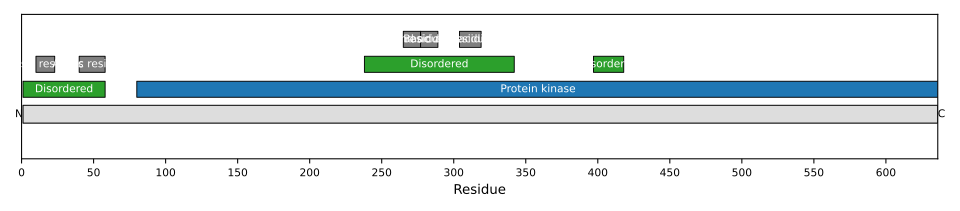
1: Serine/arginine-rich protein-specific kinase which specifically phosphorylates its substrates at serine residues located in regions rich in arginine/serine dipeptides, known as RS domains and is involved in the phosphorylation of SR splicing factors and the regulation of splicing. Plays a central role in the regulatory network for splicing, controlling the intranuclear distribution of splicing factors in interphase cells and the reorganization of nuclear speckles during mitosis. Can influence additional steps of mRNA maturation, as well as other cellular activities, such as chromatin reorganization in somatic and sperm cells and cell cycle progression. Isoform 2 phosphorylates SFRS2, ZRSR2, LBR and PRM1. Isoform 2 phosphorylates SRSF1 using a directional (C-terminal to N-terminal) and a dual-track mechanism incorporating both processive phosphorylation (in which the kinase stays attached to the substrate after each round of phosphorylation) and distributive phosphorylation steps (in which the kinase and substrate dissociate after each phosphorylation event). The RS domain of SRSF1 binds first to a docking groove in the large lobe of the kinase domain of SRPK1. This induces certain structural changes in SRPK1 and/or RRM2 domain of SRSF1, allowing RRM2 to bind the kinase and initiate phosphorylation. The cycles continue for several phosphorylation steps in a processive manner (steps 1-8) until the last few phosphorylation steps (approximately steps 9-12). During that time, a mechanical stress induces the unfolding of the beta-4 motif in RRM2, which then docks at the docking groove of SRPK1. This also signals RRM2 to begin to dissociate, which facilitates SRSF1 dissociation after phosphorylation is completed. Isoform 2 can mediate hepatitis B virus (HBV) core protein phosphorylation. It plays a negative role in the regulation of HBV replication through a mechanism not involving the phosphorylation of the core protein but by reducing the packaging efficiency of the pregenomic RNA (pgRNA) without affecting the formation of the viral core particles. Isoform 1 and isoform 2 can induce splicing of exon 10 in MAPT/TAU. The ratio of isoform 1/isoform 2 plays a decisive role in determining cell fate in K-562 leukaemic cell line: isoform 2 favors proliferation where as isoform 1 favors differentiation