Protein artemis (EC 3.1.-.-) (DNA cross-link repair 1C protein) (Protein A-SCID) (SNM1 homolog C) (hSNM1C) (SNM1-like protein)
1_MSSFE 6_ GQMAE 11_ YPTIS 16_ IDRFD 21_ RENLR 26_ ARAYF 31_ LSHCH 36_ KDHMK 41_ GLRAP 46_ TLKRR 51_ LECSL 56_ KVYLY 61_ CSPVT 66_ KELLL 71_ TSPKY 76_ RFWKK 81_ RIISI 86_ EIETP 91_ TQISL 96_ VDEAS 101_ GEKEE 106_ IVVTL 111_ LPAGH 116_ CPGSV 121_ MFLFQ 126_ GNNGT 131_ VLYTG 136_ DFRLA 141_ QGEAA 146_ RMELL 151_ HSGGR 156_ VKDIQ 161_ SVYLD 166_ TTFCD 171_ PRFYQ 176_ IPSRE 181_ ECLSG 186_ VLELV 191_ RSWIT 196_ RSPYH 201_ VVWLN 206_ CKAAY 211_ GYEYL 216_ FTNLS 221_ EELGV 226_ QVHVN 231_ KLDMF 236_ RNMPE 241_ ILHHL 246_ TTDRN 251_ TQIHA 256_ CRHPK 261_ AEEYF 266_ QWSKL 271_ PCGIT 276_ SRNRI 281_ PLHII 286_ SIKPS 291_ TMWFG 296_ ERSRK 301_ TNVIV 306_ RTGES 311_ SYRAC 316_ FSFHS 321_ SYSEI 326_ KDFLS 331_ YLCPV 336_ NAYPN 341_ VIPVG 346_ TTMDK 351_ VVEIL 356_ KPLCR 361_ SSQST 366_ EPKYK 371_ PLGKL 376_ KRART 381_ VHRDS 386_ EEEDD 391_ YLFDD 396_ PLPIP 401_ LRHKV 406_ PYPET 411_ FHPEV 416_ FSMTA 421_ VSEKQ 426_ PEKLR 431_ QTPGC 436_ CRAEC 441_ MQSSR 446_ FTNFV 451_ DCEES 456_ NSESE 461_ EEVGI 466_ PASLQ 471_ GDLGS 476_ VLHLQ 481_ KADGD 486_ VPQWE 491_ VFFKR 496_ NDEIT 501_ DESLE 506_ NFPSS 511_ TVAGG 516_ SQSPK 521_ LFSDS 526_ DGEST 531_ HISSQ 536_ NSSQS 541_ THITE 546_ QGSQG 551_ WDSQS 556_ DTVLL 561_ SSQER 566_ NSGDI 571_ TSLDK 576_ ADYRP 581_ TIKEN 586_ IPASL 591_ MEQNV 596_ ICPKD 601_ TYSDL 606_ KSRDK 611_ DVTIV 616_ PSTGE 621_ PTTLS 626_ SETHI 631_ PEEKS 636_ LLNLS 641_ TNADS 646_ QSSSD 651_ FEVPS 656_ TPEAE 661_ LPKRE 666_ HLQYL 671_ YEKLA 676_ TGESI 681_ AVKKR 686_KCSLL
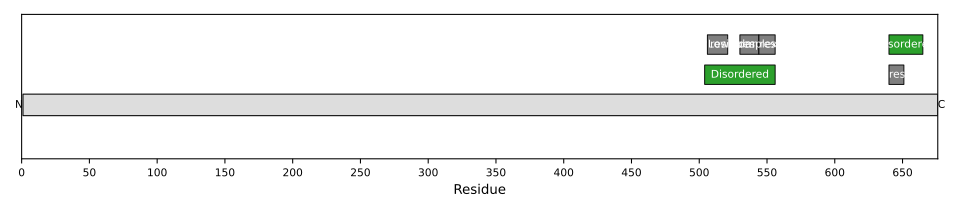
1: Nuclease involved in DNA non-homologous end joining (NHEJ); required for double-strand break repair and V(D)J recombination (PubMed:11336668, PubMed:11955432, PubMed:12055248, PubMed:14744996, PubMed:15071507, PubMed:15574326, PubMed:15936993). Required for V(D)J recombination, the process by which exons encoding the antigen-binding domains of immunoglobulins and T-cell receptor proteins are assembled from individual V, (D), and J gene segments (PubMed:11336668, PubMed:11955432, PubMed:14744996). V(D)J recombination is initiated by the lymphoid specific RAG endonuclease complex, which generates site specific DNA double strand breaks (DSBs) (PubMed:11336668, PubMed:11955432, PubMed:14744996). These DSBs present two types of DNA end structures: hairpin sealed coding ends and phosphorylated blunt signal ends (PubMed:11336668, PubMed:11955432, PubMed:14744996). These ends are independently repaired by the non homologous end joining (NHEJ) pathway to form coding and signal joints respectively (PubMed:11336668, PubMed:11955432, PubMed:14744996). This protein exhibits single-strand specific 5'-3' exonuclease activity in isolation and acquires endonucleolytic activity on 5' and 3' hairpins and overhangs when in a complex with PRKDC (PubMed:11955432, PubMed:15071507, PubMed:15574326, PubMed:15936993). The latter activity is required specifically for the resolution of closed hairpins prior to the formation of the coding joint (PubMed:11955432). Also required for the repair of complex DSBs induced by ionizing radiation, which require substantial end-processing prior to religation by NHEJ (PubMed:15456891, PubMed:15468306, PubMed:15574327, PubMed:15811628)