Protein orai-2 (CAP-binding protein complex-interacting protein 2) (Transmembrane protein 142B)
1_MSAEL 6_ NVPID 11_ PSAPA 16_ CPEPG 21_ HKGMD 26_ YRDWV 31_ RRSYL 36_ ELVTS 41_ NHHSV 46_ QALSW 51_ RKLYL 56_ SRAKL 61_ KASSR 66_ TSALL 71_ SGFAM 76_ VAMVE 81_ VQLET 86_ QYQYP 91_ RPLLI 96_ AFSAC 101_ TTVLV 106_ AVHLF 111_ ALLIS 116_ TCILP 121_ NVEAV 126_ SNIHN 131_ LNSIS 136_ ESPHE 141_ RMHPY 146_ IELAW 151_ GFSTV 156_ LGILL 161_ FLAEV 166_ VLLCW 171_ IKFLP 176_ VDARR 181_ QPGPP 186_ PGPGS 191_ HTGWQ 196_ AALVS 201_ TIIMV 206_ PVGLI 211_ FVVFT 216_ IHFYR 221_ SLVRH 226_ KTERH 231_ NREIE 236_ ELHKL 241_ KVQLD 246_GHERS
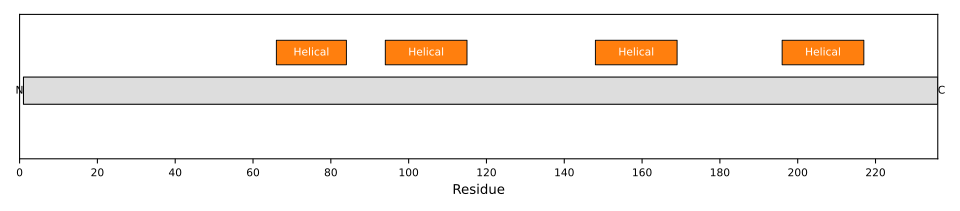
1: Pore-forming subunit of inward rectifying Ca(2+) release-activated Ca(2+) (CRAC) channels. Assembles with ORAI1 and ORAI3 to form hexameric CRAC channels that mediate Ca(2+) influx upon depletion of endoplasmic reticulum Ca(2+) store and channel activation by Ca(2+) sensor STIM1, a process known as store-operated Ca(2+) entry (SOCE). Various pore subunit combinations may account for distinct CRAC channel spatiotemporal and cell-type specific dynamics. ORAI1 mainly contributes to the generation of Ca(2+) plateaus involved in sustained Ca(2+) entry and is dispensable for cytosolic Ca(2+) oscillations, whereas ORAI2 and ORAI3 generate oscillatory patterns. CRAC channels assemble in Ca(2+) signaling microdomains where Ca(2+) influx is coupled to calmodulin and calcineurin signaling and activation of NFAT transcription factors recruited to ORAI1 via AKAP5. CRAC channels are the main pathway for Ca(2+) influx in T cells and promote the immune response to pathogens by activating NFAT-dependent cytokine and chemokine transcription