Transcription factor ATOH8 (Class A basic helix-loop-helix protein 21) (bHLHa21) (Helix-loop-helix protein hATH-6) (hATH6) (Protein atonal homolog 8)
1_MKHIP 6_ VLEDG 11_ PWKTV 16_ CVKEL 21_ NGLKK 26_ LKRKG 31_ KEPAR 36_ RANGY 41_ KTFRL 46_ DLEAP 51_ EPRAV 56_ ATNGL 61_ RDRTH 66_ RLQPV 71_ PVPVP 76_ VPVPV 81_ APAVP 86_ PRGGT 91_ DTAGE 96_ RGGSR 101_ APEVS 106_ DARKR 111_ CFALG 116_ AVGPG 121_ LPTPP 126_ PPPPP 131_ APQSQ 136_ APGGP 141_ EAQPF 146_ REPGL 151_ RPRIL 156_ LCAPP 161_ ARPAP 166_ SAPPA 171_ PPAPP 176_ ESTVR 181_ PAPPT 186_ RPGES 191_ SYSSI 196_ SHVIY 201_ NNHQD 206_ SSASP 211_ RKRPG 216_ EATAA 221_ SSEIK 226_ ALQQT 231_ RRLLA 236_ NARER 241_ TRVHT 246_ ISAAF 251_ EALRK 256_ QVPCY 261_ SYGQK 266_ LSKLA 271_ ILRIA 276_ CNYIL 281_ SLARL 286_ ADLDY 291_ SADHS 296_ NLSFS 301_ ECVQR 306_ CTRTL 311_ QAEGR 316_AKKRK
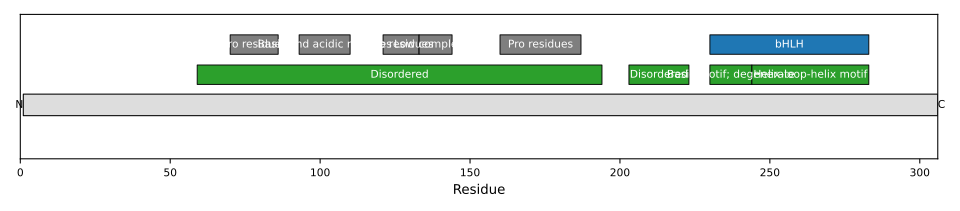
1: Transcription factor that binds a palindromic (canonical) core consensus DNA sequence 5'-CANNTG- 3' known as an E-box element, possibly as a heterodimer with other bHLH proteins (PubMed:24236640). Regulates endothelial cell proliferation, migration and tube-like structures formation (PubMed:24463812). Modulates endothelial cell differentiation through NOS3 (PubMed:24463812). May be implicated in specification and differentiation of neuronal cell lineages in the brain (By similarity). May participate in kidney development and may be involved in podocyte differentiation (By similarity). During early embryonic development is involved in tissue-specific differentiation processes that are dependent on class II bHLH factors and namely modulates the differentiation program initiated by the pro-endocrine factor NEUROG3 (By similarity). During myogenesis, may play a role during the transition of myoblasts from the proliferative phase to the differentiation phase (By similarity). Positively regulates HAMP transcription in two ways, firstly by acting directly on the HAMP promoter via E-boxes binding and indirectly through increased phosphorylation of SMAD protein complex (PubMed:24236640). Repress NEUROG3-dependent gene activation in a gene-specific manner through at least two mechanisms; requires only either the sequestering of a general partner such as TCF3 through heterodimerization, either also requires binding of the bHLH domain to DNA via a basic motif (By similarity)