Potassium channel subfamily K member 17 (2P domain potassium channel Talk-2) (Acid-sensitive potassium channel protein TASK-4) (TWIK-related acid-sensitive K(+) channel 4) (TWIK-related alkaline pH-activated K(+) channel 2) (TALK-2)
1_MYRPR 6_ ARAAP 11_ EGRVR 16_ GCAVP 21_ STVLL 26_ LLAYL 31_ AYLAL 36_ GTGVF 41_ WTLEG 46_ RAAQD 51_ SSRSF 56_ QRDKW 61_ ELLQN 66_ FTCLD 71_ RPALD 76_ SLIRD 81_ VVQAY 86_ KNGAS 91_ LLSNT 96_ TSMGR 101_ WELVG 106_ SFFFS 111_ VSTIT 116_ TIGYG 121_ NLSPN 126_ TMAAR 131_ LFCIF 136_ FALVG 141_ IPLNL 146_ VVLNR 151_ LGHLM 156_ QQGVN 161_ HWASR 166_ LGGTW 171_ QDPDK 176_ ARWLA 181_ GSGAL 186_ LSGLL 191_ LFLLL 196_ PPLLF 201_ SHMEG 206_ WSYTE 211_ GFYFA 216_ FITLS 221_ TVGFG 226_ DYVIG 231_ MNPSQ 236_ RYPLW 241_ YKNMV 246_ SLWIL 251_ FGMAW 256_ LALII 261_ KLILS 266_ QLETP 271_ GRVCS 276_ CCHHS 281_ SKEDF 286_ KSQSW 291_ RQGPD 296_ REPES 301_ HSPQQ 306_ GCYPE 311_ GPMGI 316_ IQHLE 321_ PSAHA 326_AGCGK
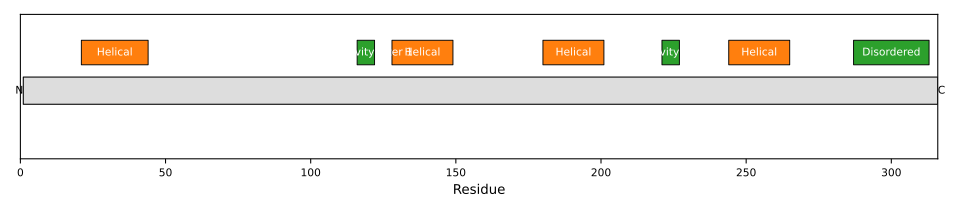
1: K(+) channel that conducts voltage-dependent outward rectifying currents upon membrane depolarization. Voltage sensing is coupled to K(+) electrochemical gradient in an 'ion flux gating' mode where outward but not inward ion flow opens the gate (PubMed:11248242, PubMed:11263999, PubMed:26919430, PubMed:36063992). Homo- and heterodimerizes to form functional channels with distinct regulatory and gating properties (PubMed:36063992). Present in the cardiac conduction system where it may regulate action potential duration and beating frequency of cardiac myocytes (PubMed:24972929). Permeable to other monovalent cations such as Rb(+) and Cs(+) (By similarity) (PubMed:26919430)