E3 ubiquitin-protein ligase RING2 (EC 2.3.2.27) (Huntingtin-interacting protein 2-interacting protein 3) (HIP2-interacting protein 3) (Protein DinG) (RING finger protein 1B) (RING1b) (RING finger protein 2) (RING finger protein BAP-1) (RING-type E3 ubiquitin transferase RING2)
1_MSQAV 6_ QTNGT 11_ QPLSK 16_ TWELS 21_ LYELQ 26_ RTPQE 31_ AITDG 36_ LEIVV 41_ SPRSL 46_ HSELM 51_ CPICL 56_ DMLKN 61_ TMTTK 66_ ECLHR 71_ FCADC 76_ IITAL 81_ RSGNK 86_ ECPTC 91_ RKKLV 96_ SKRSL 101_ RPDPN 106_ FDALI 111_ SKIYP 116_ SRDEY 121_ EAHQE 126_ RVLAR 131_ INKHN 136_ NQQAL 141_ SHSIE 146_ EGLKI 151_ QAMNR 156_ LQRGK 161_ KQQIE 166_ NGSGA 171_ EDNGD 176_ SSHCS 181_ NASTH 186_ SNQEA 191_ GPSNK 196_ RTKTS 201_ DDSGL 206_ ELDNN 211_ NAAMA 216_ IDPVM 221_ DGASE 226_ IELVF 231_ RPHPT 236_ LMEKD 241_ DSAQT 246_ RYIKT 251_ SGNAT 256_ VDHLS 261_ KYLAV 266_ RLALE 271_ ELRSK 276_ GESNQ 281_ MNLDT 286_ ASEKQ 291_ YTIYI 296_ ATASG 301_ QFTVL 306_ NGSFS 311_ LELVS 316_ EKYWK 321_ VNKPM 326_ ELYYA 331_PTKEH
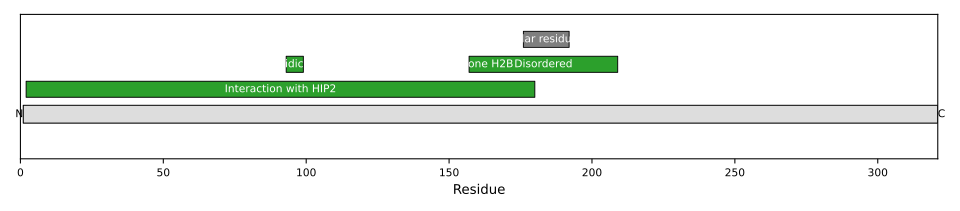
1: E3 ubiquitin-protein ligase that mediates monoubiquitination of 'Lys-119' of histone H2A (H2AK119Ub), thereby playing a central role in histone code and gene regulation (PubMed:15386022, PubMed:16359901, PubMed:21772249, PubMed:25355358, PubMed:25519132, PubMed:26151332, PubMed:33864376). H2AK119Ub gives a specific tag for epigenetic transcriptional repression and participates in X chromosome inactivation of female mammals. May be involved in the initiation of both imprinted and random X inactivation (By similarity). Essential component of a Polycomb group (PcG) multiprotein PRC1-like complex, a complex class required to maintain the transcriptionally repressive state of many genes, including Hox genes, throughout development (PubMed:16359901, PubMed:26151332). PcG PRC1 complex acts via chromatin remodeling and modification of histones, rendering chromatin heritably changed in its expressibility (PubMed:26151332). E3 ubiquitin-protein ligase activity is enhanced by BMI1/PCGF4 (PubMed:21772249). Acts as the main E3 ubiquitin ligase on histone H2A of the PRC1 complex, while RING1 may rather act as a modulator of RNF2/RING2 activity (Probable). Association with the chromosomal DNA is cell-cycle dependent. In resting B- and T-lymphocytes, interaction with AURKB leads to block its activity, thereby maintaining transcription in resting lymphocytes (By similarity). Also acts as a negative regulator of autophagy by mediating ubiquitination of AMBRA1, leading to its subsequent degradation (By similarity)