Cell cycle checkpoint control protein RAD9A (hRAD9) (EC 3.1.11.2) (DNA repair exonuclease rad9 homolog A)
1_MKCLV 6_ TGGNV 11_ KVLGK 16_ AVHSL 21_ SRIGD 26_ ELYLE 31_ PLEDG 36_ LSLRT 41_ VNSSR 46_ SAYAC 51_ FLFAP 56_ LFFQQ 61_ YQAAT 66_ PGQDL 71_ LRCKI 76_ LMKSF 81_ LSVFR 86_ SLAML 91_ EKTVE 96_ KCCIS 101_ LNGRS 106_ SRLVV 111_ QLHCK 116_ FGVRK 121_ THNLS 126_ FQDCE 131_ SLQAV 136_ FDPAS 141_ CPHML 146_ RAPAR 151_ VLGEA 156_ VLPFS 161_ PALAE 166_ VTLGI 171_ GRGRR 176_ VILRS 181_ YHEEE 186_ ADSTA 191_ KAMVT 196_ EMCLG 201_ EEDFQ 206_ QLQAQ 211_ EGVAI 216_ TFCLK 221_ EFRGL 226_ LSFAE 231_ SANLN 236_ LSIHF 241_ DAPGR 246_ PAIFT 251_ IKDSL 256_ LDGHF 261_ VLATL 266_ SDTDS 271_ HSQDL 276_ GSPER 281_ HQPVP 286_ QLQAH 291_ STPHP 296_ DDFAN 301_ DDIDS 306_ YMIAM 311_ ETTIG 316_ NEGSR 321_ VLPSI 326_ SLSPG 331_ PQPPK 336_ SPGPH 341_ SEEED 346_ EAEPS 351_ TVPGT 356_ PPPKK 361_ FRSLF 366_ FGSIL 371_ APVRS 376_ PQGPS 381_ PVLAE 386_DSEGE
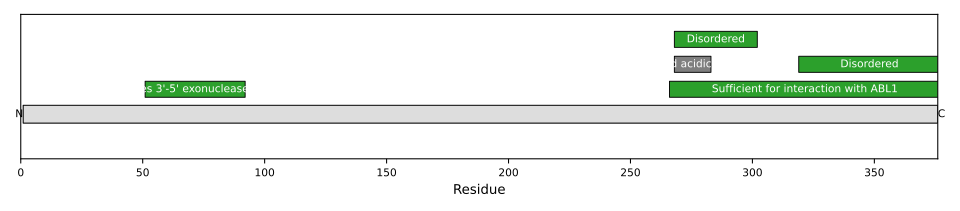
1: Component of the 9-1-1 cell-cycle checkpoint response complex that plays a major role in DNA repair (PubMed:10713044, PubMed:17575048, PubMed:20545769, PubMed:21659603, PubMed:31135337). The 9-1-1 complex is recruited to DNA lesion upon damage by the RAD17-replication factor C (RFC) clamp loader complex (PubMed:21659603). Acts then as a sliding clamp platform on DNA for several proteins involved in long-patch base excision repair (LP-BER) (PubMed:21659603). The 9-1-1 complex stimulates DNA polymerase beta (POLB) activity by increasing its affinity for the 3'-OH end of the primer-template and stabilizes POLB to those sites where LP-BER proceeds; endonuclease FEN1 cleavage activity on substrates with double, nick, or gap flaps of distinct sequences and lengths; and DNA ligase I (LIG1) on long-patch base excision repair substrates (PubMed:21659603). The 9-1-1 complex is necessary for the recruitment of RHNO1 to sites of double-stranded breaks (DSB) occurring during the S phase (PubMed:21659603). RAD9A possesses 3'->5' double stranded DNA exonuclease activity (PubMed:10713044)