Calcineurin B homologous protein 1 (Calcineurin B-like protein) (Calcium-binding protein CHP) (Calcium-binding protein p22) (EF-hand calcium-binding domain-containing protein p22)
1_MGSRA 6_ STLLR 11_ DEELE 16_ EIKKE 21_ TGFSH 26_ SQITR 31_ LYSRF 36_ TSLDK 41_ GENGT 46_ LSRED 51_ FQRIP 56_ ELAIN 61_ PLGDR 66_ IINAF 71_ FPEGE 76_ DQVNF 81_ RGFMR 86_ TLAHF 91_ RPIED 96_ NEKSK 101_ DVNGP 106_ EPLNS 111_ RSNKL 116_ HFAFR 121_ LYDLD 126_ KDEKI 131_ SRDEL 136_ LQVLR 141_ MMVGV 146_ NISDE 151_ QLGSI 156_ ADRTI 161_ QEADQ 166_ DGDSA 171_ ISFTE 176_ FVKVL 181_ EKVDV 186_EQKMS
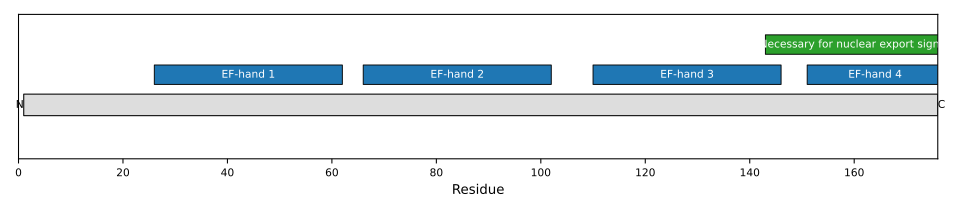
1: Calcium-binding protein involved in different processes such as regulation of vesicular trafficking, plasma membrane Na(+)/H(+) exchanger and gene transcription. Involved in the constitutive exocytic membrane traffic. Mediates the association between microtubules and membrane-bound organelles of the endoplasmic reticulum and Golgi apparatus and is also required for the targeting and fusion of transcytotic vesicles (TCV) with the plasma membrane. Functions as an integral cofactor in cell pH regulation by controlling plasma membrane-type Na(+)/H(+) exchange activity. Affects the pH sensitivity of SLC9A1/NHE1 by increasing its sensitivity at acidic pH. Required for the stabilization and localization of SLC9A1/NHE1 at the plasma membrane. Inhibits serum- and GTPase-stimulated Na(+)/H(+) exchange. Plays a role as an inhibitor of ribosomal RNA transcription by repressing the nucleolar UBF1 transcriptional activity. May sequester UBF1 in the nucleoplasm and limit its translocation to the nucleolus. Associates to the ribosomal gene promoter. Acts as a negative regulator of the calcineurin/NFAT signaling pathway. Inhibits NFAT nuclear translocation and transcriptional activity by suppressing the calcium-dependent calcineurin phosphatase activity. Also negatively regulates the kinase activity of the apoptosis-induced kinase STK17B. Inhibits both STK17B auto- and substrate-phosphorylations in a calcium-dependent manner