Neuronal PAS domain-containing protein 2 (Neuronal PAS2) (Basic-helix-loop-helix-PAS protein MOP4) (Class E basic helix-loop-helix protein 9) (bHLHe9) (Member of PAS protein 4) (PAS domain-containing protein 4)
1_MDEDE 6_ KDRAK 11_ RASRN 16_ KSEKK 21_ RRDQF 26_ NVLIK 31_ ELSSM 36_ LPGNT 41_ RKMDK 46_ TTVLE 51_ KVIGF 56_ LQKHN 61_ EVSAQ 66_ TEICD 71_ IQQDW 76_ KPSFL 81_ SNEEF 86_ TQLML 91_ EALDG 96_ FIIAV 101_ TTDGS 106_ IIYVS 111_ DSITP 116_ LLGHL 121_ PSDVM 126_ DQNLL 131_ NFLPE 136_ QEHSE 141_ VYKIL 146_ SSHML 151_ VTDSP 156_ SPEYL 161_ KSDSD 166_ LEFYC 171_ HLLRG 176_ SLNPK 181_ EFPTY 186_ EYIKF 191_ VGNFR 196_ SYNNV 201_ PSPSC 206_ NGFDN 211_ TLSRP 216_ CRVPL 221_ GKEVC 226_ FIATV 231_ RLATP 236_ QFLKE 241_ MCIVD 246_ EPLEE 251_ FTSRH 256_ SLEWK 261_ FLFLD 266_ HRAPP 271_ IIGYL 276_ PFEVL 281_ GTSGY 286_ DYYHI 291_ DDLEL 296_ LARCH 301_ QHLMQ 306_ FGKGK 311_ SCCYR 316_ FLTKG 321_ QQWIW 326_ LQTHY 331_ YITYH 336_ QWNSK 341_ PEFIV 346_ CTHSV 351_ VSYAD 356_ VRVER 361_ RQELA 366_ LEDPP 371_ SEALH 376_ SSALK 381_ DKGSS 386_ LEPRQ 391_ HFNTL 396_ DVGAS 401_ GLNTS 406_ HSPSA 411_ SSRSS 416_ HKSSH 421_ TAMSE 426_ PTSTP 431_ TKLMA 436_ EASTP 441_ ALPRS 446_ ATLPQ 451_ ELPVP 456_ GLSQA 461_ ATMPA 466_ PLPSP 471_ SSCDL 476_ TQQLL 481_ PQTVL 486_ QSTPA 491_ PMAQF 496_ SAQFS 501_ MFQTI 506_ KDQLE 511_ QRTRI 516_ LQANI 521_ RWQQE 526_ ELHKI 531_ QEQLC 536_ LVQDS 541_ NVQMF 546_ LQQPA 551_ VSLSF 556_ SSTQR 561_ PEAQQ 566_ QLQQR 571_ SAAVT 576_ QPQLG 581_ AGPQL 586_ PGQIS 591_ SAQVT 596_ SQHLL 601_ RESSV 606_ ISTQG 611_ PKPMR 616_ SSQLM 621_ QSSGR 626_ SGSSL 631_ VSPFS 636_ SATAA 641_ LPPSL 646_ NLTTP 651_ ASTSQ 656_ DASQC 661_ QPSPD 666_ FSHDR 671_ QLRLL 676_ LSQPI 681_ QPMMP 686_ GSCDA 691_ RQPSE 696_ VSRTG 701_ RQVKY 706_ AQSQT 711_ VFQNP 716_ DAHPA 721_ NSSSA 726_ PMPVL 731_ LMGQA 736_ VLHPS 741_ FPASQ 746_ PSPLQ 751_ PAQAR 756_ QQPPQ 761_ HYLQV 766_ QAPTS 771_ LHSEQ 776_ QDSLL 781_ LSTYS 786_ QQPGT 791_ LGYPQ 796_ PPPAQ 801_ PQPLR 806_ PPRRV 811_ SSLSE 816_SSGLQ
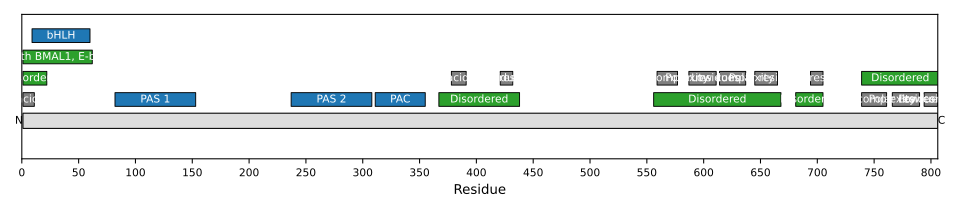
1: Transcriptional activator which forms a core component of the circadian clock. The circadian clock, an internal time-keeping system, regulates various physiological processes through the generation of approximately 24 hour circadian rhythms in gene expression, which are translated into rhythms in metabolism and behavior. It is derived from the Latin roots 'circa' (about) and 'diem' (day) and acts as an important regulator of a wide array of physiological functions including metabolism, sleep, body temperature, blood pressure, endocrine, immune, cardiovascular, and renal function. Consists of two major components: the central clock, residing in the suprachiasmatic nucleus (SCN) of the brain, and the peripheral clocks that are present in nearly every tissue and organ system. Both the central and peripheral clocks can be reset by environmental cues, also known as Zeitgebers (German for 'timegivers'). The predominant Zeitgeber for the central clock is light, which is sensed by retina and signals directly to the SCN. The central clock entrains the peripheral clocks through neuronal and hormonal signals, body temperature and feeding-related cues, aligning all clocks with the external light/dark cycle. Circadian rhythms allow an organism to achieve temporal homeostasis with its environment at the molecular level by regulating gene expression to create a peak of protein expression once every 24 hours to control when a particular physiological process is most active with respect to the solar day. Transcription and translation of core clock components (CLOCK, NPAS2, BMAL1, BMAL2, PER1, PER2, PER3, CRY1 and CRY2) plays a critical role in rhythm generation, whereas delays imposed by post-translational modifications (PTMs) are important for determining the period (tau) of the rhythms (tau refers to the period of a rhythm and is the length, in time, of one complete cycle). A diurnal rhythm is synchronized with the day/night cycle, while the ultradian and infradian rhythms have a period shorter and longer than 24 hours, respectively. Disruptions in the circadian rhythms contribute to the pathology of cardiovascular diseases, cancer, metabolic syndromes and aging. A transcription/translation feedback loop (TTFL) forms the core of the molecular circadian clock mechanism. Transcription factors, CLOCK or NPAS2 and BMAL1 or BMAL2, form the positive limb of the feedback loop, act in the form of a heterodimer and activate the transcription of core clock genes and clock-controlled genes (involved in key metabolic processes), harboring E-box elements (5'-CACGTG-3') within their promoters. The core clock genes: PER1/2/3 and CRY1/2 which are transcriptional repressors form the negative limb of the feedback loop and interact with the CLOCK|NPAS2-BMAL1|BMAL2 heterodimer inhibiting its activity and thereby negatively regulating their own expression. This heterodimer also activates nuclear receptors NR1D1/2 and RORA/B/G, which form a second feedback loop and which activate and repress BMAL1 transcription, respectively. The NPAS2-BMAL1 heterodimer positively regulates the expression of MAOA, F7 and LDHA and modulates the circadian rhythm of daytime contrast sensitivity by regulating the rhythmic expression of adenylate cyclase type 1 (ADCY1) in the retina. NPAS2 plays an important role in sleep homeostasis and in maintaining circadian behaviors in normal light/dark and feeding conditions and in the effective synchronization of feeding behavior with scheduled food availability. Regulates the gene transcription of key metabolic pathways in the liver and is involved in DNA damage response by regulating several cell cycle and DNA repair genes. Controls the circadian rhythm of NR0B2 expression by binding rhythmically to its promoter (By similarity). Mediates the diurnal variation in the expression of GABARA1 receptor in the brain and contributes to the regulation of anxiety-like behaviors and GABAergic neurotransmission in the ventral striatum (By similarity)