Phosphatidylinositol 4-phosphate 5-kinase type-1 alpha (PIP5K1-alpha) (PtdIns(4)P-5-kinase 1 alpha) (EC 2.7.1.68) (68 kDa type I phosphatidylinositol 4-phosphate 5-kinase alpha) (Phosphatidylinositol 4-phosphate 5-kinase type I alpha) (PIP5KIalpha)
1_MASAS 6_ SGPSS 11_ SVGFS 16_ SFDPA 21_ VPSCT 26_ LSSAA 31_ SGIKR 36_ PMASE 41_ VLEAR 46_ QDSYI 51_ SLVPY 56_ ASGMP 61_ IKKIG 66_ HRSVD 71_ SSGET 76_ TYKKT 81_ TSSAL 86_ KGAIQ 91_ LGITH 96_ TVGSL 101_ STKPE 106_ RDVLM 111_ QDFYV 116_ VESIF 121_ FPSEG 126_ SNLTP 131_ AHHYN 136_ DFRFK 141_ TYAPV 146_ AFRYF 151_ RELFG 156_ IRPDD 161_ YLYSL 166_ CSEPL 171_ IELCS 176_ SGASG 181_ SLFYV 186_ SSDDE 191_ FIIKT 196_ VQHKE 201_ AEFLQ 206_ KLLPG 211_ YYMNL 216_ NQNPR 221_ TLLPK 226_ FYGLY 231_ CVQAG 236_ GKNIR 241_ IVVMN 246_ NLLPR 251_ SVKMH 256_ IKYDL 261_ KGSTY 266_ KRRAS 271_ QKERE 276_ KPLPT 281_ FKDLD 286_ FLQDI 291_ PDGLF 296_ LDADM 301_ YNALC 306_ KTLQR 311_ DCLVL 316_ QSFKI 321_ MDYSL 326_ LMSIH 331_ NIDHA 336_ QREPL 341_ SSETQ 346_ YSVDT 351_ RRPAP 356_ QKALY 361_ STAME 366_ SIQGE 371_ ARRGG 376_ TMETD 381_ DHMGG 386_ IPARN 391_ SKGER 396_ LLLYI 401_ GIIDI 406_ LQSYR 411_ FVKKL 416_ EHSWK 421_ ALVHD 426_ GDTVS 431_ VHRPG 436_ FYAER 441_ FQRFM 446_ CNTVF 451_ KKIPL 456_ KPSPS 461_ KKFRS 466_ GSSFS 471_ RRAGS 476_ SGNSC 481_ ITYQP 486_ SVSGE 491_ HKAQV 496_ TTKAE 501_ VEPGV 506_ HLGRP 511_ DVLPQ 516_ TPPLE 521_ EISEG 526_ SPIPD 531_ PSFSP 536_ LVGET 541_ LQMLT 546_ TSTTL 551_ EKLEV 556_AESEF
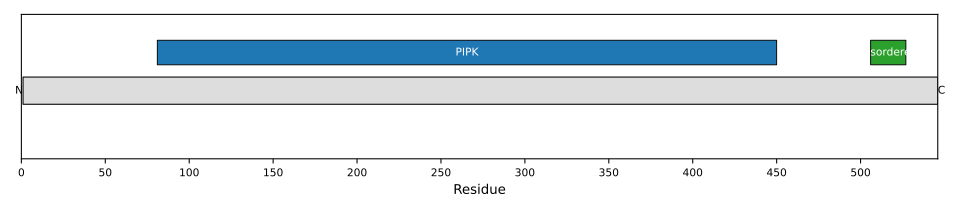
1: Catalyzes the phosphorylation of phosphatidylinositol 4-phosphate (PtdIns(4)P/PI4P) to form phosphatidylinositol 4,5-bisphosphate (PtdIns(4,5)P2/PIP2), a lipid second messenger that regulates several cellular processes such as signal transduction, vesicle trafficking, actin cytoskeleton dynamics, cell adhesion, and cell motility (PubMed:21477596, PubMed:22942276, PubMed:8955136). PtdIns(4,5)P2 can directly act as a second messenger or can be utilized as a precursor to generate other second messengers: inositol 1,4,5-trisphosphate (IP3), diacylglycerol (DAG) or phosphatidylinositol-3,4,5-trisphosphate (PtdIns(3,4,5)P3/PIP3) (PubMed:19158393, PubMed:20660631). PIP5K1A-mediated phosphorylation of PtdIns(4)P is the predominant pathway for PtdIns(4,5)P2 synthesis (By similarity). Can also use phosphatidylinositol (PtdIns) as substrate in vitro (PubMed:22942276). Together with PIP5K1C, is required for phagocytosis, both enzymes regulating different types of actin remodeling at sequential steps (By similarity). Promotes particle ingestion by activating the WAS GTPase-binding protein that induces Arp2/3 dependent actin polymerization at the nascent phagocytic cup (By similarity). Together with PIP5K1B, is required, after stimulation by G-protein coupled receptors, for the synthesis of IP3 that will induce stable platelet adhesion (By similarity). Recruited to the plasma membrane by the E-cadherin/beta-catenin complex where it provides the substrate PtdIns(4,5)P2 for the production of PtdIns(3,4,5)P3, IP3 and DAG, that will mobilize internal calcium and drive keratinocyte differentiation (PubMed:19158393). Positively regulates insulin-induced translocation of SLC2A4 to the cell membrane in adipocytes (By similarity). Together with PIP5K1C has a role during embryogenesis (By similarity). Independently of its catalytic activity, is required for membrane ruffling formation, actin organization and focal adhesion formation during directional cell migration by controlling integrin-induced translocation of the small GTPase RAC1 to the plasma membrane (PubMed:20660631). Also functions in the nucleus where it acts as an activator of TUT1 adenylyltransferase activity in nuclear speckles, thereby regulating mRNA polyadenylation of a select set of mRNAs (PubMed:18288197)