Target of rapamycin complex 2 subunit MAPKAP1 (TORC2 subunit MAPKAP1) (Mitogen-activated protein kinase 2-associated protein 1) (Stress-activated map kinase-interacting protein 1) (SAPK-interacting protein 1) (mSIN1)
1_MAFLD 6_ NPTII 11_ LAHIR 16_ QSHVT 21_ SDDTG 26_ MCEMV 31_ LIDHD 36_ VDLEK 41_ IHPPS 46_ MPGDS 51_ GSEIQ 56_ GSNGE 61_ TQGYV 66_ YAQSV 71_ DITSS 76_ WDFGI 81_ RRRSN 86_ TAQRL 91_ ERLRK 96_ ERQNQ 101_ IKCKN 106_ IQWKE 111_ RNSKQ 116_ SAQEL 121_ KSLFE 126_ KKSLK 131_ EKPPI 136_ SGKQS 141_ ILSVR 146_ LEQCP 151_ LQLNN 156_ PFNEY 161_ SKFDG 166_ KGHVG 171_ TTATK 176_ KIDVY 181_ LPLHS 186_ SQDRL 191_ LPMTV 196_ VTMAS 201_ ARVQD 206_ LIGLI 211_ CWQYT 216_ SEGRE 221_ PKLND 226_ NVSAY 231_ CLHIA 236_ EDDGE 241_ VDTDF 246_ PPLDS 251_ NEPIH 256_ KFGFS 261_ TLALV 266_ EKYSS 271_ PGLTS 276_ KESLF 281_ VRINA 286_ AHGFS 291_ LIQVD 296_ NTKVT 301_ MKEIL 306_ LKAVK 311_ RRKGS 316_ QKVSG 321_ PQYRL 326_ EKQSE 331_ PNVAV 336_ DLDST 341_ LESQS 346_ AWEFC 351_ LVREN 356_ SSRAD 361_ GVFEE 366_ DSQID 371_ IATVQ 376_ DMLSS 381_ HHYKS 386_ FKVSM 391_ IHRLR 396_ FTTDV 401_ QLGIS 406_ GDKVE 411_ IDPVT 416_ NQKAS 421_ TKFWI 426_ KQKPI 431_ SIDSD 436_ LLCAC 441_ DLAEE 446_ KSPSH 451_ AIFKL 456_ TYLSN 461_ HDYKH 466_ LYFES 471_ DAATV 476_ NEIVL 481_ KVNYI 486_ LESRA 491_ STARA 496_ DYFAQ 501_ KQRKL 506_ NRRTS 511_ FSFQK 516_EKKSG
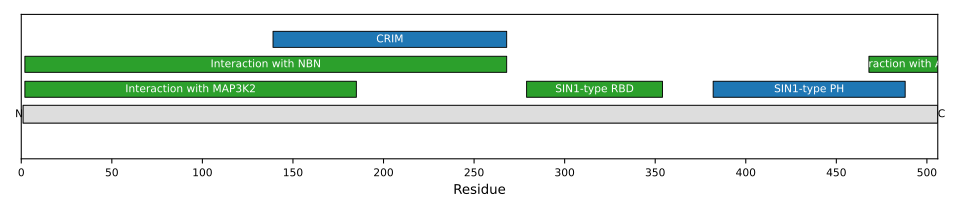
1: Component of the mechanistic target of rapamycin complex 2 (mTORC2), which transduces signals from growth factors to pathways involved in proliferation, cytoskeletal organization, lipogenesis and anabolic output (PubMed:15467718, PubMed:16919458, PubMed:16962653, PubMed:17043309, PubMed:21806543, PubMed:28264193, PubMed:28968999, PubMed:30837283, PubMed:35926713). In response to growth factors, mTORC2 phosphorylates and activates AGC protein kinase family members, including AKT (AKT1, AKT2 and AKT3), PKC (PRKCA, PRKCB and PRKCE) and SGK1 (PubMed:16919458, PubMed:16962653, PubMed:21806543, PubMed:28264193, PubMed:28968999, PubMed:30837283, PubMed:35926713). In contrast to mTORC1, mTORC2 is nutrient-insensitive (PubMed:16962653). Within the mTORC2 complex, MAPKAP1/SIN1 acts as a substrate adapter which recognizes and binds AGC protein kinase family members for phosphorylation by MTOR (PubMed:21806543, PubMed:28264193). mTORC2 plays a critical role in AKT1 activation by mediating phosphorylation of different sites depending on the context, such as 'Thr-450', 'Ser-473', 'Ser-477' or 'Thr-479', facilitating the phosphorylation of the activation loop of AKT1 on 'Thr-308' by PDPK1/PDK1 which is a prerequisite for full activation (PubMed:28264193, PubMed:35926713). mTORC2 catalyzes the phosphorylation of SGK1 at 'Ser-422' and of PRKCA on 'Ser-657' (PubMed:30837283, PubMed:35926713). The mTORC2 complex also phosphorylates various proteins involved in insulin signaling, such as FBXW8 and IGF2BP1 (By similarity). mTORC2 acts upstream of Rho GTPases to regulate the actin cytoskeleton, probably by activating one or more Rho-type guanine nucleotide exchange factors (PubMed:15467718). mTORC2 promotes the serum-induced formation of stress-fibers or F-actin (PubMed:15467718). MAPKAP1 inhibits MAP3K2 by preventing its dimerization and autophosphorylation (PubMed:15988011). Inhibits HRAS and KRAS independently of mTORC2 complex (PubMed:17303383, PubMed:34380736, PubMed:35522713). Enhances osmotic stress-induced phosphorylation of ATF2 and ATF2-mediated transcription (PubMed:17054722). Involved in ciliogenesis, regulates cilia length through its interaction with CCDC28B independently of mTORC2 complex (PubMed:23727834)
2: In contrast to isoform 1, isoform 2 and isoform 6, isoform 4 is not a component of the a mTORC2 complex