RAD9, HUS1, RAD1-interacting nuclear orphan protein 1 (RAD9, RAD1, HUS1-interacting nuclear orphan protein)
1_MPPRK 6_ KRRQP 11_ SQKAP 16_ LLFHQ 21_ QPLEG 26_ PKHSC 31_ ASTQL 36_ PITHT 41_ RQVPS 46_ KPIDH 51_ STITS 56_ WVSPD 61_ FDTAA 66_ GSLFP 71_ AYQKH 76_ QNRAR 81_ HSSRK 86_ PTTSK 91_ FPHLT 96_ FESPQ 101_ SSSSE 106_ TLGIP 111_ LIREC 116_ PSESE 121_ KDVSR 126_ RPLVP 131_ VLSPQ 136_ SCGNM 141_ SVQAL 146_ QSLPY 151_ VFIPP 156_ DIQTP 161_ ESSSV 166_ KEELI 171_ PQDQK 176_ ENSLL 181_ SCTLH 186_ TGTPN 191_ SPEPG 196_ PVLVK 201_ DTPED 206_ KYGIK 211_ VTWRR 216_ RQHLL 221_ AYLRE 226_ RGKLS 231_RSQFL
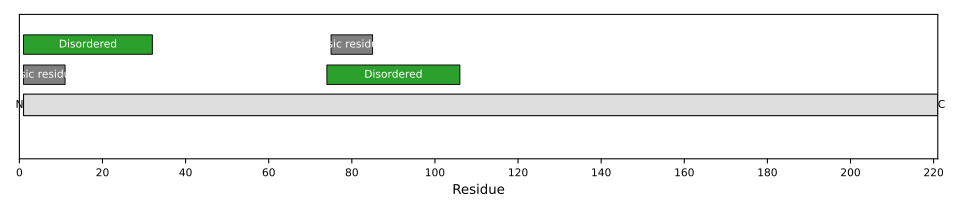
1: Involved in microhomology-mediated end-joining (MMEJ) DNA repair by promoting recruitment of polymerase theta (POLQ) to DNA damage sites during mitosis (PubMed:37440612). MMEJ is an alternative non-homologous end-joining (NHEJ) machinery that takes place during mitosis to repair double-strand breaks in DNA that originate in S-phase (PubMed:37440612). Accumulates in M-phase; following phosphorylation by PLK1, interacts with POLQ, enabling its recruitment to double-strand breaks for subsequent repair (PubMed:37440612). Also involved in the DNA damage response (DDR) signaling in response to genotoxic stresses such as ionizing radiation (IR) during the S phase (PubMed:21659603, PubMed:25602520). Recruited to sites of DNA damage through interaction with the 9-1-1 cell-cycle checkpoint response complex and TOPBP1 in a ATR-dependent manner (PubMed:21659603, PubMed:25602520). Required for the progression of the G1 to S phase transition (PubMed:21659603). Plays a role in the stimulation of CHEK1 phosphorylation (PubMed:21659603)