Polycomb group RING finger protein 1 (Nervous system Polycomb-1) (NSPc1) (RING finger protein 68)
1_MASPQ 6_ GGQIA 11_ IAMRL 16_ RNQLQ 21_ SVYKM 26_ DPLRN 31_ EEEVR 36_ VKIKD 41_ LNEHI 46_ VCCLC 51_ AGYFV 56_ DATTI 61_ TECLH 66_ TFCKS 71_ CIVKY 76_ LQTSK 81_ YCPMC 86_ NIKIH 91_ ETQPL 96_ LNLKL 101_ DRVMQ 106_ DIVYK 111_ LVPGL 116_ QDSEE 121_ KRIRE 126_ FYQSR 131_ GLDRV 136_ TQPTG 141_ EEPAL 146_ SNLGL 151_ PFSSF 156_ DHSKA 161_ HYYRY 166_ DEQLN 171_ LCLER 176_ LSSGK 181_ DKNKS 186_ VLQNK 191_ YVRCS 196_ VRAEV 201_ RHLRR 206_ VLCHR 211_ LMLNP 216_ QHVQL 221_ LFDNE 226_ VLPDH 231_ MTMKQ 236_ IWLSR 241_ WFGKP 246_ SPLLL 251_QYSVK
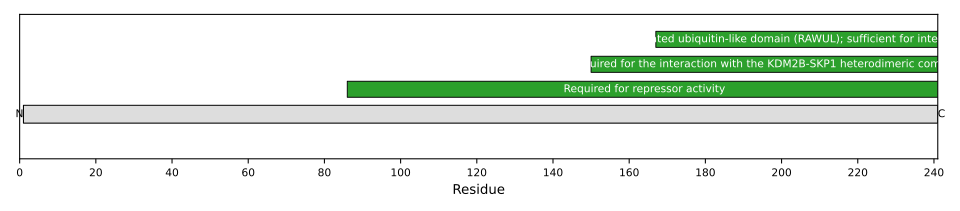
1: Component of the Polycomb group (PcG) multiprotein BCOR complex, a complex required to maintain the transcriptionally repressive state of some genes, such as BCL6 and the cyclin-dependent kinase inhibitor, CDKN1A. Transcriptional repressor that may be targeted to the DNA by BCL6; this transcription repressor activity may be related to PKC signaling pathway. Represses CDKN1A expression by binding to its promoter, and this repression is dependent on the retinoic acid response element (RARE element). Promotes cell cycle progression and enhances cell proliferation as well. May have a positive role in tumor cell growth by down-regulating CDKN1A. Component of a Polycomb group (PcG) multiprotein PRC1-like complex, a complex class required to maintain the transcriptionally repressive state of many genes, including Hox genes, throughout development. PcG PRC1 complex acts via chromatin remodeling and modification of histones; it mediates monoubiquitination of histone H2A 'Lys-119', rendering chromatin heritably changed in its expressibility (PubMed:26151332). Within the PRC1-like complex, regulates RNF2 ubiquitin ligase activity (PubMed:26151332). Regulates the expression of DPPA4 and NANOG in the NT2 embryonic carcinoma cells (PubMed:26687479)