PAXIP1-associated glutamate-rich protein 1 (Glutamate-rich coactivator interacting with SRC1) (GAS) (PAXIP1-associated protein 1) (PTIP-associated protein 1)
1_MSLAR 6_ GHGDT 11_ AASTA 16_ APLSE 21_ EGEVT 26_ SGLQA 31_ LAVED 36_ TGGPS 41_ ASAGK 46_ AEDEG 51_ EGGRE 56_ ETERE 61_ GSGGE 66_ EAQGE 71_ VPSAG 76_ GEEPA 81_ EEDSE 86_ DWCVP 91_ CSDEE 96_ VELPA 101_ DGQPW 106_ MPPPS 111_ EIQRL 116_ YELLA 121_ AHGTL 126_ ELQAE 131_ ILPRR 136_ PPTPE 141_ AQSEE 146_ ERSDE 151_ EPEAK 156_ EEEEE 161_ KPHMP 166_ TEFDF 171_ DDEPV 176_ TPKDS 181_ LIDRR 186_ RTPGS 191_ SARSQ 196_ KREAR 201_ LDKVL 206_ SDMKR 211_ HKKLE 216_ EQILR 221_ TGRDL 226_ FSLDS 231_ EDPSP 236_ ASPPL 241_ RSSGS 246_SLFPR
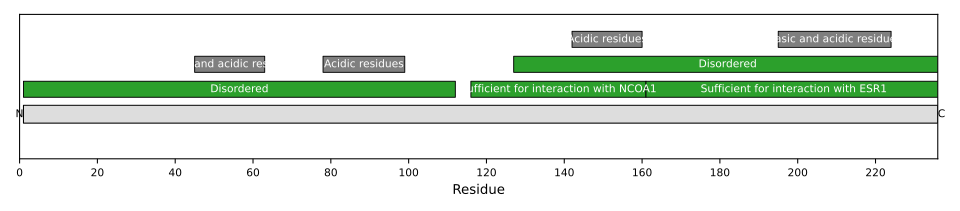
1: Its association with the histone methyltransferase MLL2/MLL3 complex is suggesting a role in epigenetic transcriptional activation. However, in association with PAXIP1/PTIP is proposed to function at least in part independently of the MLL2/MLL3 complex. Proposed to be recruited by PAXIP1 to sites of DNA damage where the PAGR1:PAXIP1 complex is required for cell survival in response to DNA damage independently of the MLL2/MLL3 complex (PubMed:19124460). However, its function in DNA damage has been questioned (By similarity). During immunoglobulin class switching in activated B-cells is involved in transcription regulation of downstream switch regions at the immunoglobulin heavy-chain (Igh) locus independently of the MLL2/MLL3 complex (By similarity). Involved in both estrogen receptor-regulated gene transcription and estrogen-stimulated G1/S cell-cycle transition (PubMed:19039327). Acts as a transcriptional cofactor for nuclear hormone receptors. Inhibits the induction properties of several steroid receptors such as NR3C1, AR and PPARG; the mechanism of inhibition appears to be gene-dependent (PubMed:23161582)