Succinate receptor 1 (G-protein coupled receptor 91) (P2Y purinoceptor 1-like)
1_MLGIM 6_ AWNAT 11_ CKNWL 16_ AAEAA 21_ LEKYY 26_ LSIFY 31_ GIEFV 36_ VGVLG 41_ NTIVV 46_ YGYIF 51_ SLKNW 56_ NSSNI 61_ YLFNL 66_ SVSDL 71_ AFLCT 76_ LPMLI 81_ RSYAN 86_ GNWIY 91_ GDVLC 96_ ISNRY 101_ VLHAN 106_ LYTSI 111_ LFLTF 116_ ISIDR 121_ YLIIK 126_ YPFRE 131_ HLLQK 136_ KEFAI 141_ LISLA 146_ IWVLV 151_ TLELL 156_ PILPL 161_ INPVI 166_ TDNGT 171_ TCNDF 176_ ASSGD 181_ PNYNL 186_ IYSMC 191_ LTLLG 196_ FLIPL 201_ FVMCF 206_ FYYKI 211_ ALFLK 216_ QRNRQ 221_ VATAL 226_ PLEKP 231_ LNLVI 236_ MAVVI 241_ FSVLF 246_ TPYHV 251_ MRNVR 256_ IASRL 261_ GSWKQ 266_ YQCTQ 271_ VVINS 276_ FYIVT 281_ RPLAF 286_ LNSVI 291_ NPVFY 296_ FLLGD 301_ HFRDM 306_ LMNQL 311_ RHNFK 316_ SLTSF 321_ SRWAH 326_ELLLS
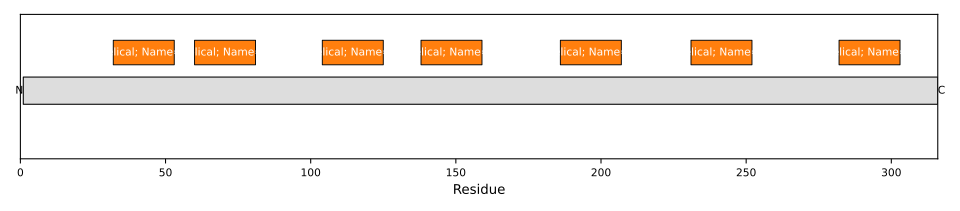
1: G protein-coupled receptor for succinate able to mediate signaling through Gq/GNAQ or Gi/GNAI second messengers depending on the cell type and the processes regulated (By similarity) (PubMed:15141213, PubMed:23770096, PubMed:34133934). Succinate-SUCNR1 signaling serves as a link between metabolic stress, inflammation and energy homeostasis (PubMed:18820681, PubMed:34133934). In macrophages, plays a range of immune-regulatory roles. During inflammation, succinate-SUCNR1 signaling may act as an anti-inflammatory mediator or boost inflammation depending on the inflammatory status of cells (By similarity). Hyperpolarizes M2 macrophages versus M1 phenotype through Gq signaling by regulating the transcription of genes involved in immune function (PubMed:34133934). In activated M1 macrophages, plays a pro-inflammatory role in response to LPS (By similarity). Expressed in dendritic cells, where it is involved in the sensing of immunological danger and enhances immunity. Mediates succinate triggered intracelleular calcium mobilization, induces migratory responses and acts in synergy with Toll-like receptor ligands for the production of proinflammatory cytokines as well as an enhancement of antigen-specific activation of helper T cells (PubMed:18820681). In the small intestine, mediates the activation of tuft cells by dietary succinate and triggers type 2 immunity (By similarity). In adipocytes, plays an important role in the control of energy metabolism. In response to succinate, controls leptin expression in an AMPK-JNK-CEBPA-dependent as well as circadian clock-regulated manner (By similarity). In muscle tissue, is expressed in non-muscle cells and coordinates muscle remodeling in response to the succinate produced during exercise training in a paracrine manner (By similarity). In retina, acts as a mediator of vessel growth during retinal development. In response to succinate, regulates the production of angiogenic factors, including VEGF, by retinal ganglion neurons (By similarity)