Serine/threonine-protein kinase PINK1, mitochondrial (EC 2.7.11.1) (BRPK) (PTEN-induced putative kinase protein 1)
1_MAVRQ 6_ ALGRG 11_ LQLGR 16_ ALLLR 21_ FTGKP 26_ GRAYG 31_ LGRPG 36_ PAAGC 41_ VRGER 46_ PGWAA 51_ GPGAE 56_ PRRVG 61_ LGLPN 66_ RLRFF 71_ RQSVA 76_ GLAAR 81_ LQRQF 86_ VVRAW 91_ GCAGP 96_ CGRAV 101_ FLAFG 106_ LGLGL 111_ IEEKQ 116_ AESRR 121_ AVSAC 126_ QEIQA 131_ IFTQK 136_ SKPGP 141_ DPLDT 146_ RRLQG 151_ FRLEE 156_ YLIGQ 161_ SIGKG 166_ CSAAV 171_ YEATM 176_ PTLPQ 181_ NLEVT 186_ KSTGL 191_ LPGRG 196_ PGTSA 201_ PGEGQ 206_ ERAPG 211_ APAFP 216_ LAIKM 221_ MWNIS 226_ AGSSS 231_ EAILN 236_ TMSQE 241_ LVPAS 246_ RVALA 251_ GEYGA 256_ VTYRK 261_ SKRGP 266_ KQLAP 271_ HPNII 276_ RVLRA 281_ FTSSV 286_ PLLPG 291_ ALVDY 296_ PDVLP 301_ SRLHP 306_ EGLGH 311_ GRTLF 316_ LVMKN 321_ YPCTL 326_ RQYLC 331_ VNTPS 336_ PRLAA 341_ MMLLQ 346_ LLEGV 351_ DHLVQ 356_ QGIAH 361_ RDLKS 366_ DNILV 371_ ELDPD 376_ GCPWL 381_ VIADF 386_ GCCLA 391_ DESIG 396_ LQLPF 401_ SSWYV 406_ DRGGN 411_ GCLMA 416_ PEVST 421_ ARPGP 426_ RAVID 431_ YSKAD 436_ AWAVG 441_ AIAYE 446_ IFGLV 451_ NPFYG 456_ QGKAH 461_ LESRS 466_ YQEAQ 471_ LPALP 476_ ESVPP 481_ DVRQL 486_ VRALL 491_ QREAS 496_ KRPSA 501_ RVAAN 506_ VLHLS 511_ LWGEH 516_ ILALK 521_ NLKLD 526_ KMVGW 531_ LLQQS 536_ AATLL 541_ ANRLT 546_ EKCCV 551_ ETKMK 556_ MLFLA 561_ NLECE 566_ TLCQA 571_ ALLLC 576_SWRAA
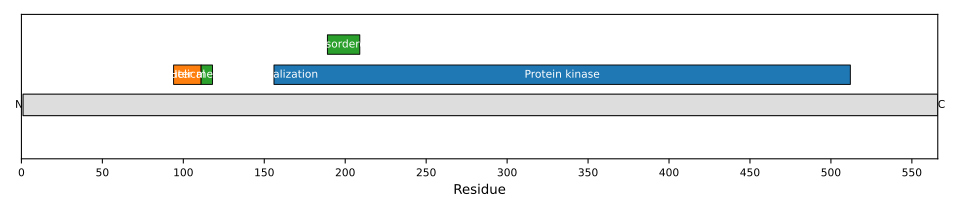
1: Serine/threonine-protein kinase which acts as a sensor of mitochondrial damage and protects against mitochondrial dysfunction during cellular stress. It phosphorylates mitochondrial proteins to coordinate mitochondrial quality control mechanisms that remove and replace dysfunctional mitochondrial components (PubMed:14607334, PubMed:15087508, PubMed:18443288, PubMed:18957282, PubMed:19229105, PubMed:19966284, PubMed:20404107, PubMed:20547144, PubMed:20798600, PubMed:22396657, PubMed:23620051, PubMed:23754282, PubMed:23933751, PubMed:24660806, PubMed:24751536, PubMed:24784582, PubMed:24896179, PubMed:24898855, PubMed:25527291, PubMed:32484300). Depending on the severity of mitochondrial damage, activity ranges from preventing apoptosis and stimulating mitochondrial biogenesis to eliminating severely damaged mitochondria via PINK1-PRKN-dependent mitophagy (PubMed:14607334, PubMed:15087508, PubMed:18443288, PubMed:19966284, PubMed:20404107, PubMed:20798600, PubMed:22396657, PubMed:23620051, PubMed:23933751, PubMed:24898855, PubMed:32047033, PubMed:32484300). When cellular stress results in irreversible mitochondrial damage, PINK1 accumulates at the outer mitochondrial membrane (OMM) where it phosphorylates pre-existing polyubiquitin chains at 'Ser-65', recruits PRKN from the cytosol to the OMM and activates PRKN by phosphorylation at 'Ser-65'; activated PRKN then ubiquinates VDAC1 and other OMM proteins to initiate mitophagy (PubMed:14607334, PubMed:15087508, PubMed:19966284, PubMed:20404107, PubMed:20798600, PubMed:23754282, PubMed:23933751, PubMed:24660806, PubMed:24751536, PubMed:24784582, PubMed:25474007, PubMed:25527291, PubMed:32047033). The PINK1-PRKN pathway also promotes fission of damaged mitochondria through phosphorylation and PRKN-dependent degradation of mitochondrial proteins involved in fission such as MFN2 (PubMed:18443288, PubMed:23620051, PubMed:24898855). This prevents the refusion of unhealthy mitochondria with the mitochondrial network or initiates mitochondrial fragmentation facilitating their later engulfment by autophagosomes (PubMed:18443288, PubMed:23620051). Also promotes mitochondrial fission independently of PRKN and ATG7-mediated mitophagy, via the phosphorylation and activation of DNM1L (PubMed:18443288, PubMed:32484300). Regulates motility of damaged mitochondria by promoting the ubiquitination and subsequent degradation of MIRO1 and MIRO2; in motor neurons, this likely inhibits mitochondrial intracellular anterograde transport along the axons which probably increases the chance of the mitochondria undergoing mitophagy in the soma (PubMed:22396657). Required for ubiquinone reduction by mitochondrial complex I by mediating phosphorylation of complex I subunit NDUFA10 (By similarity). Phosphorylates LETM1, positively regulating its mitochondrial calcium transport activity (PubMed:29123128)