Solute carrier family 26 member 6 (Anion exchange transporter) (Pendrin-like protein 1) (Pendrin-L1)
1_MGLAD 6_ ASGPR 11_ DTQAL 16_ LSATQ 21_ AMDLR 26_ RRDYH 31_ MERPL 36_ LNQEH 41_ LEELG 46_ RWGSA 51_ PRTHQ 56_ WRTWL 61_ QCSRA 66_ RAYAL 71_ LLQHL 76_ PVLVW 81_ LPRYP 86_ VRDWL 91_ LGDLL 96_ SGLSV 101_ AIMQL 106_ PQGLA 111_ YALLA 116_ GLPPV 121_ FGLYS 126_ SFYPV 131_ FIYFL 136_ FGTSR 141_ HISVG 146_ TFAVM 151_ SVMVG 156_ SVTES 161_ LAPQA 166_ LNDSM 171_ INETA 176_ RDAAR 181_ VQVAS 186_ TLSVL 191_ VGLFQ 196_ VGLGL 201_ IHFGF 206_ VVTYL 211_ SEPLV 216_ RGYTT 221_ AAAVQ 226_ VFVSQ 231_ LKYVF 236_ GLHLS 241_ SHSGP 246_ LSLIY 251_ TVLEV 256_ CWKLP 261_ QSKVG 266_ TVVTA 271_ AVAGV 276_ VLVVV 281_ KLLND 286_ KLQQQ 291_ LPMPI 296_ PGELL 301_ TLIGA 306_ TGISY 311_ GMGLK 316_ HRFEV 321_ DVVGN 326_ IPAGL 331_ VPPVA 336_ PNTQL 341_ FSKLV 346_ GSAFT 351_ IAVVG 356_ FAIAI 361_ SLGKI 366_ FALRH 371_ GYRVD 376_ SNQEL 381_ VALGL 386_ SNLIG 391_ GIFQC 396_ FPVSC 401_ SMSRS 406_ LVQES 411_ TGGNS 416_ QVAGA 421_ ISSLF 426_ ILLII 431_ VKLGE 436_ LFHDL 441_ PKAVL 446_ AAIII 451_ VNLKG 456_ MLRQL 461_ SDMRS 466_ LWKAN 471_ RADLL 476_ IWLVT 481_ FTATI 486_ LLNLD 491_ LGLVV 496_ AVIFS 501_ LLLVV 506_ VRTQM 511_ PHYSV 516_ LGQVP 521_ DTDIY 526_ RDVAE 531_ YSEAK 536_ EVRGV 541_ KVFRS 546_ SATVY 551_ FANAE 556_ FYSDA 561_ LKQRC 566_ GVDVD 571_ FLISQ 576_ KKKLL 581_ KKQEQ 586_ LKLKQ 591_ LQKEE 596_ KLRKQ 601_ AASPK 606_ GASVS 611_ INVNT 616_ SLEDM 621_ RSNNV 626_ EDCKM 631_ MQVSS 636_ GDKME 641_ DATAN 646_ GQEDS 651_ KAPDG 656_ STLKA 661_ LGLPQ 666_ PDFHS 671_ LILDL 676_ GALSF 681_ VDTVC 686_ LKSLK 691_ NIFHD 696_ FREIE 701_ VEVYM 706_ AACHS 711_ PVVSQ 716_ LEAGH 721_ FFDAS 726_ ITKKH 731_ LFASV 736_ HDAVT 741_ FALQH 746_ PRPVP 751_DSPVS
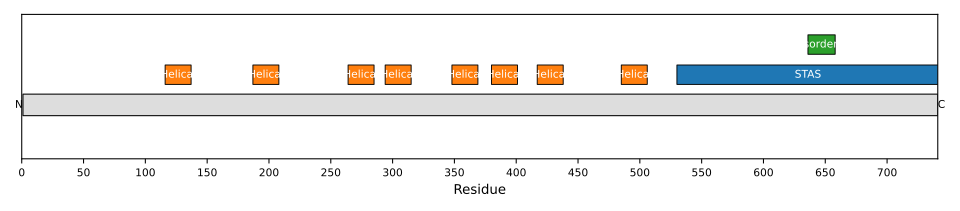
1: Apical membrane anion-exchanger with wide epithelial distribution that plays a role as a component of the pH buffering system for maintaining acid-base homeostasis. Acts as a versatile DIDS-sensitive inorganic and organic anion transporter that mediates the uptake of monovalent anions like chloride, bicarbonate, formate and hydroxyl ion and divalent anions like sulfate and oxalate. Functions in multiple exchange modes involving pairs of these anions, which include chloride-bicarbonate, chloride-oxalate, oxalate-formate, oxalate-sulfate and chloride-formate exchange. Apical membrane chloride-bicarbonate exchanger that mediates luminal chloride absorption and bicarbonate secretion by the small intestinal brush border membrane and contributes to intracellular pH regulation in the duodenal upper villous epithelium during proton-coupled peptide absorption, possibly by providing a bicarbonate import pathway. Also mediates intestinal chloride absorption and oxalate secretion, thereby preventing hyperoxaluria and calcium oxalate urolithiasis. Transepithelial oxalate secretion, chloride-formate, chloride-oxalate and chloride-bicarbonate transport activities in the duodenum are inhibited by PKC activation in a calcium-independent manner. The apical membrane chloride-bicarbonate exchanger also provides a major route for fluid and bicarbonate secretion into the proximal tubules of the kidney as well as into the proximal part of the interlobular pancreatic ductal tree, where it mediates electrogenic chloride-bicarbonate exchange with a chloride-bicarbonate stoichiometry of 1:2, and hence will dilute and alkalinize protein-rich acinar secretion. Also mediates the transcellular sulfate absorption and oxalate secretion across the apical membrane in the duodenum and the formate ion efflux at the apical brush border of cells in the proximal tubules of kidney. Plays a role in sperm capacitation by increasing intracellular pH
2: Apical membrane chloride-bicarbonate exchanger. Its association with carbonic anhydrase CA2 forms a bicarbonate transport metabolon; hence maximizes the local concentration of bicarbonate at the transporter site