R-spondin-3 (Protein with TSP type-1 repeat) (hPWTSR) (Roof plate-specific spondin-3) (hRspo3) (Thrombospondin type-1 domain-containing protein 2)
1_MHLRL 6_ ISWLF 11_ IILNF 16_ MEYIG 21_ SQNAS 26_ RGRRQ 31_ RRMHP 36_ NVSQG 41_ CQGGC 46_ ATCSD 51_ YNGCL 56_ SCKPR 61_ LFFAL 66_ ERIGM 71_ KQIGV 76_ CLSSC 81_ PSGYY 86_ GTRYP 91_ DINKC 96_ TKCKA 101_ DCDTC 106_ FNKNF 111_ CTKCK 116_ SGFYL 121_ HLGKC 126_ LDNCP 131_ EGLEA 136_ NNHTM 141_ ECVSI 146_ VHCEV 151_ SEWNP 156_ WSPCT 161_ KKGKT 166_ CGFKR 171_ GTETR 176_ VREII 181_ QHPSA 186_ KGNLC 191_ PPTNE 196_ TRKCT 201_ VQRKK 206_ CQKGE 211_ RGKKG 216_ RERKR 221_ KKPNK 226_ GESKE 231_ AIPDS 236_ KSLES 241_ SKEIP 246_ EQREN 251_ KQQQK 256_ KRKVQ 261_ DKQKS 266_VSVST
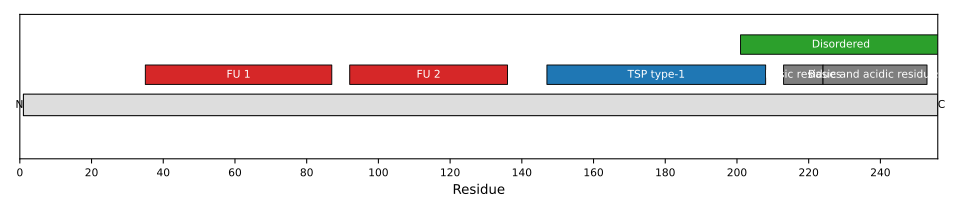
1: Activator of the canonical Wnt signaling pathway by acting as a ligand for LGR4-6 receptors, which acts as a key regulator of angiogenesis. Upon binding to LGR4-6 (LGR4, LGR5 or LGR6), LGR4-6 associate with phosphorylated LRP6 and frizzled receptors that are activated by extracellular Wnt receptors, triggering the canonical Wnt signaling pathway to increase expression of target genes. Also regulates the canonical Wnt/beta-catenin-dependent pathway and non-canonical Wnt signaling by acting as an inhibitor of ZNRF3, an important regulator of the Wnt signaling pathway. Acts as a ligand for frizzled FZD8 and LRP6. May negatively regulate the TGF-beta pathway (PubMed:21727895, PubMed:21909076, PubMed:22615920). Acts as a key regulator of angiogenesis by controlling vascular stability and pruning: acts by activating the non-canonical Wnt signaling pathway in endothelial cells (By similarity) (PubMed:21727895, PubMed:21909076, PubMed:22615920). Can also amplify Wnt signaling pathway independently of LGR4-6 receptors, possibly by acting as a direct antagonistic ligand to RNF43 and ZNRF3 (PubMed:29769720)