Charged multivesicular body protein 4a (Chromatin-modifying protein 4a) (CHMP4a) (SNF7 homolog associated with Alix-2) (SNF7-1) (hSnf-1) (Vacuolar protein sorting-associated protein 32-1) (Vps32-1) (hVps32-1)
1_MSGLG 6_ RLFGK 11_ GKKEK 16_ GPTPE 21_ EAIQK 26_ LKETE 31_ KILIK 36_ KQEFL 41_ EQKIQ 46_ QELQT 51_ AKKYG 56_ TKNKR 61_ AALQA 66_ LRRKK 71_ RFEQQ 76_ LAQTD 81_ GTLST 86_ LEFQR 91_ EAIEN 96_ ATTNA 101_ EVLRT 106_ MELAA 111_ QSMKK 116_ AYQDM 121_ DIDKV 126_ DELMT 131_ DITEQ 136_ QEVAQ 141_ QISDA 146_ ISRPM 151_ GFGDD 156_ VDEDE 161_ LLEEL 166_ EELEQ 171_ EELAQ 176_ ELLNV 181_ GDKEE 186_ EPSVK 191_ LPSVP 196_ STHLP 201_ AGPAP 206_ KVDED 211_ EEALK 216_QLAEW
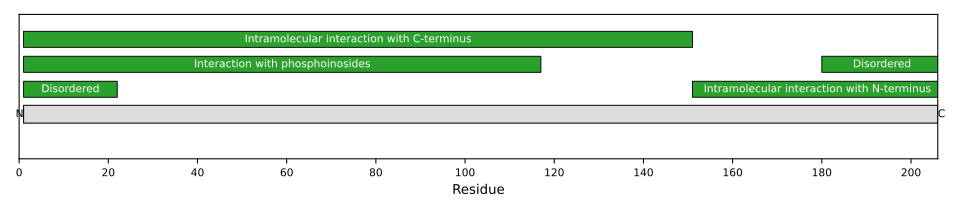
1: Probable core component of the endosomal sorting required for transport complex III (ESCRT-III) which is involved in multivesicular bodies (MVBs) formation and sorting of endosomal cargo proteins into MVBs. MVBs contain intraluminal vesicles (ILVs) that are generated by invagination and scission from the limiting membrane of the endosome and mostly are delivered to lysosomes enabling degradation of membrane proteins, such as stimulated growth factor receptors, lysosomal enzymes and lipids. The MVB pathway appears to require the sequential function of ESCRT-O, -I,-II and -III complexes. ESCRT-III proteins mostly dissociate from the invaginating membrane before the ILV is released. The ESCRT machinery also functions in topologically equivalent membrane fission events, such as the terminal stages of cytokinesis and the budding of enveloped viruses (HIV-1 and other lentiviruses). ESCRT-III proteins are believed to mediate the necessary vesicle extrusion and/or membrane fission activities, possibly in conjunction with the AAA ATPase VPS4. When overexpressed, membrane-assembled circular arrays of CHMP4A filaments can promote or stabilize negative curvature and outward budding. Via its interaction with PDCD6IP involved in HIV-1 p6- and p9-dependent virus release. CHMP4A/B/C are required for the exosomal release of SDCBP, CD63 and syndecan (PubMed:22660413)