RanBP-type and C3HC4-type zinc finger-containing protein 1 (EC 2.3.2.31) (HBV-associated factor 4) (Heme-oxidized IRP2 ubiquitin ligase 1) (HOIL-1) (Hepatitis B virus X-associated protein 4) (RING finger protein 54) (RING-type E3 ubiquitin transferase HOIL-1) (Ubiquitin-conjugating enzyme 7-interacting protein 3)
1_MDEKT 6_ KKAEE 11_ MALSL 16_ TRAVA 21_ GGDEQ 26_ VAMKC 31_ AIWLA 36_ EQRVP 41_ LSVQL 46_ KPEVS 51_ PTQDI 56_ RLWVS 61_ VEDAQ 66_ MHTVT 71_ IWLTV 76_ RPDMT 81_ VASLK 86_ DMVFL 91_ DYGFP 96_ PVLQQ 101_ WVIGQ 106_ RLARD 111_ QETLH 116_ SHGVR 121_ QNGDS 126_ AYLYL 131_ LSARN 136_ TSLNP 141_ QELQR 146_ ERQLR 151_ MLEDL 156_ GFKDL 161_ TLQPR 166_ GPLEP 171_ GPPKP 176_ GVPQE 181_ PGRGQ 186_ PDAVP 191_ EPPPV 196_ GWQCP 201_ GCTFI 206_ NKPTR 211_ PGCEM 216_ CCRAR 221_ PEAYQ 226_ VPASY 231_ QPDEE 236_ ERARL 241_ AGEEE 246_ ALRQY 251_ QQRKQ 256_ QQQEG 261_ NYLQH 266_ VQLDQ 271_ RSLVL 276_ NTEPA 281_ ECPVC 286_ YSVLA 291_ PGEAV 296_ VLREC 301_ LHTFC 306_ RECLQ 311_ GTIRN 316_ SQEAE 321_ VSCPF 326_ IDNTY 331_ SCSGK 336_ LLERE 341_ IKALL 346_ TPEDY 351_ QRFLD 356_ LGISI 361_ AENRS 366_ AFSYH 371_ CKTPD 376_ CKGWC 381_ FFEDD 386_ VNEFT 391_ CPVCF 396_ HVNCL 401_ LCKAI 406_ HEQMN 411_ CKEYQ 416_ EDLAL 421_ RAQND 426_ VAARQ 431_ TTEML 436_ KVMLQ 441_ QGEAM 446_ RCPQC 451_ QIVVQ 456_ KKDGC 461_ DWIRC 466_ TVCHT 471_ EICWV 476_ TKGPR 481_ WGPGG 486_ PGDTS 491_ GGCRC 496_ RVNGI 501_PCHPS
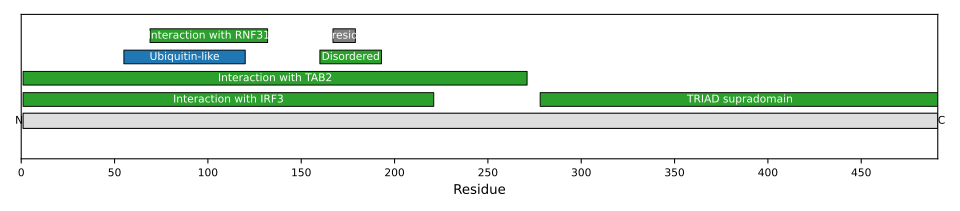
1: E3 ubiquitin-protein ligase, which accepts ubiquitin from specific E2 ubiquitin-conjugating enzymes, such as UBE2L3/UBCM4, and then transfers it to substrates (PubMed:12629548, PubMed:17449468, PubMed:18711448). Functions as an E3 ligase for oxidized IREB2 and both heme and oxygen are necessary for IREB2 ubiquitination (PubMed:12629548). Promotes ubiquitination of TAB2 and IRF3 and their degradation by the proteasome (PubMed:17449468, PubMed:18711448). Component of the LUBAC complex which conjugates linear ('Met-1'-linked) polyubiquitin chains to substrates and plays a key role in NF-kappa-B activation and regulation of inflammation (PubMed:17006537, PubMed:19136968, PubMed:21455173, PubMed:21455180, PubMed:21455181). LUBAC conjugates linear polyubiquitin to IKBKG and RIPK1 and is involved in activation of the canonical NF-kappa-B and the JNK signaling pathways (PubMed:17006537, PubMed:19136968, PubMed:21455173, PubMed:21455180, PubMed:21455181). Linear ubiquitination mediated by the LUBAC complex interferes with TNF-induced cell death and thereby prevents inflammation (PubMed:17006537, PubMed:21455173, PubMed:21455180, PubMed:21455181). LUBAC is recruited to the TNF-R1 signaling complex (TNF-RSC) following polyubiquitination of TNF-RSC components by BIRC2 and/or BIRC3 and to conjugate linear polyubiquitin to IKBKG and possibly other components contributing to the stability of the complex (PubMed:17006537, PubMed:19136968, PubMed:21455173, PubMed:21455180, PubMed:21455181). The LUBAC complex is also involved in innate immunity by conjugating linear polyubiquitin chains at the surface of bacteria invading the cytosol to form the ubiquitin coat surrounding bacteria (PubMed:28481331). LUBAC is not able to initiate formation of the bacterial ubiquitin coat, and can only promote formation of linear polyubiquitins on pre-existing ubiquitin (PubMed:28481331). The bacterial ubiquitin coat acts as an 'eat-me' signal for xenophagy and promotes NF-kappa-B activation (PubMed:28481331). Together with OTULIN, the LUBAC complex regulates the canonical Wnt signaling during angiogenesis (PubMed:23708998). Binds polyubiquitin of different linkage types (PubMed:20005846, PubMed:21455181)