NACHT, LRR and PYD domains-containing protein 1 (EC 3.4.-.-) (EC 3.6.4.-) (Caspase recruitment domain-containing protein 7) (Death effector filament-forming ced-4-like apoptosis protein) (Nucleotide-binding domain and caspase recruitment domain) [Cleaved into: NACHT, LRR and PYD domains-containing protein 1, C-terminus (NLRP1-CT); NACHT, LRR and PYD domains-containing protein 1, N-terminus (NLRP1-NT)]
1_MAGGA 6_ WGRLA 11_ CYLEF 16_ LKKEE 21_ LKEFQ 26_ LLLAN 31_ KAHSR 36_ SSSGE 41_ TPAQP 46_ EKTSG 51_ MEVAS 56_ YLVAQ 61_ YGEQR 66_ AWDLA 71_ LHTWE 76_ QMGLR 81_ SLCAQ 86_ AQEGA 91_ GHSPS 96_ FPYSP 101_ SEPHL 106_ GSPSQ 111_ PTSTA 116_ VLMPW 121_ IHELP 126_ AGCTQ 131_ GSERR 136_ VLRQL 141_ PDTSG 146_ RRWRE 151_ ISASL 156_ LYQAL 161_ PSSPD 166_ HESPS 171_ QESPN 176_ APTST 181_ AVLGS 186_ WGSPP 191_ QPSLA 196_ PREQE 201_ APGTQ 206_ WPLDE 211_ TSGIY 216_ YTEIR 221_ ERERE 226_ KSEKG 231_ RPPWA 236_ AVVGT 241_ PPQAH 246_ TSLQP 251_ HHHPW 256_ EPSVR 261_ ESLCS 266_ TWPWK 271_ NEDFN 276_ QKFTQ 281_ LLLLQ 286_ RPHPR 291_ SQDPL 296_ VKRSW 301_ PDYVE 306_ ENRGH 311_ LIEIR 316_ DLFGP 321_ GLDTQ 326_ EPRIV 331_ ILQGA 336_ AGIGK 341_ STLAR 346_ QVKEA 351_ WGRGQ 356_ LYGDR 361_ FQHVF 366_ YFSCR 371_ ELAQS 376_ KVVSL 381_ AELIG 386_ KDGTA 391_ TPAPI 396_ RQILS 401_ RPERL 406_ LFILD 411_ GVDEP 416_ GWVLQ 421_ EPSSE 426_ LCLHW 431_ SQPQP 436_ ADALL 441_ GSLLG 446_ KTILP 451_ EASFL 456_ ITART 461_ TALQN 466_ LIPSL 471_ EQARW 476_ VEVLG 481_ FSESS 486_ RKEYF 491_ YRYFT 496_ DERQA 501_ IRAFR 506_ LVKSN 511_ KELWA 516_ LCLVP 521_ WVSWL 526_ ACTCL 531_ MQQMK 536_ RKEKL 541_ TLTSK 546_ TTTTL 551_ CLHYL 556_ AQALQ 561_ AQPLG 566_ PQLRD 571_ LCSLA 576_ AEGIW 581_ QKKTL 586_ FSPDD 591_ LRKHG 596_ LDGAI 601_ ISTFL 606_ KMGIL 611_ QEHPI 616_ PLSYS 621_ FIHLC 626_ FQEFF 631_ AAMSY 636_ VLEDE 641_ KGRGK 646_ HSNCI 651_ IDLEK 656_ TLEAY 661_ GIHGL 666_ FGAST 671_ TRFLL 676_ GLLSD 681_ EGERE 686_ MENIF 691_ HCRLS 696_ QGRNL 701_ MQWVP 706_ SLQLL 711_ LQPHS 716_ LESLH 721_ CLYET 726_ RNKTF 731_ LTQVM 736_ AHFEE 741_ MGMCV 746_ ETDME 751_ LLVCT 756_ FCIKF 761_ SRHVK 766_ KLQLI 771_ EGRQH 776_ RSTWS 781_ PTMVV 786_ LFRWV 791_ PVTDA 796_ YWQIL 801_ FSVLK 806_ VTRNL 811_ KELDL 816_ SGNSL 821_ SHSAV 826_ KSLCK 831_ TLRRP 836_ RCLLE 841_ TLRLA 846_ GCGLT 851_ AEDCK 856_ DLAFG 861_ LRANQ 866_ TLTEL 871_ DLSFN 876_ VLTDA 881_ GAKHL 886_ CQRLR 891_ QPSCK 896_ LQRLQ 901_ LVSCG 906_ LTSDC 911_ CQDLA 916_ SVLSA 921_ SPSLK 926_ ELDLQ 931_ QNNLD 936_ DVGVR 941_ LLCEG 946_ LRHPA 951_ CKLIR 956_ LGLDQ 961_ TTLSD 966_ EMRQE 971_ LRALE 976_ QEKPQ 981_ LLIFS 986_ RRKPS 991_ VMTPT 996_ EGLDT 1001_ GEMSN 1006_ STSSL 1011_ KRQRL 1016_ GSERA 1021_ ASHVA 1026_ QANLK 1031_ LLDVS 1036_ KIFPI 1041_ AEIAE 1046_ ESSPE 1051_ VVPVE 1056_ LLCVP 1061_ SPASQ 1066_ GDLHT 1071_ KPLGT 1076_ DDDFW 1081_ GPTGP 1086_ VATEV 1091_ VDKEK 1096_ NLYRV 1101_ HFPVA 1106_ GSYRW 1111_ PNTGL 1116_ CFVMR 1121_ EAVTV 1126_ EIEFC 1131_ VWDQF 1136_ LGEIN 1141_ PQHSW 1146_ MVAGP 1151_ LLDIK 1156_ AEPGA 1161_ VEAVH 1166_ LPHFV 1171_ ALQGG 1176_ HVDTS 1181_ LFQMA 1186_ HFKEE 1191_ GMLLE 1196_ KPARV 1201_ ELHHI 1206_ VLENP 1211_ SFSPL 1216_ GVLLK 1221_ MIHNA 1226_ LRFIP 1231_ VTSVV 1236_ LLYHR 1241_ VHPEE 1246_ VTFHL 1251_ YLIPS 1256_ DCSIR 1261_ KAIDD 1266_ LEMKF 1271_ QFVRI 1276_ HKPPP 1281_ LTPLY 1286_ MGCRY 1291_ TVSGS 1296_ GSGML 1301_ EILPK 1306_ ELELC 1311_ YRSPG 1316_ EDQLF 1321_ SEFYV 1326_ GHLGS 1331_ GIRLQ 1336_ VKDKK 1341_ DETLV 1346_ WEALV 1351_ KPGDL 1356_ MPATT 1361_ LIPPA 1366_ RIAVP 1371_ SPLDA 1376_ PQLLH 1381_ FVDQY 1386_ REQLI 1391_ ARVTS 1396_ VEVVL 1401_ DKLHG 1406_ QVLSQ 1411_ EQYER 1416_ VLAEN 1421_ TRPSQ 1426_ MRKLF 1431_ SLSQS 1436_ WDRKC 1441_ KDGLY 1446_ QALKE 1451_ THPHL 1456_ IMELW 1461_ EKGSK 1466_KGLLP
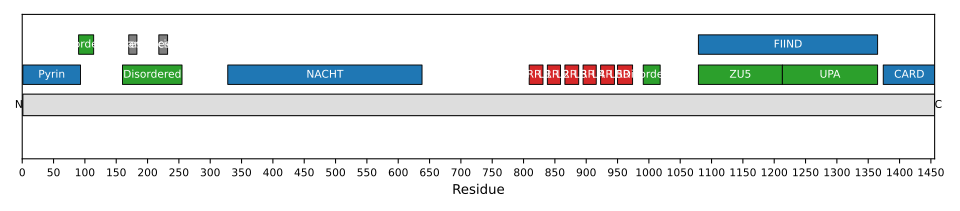
1: Acts as the sensor component of the NLRP1 inflammasome, which mediates inflammasome activation in response to various pathogen-associated signals, leading to subsequent pyroptosis (PubMed:12191486, PubMed:17349957, PubMed:22665479, PubMed:27662089, PubMed:31484767, PubMed:33093214, PubMed:33410748, PubMed:33731929, PubMed:33731932, PubMed:35857590). Inflammasomes are supramolecular complexes that assemble in the cytosol in response to pathogens and other damage-associated signals and play critical roles in innate immunity and inflammation (PubMed:12191486, PubMed:17349957, PubMed:22665479). Acts as a recognition receptor (PRR): recognizes specific pathogens and other damage-associated signals, such as cleavage by some human enteroviruses and rhinoviruses, double-stranded RNA, UV-B irradiation, or Val-boroPro inhibitor, and mediates the formation of the inflammasome polymeric complex composed of NLRP1, CASP1 and PYCARD/ASC (PubMed:12191486, PubMed:17349957, PubMed:22665479, PubMed:25562666, PubMed:30096351, PubMed:30291141, PubMed:33093214, PubMed:33243852, PubMed:33410748, PubMed:35857590). In response to pathogen-associated signals, the N-terminal part of NLRP1 is degraded by the proteasome, releasing the cleaved C-terminal part of the protein (NACHT, LRR and PYD domains-containing protein 1, C-terminus), which polymerizes and associates with PYCARD/ASC to initiate the formation of the inflammasome complex: the NLRP1 inflammasome recruits pro-caspase-1 (proCASP1) and promotes caspase-1 (CASP1) activation, which subsequently cleaves and activates inflammatory cytokines IL1B and IL18 and gasdermin-D (GSDMD), leading to pyroptosis (PubMed:12191486, PubMed:17349957, PubMed:22665479, PubMed:32051255, PubMed:33093214). In the absence of GSDMD expression, the NLRP1 inflammasome is able to recruit and activate CASP8, leading to activation of gasdermin-E (GSDME) (PubMed:33852854, PubMed:35594856). Activation of NLRP1 inflammasome is also required for HMGB1 secretion; the active cytokines and HMGB1 stimulate inflammatory responses (PubMed:22801494). Binds ATP and shows ATPase activity (PubMed:11113115, PubMed:15212762, PubMed:33243852). Plays an important role in antiviral immunity and inflammation in the human airway epithelium (PubMed:33093214). Specifically recognizes a number of pathogen-associated signals: upon infection by human rhinoviruses 14 and 16 (HRV-14 and HRV-16), NLRP1 is cleaved and activated which triggers NLRP1-dependent inflammasome activation and IL18 secretion (PubMed:33093214). Positive-strand RNA viruses, such as Semliki forest virus and long dsRNA activate the NLRP1 inflammasome, triggering IL1B release in a NLRP1-dependent fashion (PubMed:33243852). Acts as a direct sensor for long dsRNA and thus RNA virus infection (PubMed:33243852). May also be activated by muramyl dipeptide (MDP), a fragment of bacterial peptidoglycan, in a NOD2-dependent manner (PubMed:18511561). The NLRP1 inflammasome is also activated in response to UV-B irradiation causing ribosome collisions: ribosome collisions cause phosphorylation and activation of NLRP1 in a MAP3K20-dependent manner, leading to pyroptosis (PubMed:35857590)
2: Constitutes the precursor of the NLRP1 inflammasome, which mediates autoproteolytic processing within the FIIND domain to generate the N-terminal and C-terminal parts, which are associated non-covalently in absence of pathogens and other damage-associated signals
3: Regulatory part that prevents formation of the NLRP1 inflammasome: in absence of pathogens and other damage-associated signals, interacts with the C-terminal part of NLRP1 (NACHT, LRR and PYD domains-containing protein 1, C-terminus), preventing activation of the NLRP1 inflammasome (PubMed:33093214). In response to pathogen-associated signals, this part is ubiquitinated and degraded by the proteasome, releasing the cleaved C-terminal part of the protein, which polymerizes and forms the NLRP1 inflammasome (PubMed:33093214)
4: Constitutes the active part of the NLRP1 inflammasome (PubMed:33093214, PubMed:33731929, PubMed:33731932). In absence of pathogens and other damage-associated signals, interacts with the N-terminal part of NLRP1 (NACHT, LRR and PYD domains-containing protein 1, N-terminus), preventing activation of the NLRP1 inflammasome (PubMed:33093214). In response to pathogen-associated signals, the N-terminal part of NLRP1 is degraded by the proteasome, releasing this form, which polymerizes and associates with PYCARD/ASC to form of the NLRP1 inflammasome complex: the NLRP1 inflammasome complex then directly recruits pro-caspase-1 (proCASP1) and promotes caspase-1 (CASP1) activation, leading to gasdermin-D (GSDMD) cleavage and subsequent pyroptosis (PubMed:33093214)
5: It is unclear whether is involved in inflammasome formation. It is not cleaved within the FIIND domain, does not assemble into specks, nor promote IL1B release (PubMed:22665479). However, in an vitro cell-free system, it has been shown to be activated by MDP (PubMed:17349957)