Activating molecule in BECN1-regulated autophagy protein 1 (DDB1- and CUL4-associated factor 3)
1_MKVVP 6_ EKNAV 11_ RILWG 16_ RERGA 21_ RAMGA 26_ QRLLQ 31_ ELVED 36_ KTRWM 41_ KWEGK 46_ RVELP 51_ DSPRS 56_ TFLLA 61_ FSPDR 66_ TLLAS 71_ THVNH 76_ NIYIT 81_ EVKTG 86_ KCVHS 91_ LIGHR 96_ RTPWC 101_ VTFHP 106_ TISGL 111_ IASGC 116_ LDGEV 121_ RIWDL 126_ HGGSE 131_ SWFTD 136_ SNNAI 141_ ASLAF 146_ HPTAQ 151_ LLLIA 156_ TANEI 161_ HFWDW 166_ SRREP 171_ FAVVK 176_ TASEM 181_ ERVRL 186_ VRFDP 191_ LGHYL 196_ LTAIV 201_ NPSNQ 206_ QGDDE 211_ PEIPI 216_ DGTEL 221_ SHYRQ 226_ RALLQ 231_ SQPVR 236_ RTPLL 241_ HNFLH 246_ MLSSR 251_ SSGIQ 256_ VGEQS 261_ TVQDS 266_ ATPSP 271_ PPPPP 276_ QPSTE 281_ RPRTS 286_ AYIRL 291_ RQRVS 296_ YPTAE 301_ CCQHL 306_ GILCL 311_ CSRCS 316_ GTRVP 321_ SLLPH 326_ QDSVP 331_ PASAR 336_ ATTPS 341_ FSFVQ 346_ TEPFH 351_ PPEQA 356_ SSTQQ 361_ DQGLL 366_ NRPSA 371_ FSTVQ 376_ SSTAG 381_ NTLRN 386_ LSLGP 391_ TRRSL 396_ GGPLS 401_ SHPSR 406_ YHREI 411_ APGLT 416_ GSEWT 421_ RTVLS 426_ LNSRS 431_ EAESM 436_ PPPRT 441_ SASSV 446_ SLLSV 451_ LRQQE 456_ GGSQA 461_ SVYTS 466_ ATEGR 471_ GFPAS 476_ GLATE 481_ SDGGN 486_ GSSQN 491_ NSGSI 496_ RHELQ 501_ CDLRR 506_ FFLEY 511_ DRLQE 516_ LDQSL 521_ SGEAP 526_ QTQQA 531_ QEMLN 536_ NNIES 541_ ERPGP 546_ SHQPT 551_ PHSSE 556_ NNSNL 561_ SRGHL 566_ NRCRA 571_ CHNLL 576_ TFNND 581_ TLRWE 586_ RTTPN 591_ YSSGE 596_ ASSSW 601_ QVPSS 606_ FESVP 611_ SSGSQ 616_ LPPLE 621_ RTEGQ 626_ TPSSS 631_ RLELS 636_ SSASP 641_ QEERT 646_ VGVAF 651_ NQETG 656_ HWERI 661_ YTQSS 666_ RSGTV 671_ SQEAL 676_ HQDMP 681_ EESSE 686_ EDSLR 691_ RRLLE 696_ SSLIS 701_ LSRYD 706_ GAGSR 711_ EHPIY 716_ PDPAR 721_ LSPAA 726_ YYAQR 731_ MIQYL 736_ SRRDS 741_ IRQRS 746_ MRYQQ 751_ NRLRS 756_ STSSS 761_ SSDNQ 766_ GPSVE 771_ GTDLE 776_ FEDFE 781_ DNGDR 786_ SRHRA 791_ PRNAR 796_ MSAPS 801_ LGRFV 806_ PRRFL 811_ LPEYL 816_ PYAGI 821_ FHERG 826_ QPGLA 831_ THSSV 836_ NRVLA 841_ GAVIG 846_ DGQSA 851_ VASNI 856_ ANTTY 861_ RLQWW 866_ DFTKF 871_ DLPEI 876_ SNASV 881_ NVLVQ 886_ NCKIY 891_ NDASC 896_ DISAD 901_ GQLLA 906_ AFIPS 911_ SQRGF 916_ PDEGI 921_ LAVYS 926_ LAPHN 931_ LGEML 936_ YTKRF 941_ GPNAI 946_ SVSLS 951_ PMGRY 956_ VMVGL 961_ ASRRI 966_ LLHPS 971_ TEHMV 976_ AQVFR 981_ LQQAH 986_ GGETS 991_ MRRVF 996_ NVLYP 1001_ MPADQ 1006_ RRHVS 1011_ INSAR 1016_ WLPEP 1021_ GLGLA 1026_ YGTNK 1031_ GDLVI 1036_ CRPEA 1041_ LNSGV 1046_ EYYWD 1051_ QLNET 1056_ VFTVH 1061_ SNSRS 1066_ SERPG 1071_ TSRAT 1076_ WRTDR 1081_ DMGLM 1086_ NAIGL 1091_ QPRNP 1096_ ATSVT 1101_ SQGTQ 1106_ TLALQ 1111_ LQNAE 1116_ TQTER 1121_ EVPEP 1126_ GTAAS 1131_ GPGEG 1136_ EGSEY 1141_ GASGE 1146_ DALSR 1151_ IQRLM 1156_ AEGGM 1161_ TAVVQ 1166_ REQST 1171_ TMASM 1176_ GGFGN 1181_ NIIVS 1186_ HRIHR 1191_ SSQTG 1196_ TEPGA 1201_ AHTSS 1206_ PQPST 1211_ SRGLL 1216_ PEAGQ 1221_ LAERG 1226_ LSPRT 1231_ ASWDQ 1236_ PGTPG 1241_ REPTQ 1246_ PTLPS 1251_ SSPVP 1256_ IPVSL 1261_ PSAEG 1266_ PTLHC 1271_ ELTNN 1276_ NHLLD 1281_ GGSSR 1286_ GDAAG 1291_PRGEP
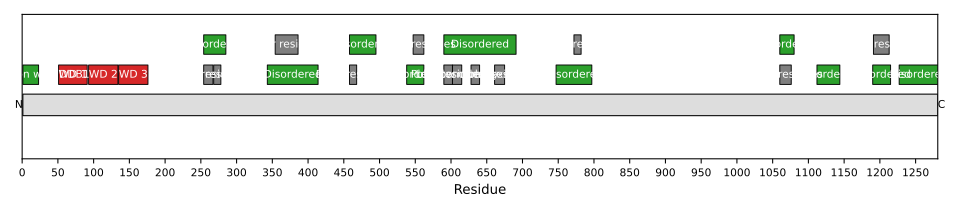
1: Substrate-recognition component of a DCX (DDB1-CUL4-X-box) E3 ubiquitin-protein ligase complex involved in cell cycle control and autophagy (PubMed:20921139, PubMed:23524951, PubMed:24587252, PubMed:32333458, PubMed:33854232, PubMed:33854235, PubMed:33854239). The DCX(AMBRA1) complex specifically mediates the polyubiquitination of target proteins such as BECN1, CCND1, CCND2, CCND3, ELOC and ULK1 (PubMed:23524951, PubMed:33854232, PubMed:33854235, PubMed:33854239). Acts as an upstream master regulator of the transition from G1 to S cell phase: AMBRA1 specifically recognizes and binds phosphorylated cyclin-D (CCND1, CCND2 and CCND3), leading to cyclin-D ubiquitination by the DCX(AMBRA1) complex and subsequent degradation (PubMed:33854232, PubMed:33854235, PubMed:33854239). By controlling the transition from G1 to S phase and cyclin-D degradation, AMBRA1 acts as a tumor suppressor that promotes genomic integrity during DNA replication and counteracts developmental abnormalities and tumor growth (PubMed:33854232, PubMed:33854235, PubMed:33854239). AMBRA1 also regulates the cell cycle by promoting MYC dephosphorylation and degradation independently of the DCX(AMBRA1) complex: acts via interaction with the catalytic subunit of protein phosphatase 2A (PPP2CA), which enhances interaction between PPP2CA and MYC, leading to MYC dephosphorylation and degradation (PubMed:25438055, PubMed:25803737). Acts as a regulator of Cul5-RING (CRL5) E3 ubiquitin-protein ligase complexes by mediating ubiquitination and degradation of Elongin-C (ELOC) component of CRL5 complexes (PubMed:25499913, PubMed:30166453). Acts as a key regulator of autophagy by modulating the BECN1-PIK3C3 complex: controls protein turnover during neuronal development, and regulates normal cell survival and proliferation (PubMed:21358617). In normal conditions, AMBRA1 is tethered to the cytoskeleton via interaction with dyneins DYNLL1 and DYNLL2 (PubMed:20921139). Upon autophagy induction, AMBRA1 is released from the cytoskeletal docking site to induce autophagosome nucleation by mediating ubiquitination of proteins involved in autophagy (PubMed:20921139). The DCX(AMBRA1) complex mediates 'Lys-63'-linked ubiquitination of BECN1, increasing the association between BECN1 and PIK3C3 to promote PIK3C3 activity (By similarity). In collaboration with TRAF6, AMBRA1 mediates 'Lys-63'-linked ubiquitination of ULK1 following autophagy induction, promoting ULK1 stability and kinase activity (PubMed:23524951). Also activates ULK1 via interaction with TRIM32: TRIM32 stimulates ULK1 through unanchored 'Lys-63'-linked polyubiquitin chains (PubMed:31123703). Also acts as an activator of mitophagy via interaction with PRKN and LC3 proteins (MAP1LC3A, MAP1LC3B or MAP1LC3C); possibly by bringing damaged mitochondria onto autophagosomes (PubMed:21753002, PubMed:25215947). Also activates mitophagy by acting as a cofactor for HUWE1; acts by promoting HUWE1-mediated ubiquitination of MFN2 (PubMed:30217973). AMBRA1 is also involved in regulatory T-cells (Treg) differentiation by promoting FOXO3 dephosphorylation independently of the DCX(AMBRA1) complex: acts via interaction with PPP2CA, which enhances interaction between PPP2CA and FOXO3, leading to FOXO3 dephosphorylation and stabilization (PubMed:30513302). May act as a regulator of intracellular trafficking, regulating the localization of active PTK2/FAK and SRC (By similarity). Also involved in transcription regulation by acting as a scaffold for protein complexes at chromatin (By similarity)