Z-DNA-binding protein 1 (DNA-dependent activator of IFN-regulatory factors) (DAI) (Tumor stroma and activated macrophage protein DLM-1)
1_MAQAP 6_ ADPGR 11_ EGHLE 16_ QRILQ 21_ VLTEA 26_ GSPVK 31_ LAQLV 36_ KECQA 41_ PKREL 46_ NQVLY 51_ RMKKE 56_ LKVSL 61_ TSPAT 66_ WCLGG 71_ TDPEG 76_ EGPAE 81_ LALSS 86_ PAERP 91_ QQHAA 96_ TIPET 101_ PGPQF 106_ SQQRE 111_ EDIYR 116_ FLKDN 121_ GPQRA 126_ LVIAQ 131_ ALGMR 136_ TAKDV 141_ NRDLY 146_ RMKSR 151_ HLLDM 156_ DEQSK 161_ AWTIY 166_ RPEDS 171_ GRRAK 176_ SASII 181_ YQHNP 186_ INMIC 191_ QNGPN 196_ SWISI 201_ ANSEA 206_ IQIGH 211_ GNIIT 216_ RQTVS 221_ REDGS 226_ AGPRH 231_ LPSMA 236_ PGDSS 241_ TWGTL 246_ VDPWG 251_ PQDIH 256_ MEQSI 261_ LRRVQ 266_ LGHSN 271_ EMRLH 276_ GVPSE 281_ GPAHI 286_ PPGSP 291_ PVSAT 296_ AAGPE 301_ ASFEA 306_ RIPSP 311_ GTHPE 316_ GEAAQ 321_ RIHMK 326_ SCFLE 331_ DATIG 336_ NSNKM 341_ SISPG 346_ VAGPG 351_ GVAGS 356_ GEGEP 361_ GEDAG 366_ RRPAD 371_ TQSRS 376_ HFPRD 381_ IGQPI 386_ TPSHS 391_ KLTPK 396_ LETMT 401_ LGNRS 406_ HKAAE 411_ GSHYV 416_ DEASH 421_EGSWW
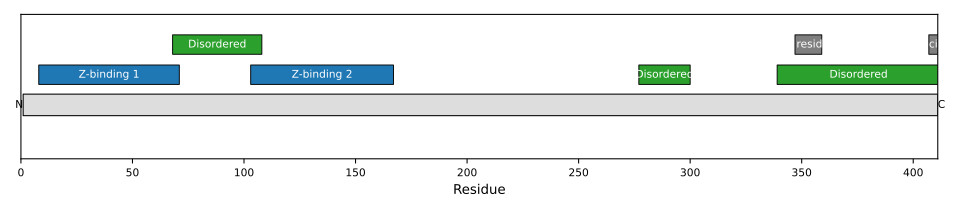
1: Key innate sensor that recognizes and binds Z-RNA structures, which are produced by a number of viruses, such as herpesvirus, orthomyxovirus or flavivirus, and triggers different forms of cell death (PubMed:32200799). ZBP1 acts as an essential mediator of pyroptosis, necroptosis and apoptosis (PANoptosis), an integral part of host defense against pathogens, by activating RIPK3, caspase-8 (CASP8), and the NLRP3 inflammasome (By similarity). Key activator of necroptosis, a programmed cell death process in response to death-inducing TNF-alpha family members, via its ability to bind Z-RNA: once activated upon Z-RNA-binding, ZBP1 interacts and stimulates RIPK3 kinase, which phosphorylates and activates MLKL, triggering execution of programmed necrosis (By similarity). In addition to TNF-induced necroptosis, necroptosis can also take place in the nucleus in response to orthomyxoviruses infection: ZBP1 recognizes and binds Z-RNA structures that are produced in infected nuclei by orthomyxoviruses, such as the influenza A virus (IAV), leading to ZBP1 activation, RIPK3 stimulation and subsequent MLKL phosphorylation, triggering disruption of the nuclear envelope and leakage of cellular DNA into the cytosol (PubMed:32200799). ZBP1-dependent cell death in response to IAV infection promotes interleukin-1 alpha (IL1A) induction in an NLRP3-inflammasome-independent manner: IL1A expression is required for the optimal interleukin-1 beta (IL1B) production, and together, these cytokines promote infiltration of inflammatory neutrophils to the lung, leading to the formation of neutrophil extracellular traps (By similarity). In addition to its direct role in driving necroptosis via its ability to sense Z-RNAs, also involved in PANoptosis triggered in response to bacterial infection: component of the AIM2 PANoptosome complex, a multiprotein complex that triggers PANoptosis (By similarity). Also acts as the apical sensor of fungal infection responsible for activating PANoptosis (By similarity). Involved in CASP8-mediated cell death via its interaction with RIPK1 but independently of its ability to sense Z-RNAs (By similarity). In some cell types, also able to restrict viral replication by promoting cell death-independent responses (By similarity). In response to Zika virus infection in neurons, promotes a cell death-independent pathway that restricts viral replication: together with RIPK3, promotes a death-independent transcriptional program that modifies the cellular metabolism via up-regulation expression of the enzyme ACOD1/IRG1 and production of the metabolite itaconate (By similarity). Itaconate inhibits the activity of succinate dehydrogenase, generating a metabolic state in neurons that suppresses replication of viral genomes (By similarity)
2: (Microbial infection) In case of herpes simplex virus 1/HHV-1 infection, forms hetero-amyloid structures with HHV-1 protein RIR1/ICP6 which may inhibit ZBP1-mediated necroptosis, thereby preventing host cell death pathway and allowing viral evasion