Small conductance calcium-activated potassium channel protein 2 (SK2) (SKCa 2) (SKCa2) (KCa2.2)
1_MSSCR 6_ YNGGV 11_ MRPLS 16_ NLSAS 21_ RRNLH 26_ EMDSE 31_ AQPLQ 36_ PPASV 41_ GGGGG 46_ ASSPS 51_ AAAAA 56_ AAAVS 61_ SSAPE 66_ IVVSK 71_ PEHNN 76_ SNNLA 81_ LYGTG 86_ GGGST 91_ GGGGG 96_ GGGSG 101_ HGSSS 106_ GTKSS 111_ KKKNQ 116_ NIGYK 121_ LGHRR 126_ ALFEK 131_ RKRLS 136_ DYALI 141_ FGMFG 146_ IVVMV 151_ IETEL 156_ SWGAY 161_ DKASL 166_ YSLAL 171_ KCLIS 176_ LSTII 181_ LLGLI 186_ IVYHA 191_ REIQL 196_ FMVDN 201_ GADDW 206_ RIAMT 211_ YERIF 216_ FICLE 221_ ILVCA 226_ IHPIP 231_ GNYTF 236_ TWTAR 241_ LAFSY 246_ APSTT 251_ TADVD 256_ IILSI 261_ PMFLR 266_ LYLIA 271_ RVMLL 276_ HSKLF 281_ TDASS 286_ RSIGA 291_ LNKIN 296_ FNTRF 301_ VMKTL 306_ MTICP 311_ GTVLL 316_ VFSIS 321_ LWIIA 326_ AWTVR 331_ ACERY 336_ HDQQD 341_ VTSNF 346_ LGAMW 351_ LISIT 356_ FLSIG 361_ YGDMV 366_ PNTYC 371_ GKGVC 376_ LLTGI 381_ MGAGC 386_ TALVV 391_ AVVAR 396_ KLELT 401_ KAEKH 406_ VHNFM 411_ MDTQL 416_ TKRVK 421_ NAAAN 426_ VLRET 431_ WLIYK 436_ NTKLV 441_ KKIDH 446_ AKVRK 451_ HQRKF 456_ LQAIH 461_ QLRSV 466_ KMEQR 471_ KLNDQ 476_ ANTLV 481_ DLAKT 486_ QNIMY 491_ DMISD 496_ LNERS 501_ EDFEK 506_ RIVTL 511_ ETKLE 516_ TLIGS 521_ IHALP 526_ GLISQ 531_ TIRQQ 536_ QRDFI 541_ EAQME 546_ SYDKH 551_ VTYNA 556_ ERSRS 561_ SSRRR 566_ RSSST 571_APPTS
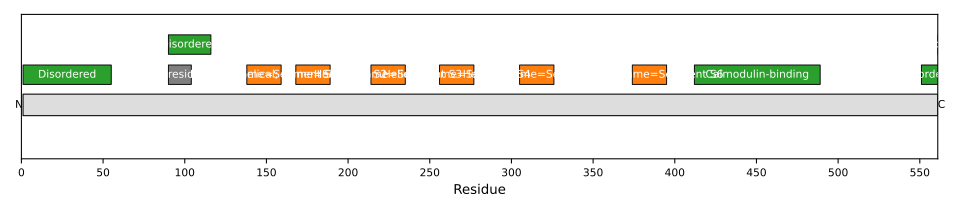
1: Small conductance calcium-activated potassium channel that mediates the voltage-independent transmembrane transfer of potassium across the cell membrane through a constitutive interaction with calmodulin which binds the intracellular calcium allowing its opening (PubMed:10991935, PubMed:33242881, PubMed:9287325). The current is characterized by a voltage-independent activation, an intracellular calcium concentration increase-dependent activation and a single-channel conductance of about 3 picosiemens (PubMed:10991935). Also presents an inwardly rectifying current, thus reducing its already small outward conductance of potassium ions, which is particularly the case when the membrane potential displays positive values, above + 20 mV (PubMed:10991935). The inward rectification could be due to a blockade of the outward current by intracellular divalent cations such as calcium and magnesium and could also be due to an intrinsic property of the channel pore, independent of intracellular divalent ions. There are three positively charged amino acids in the S6 transmembrane domain, close to the pore, that collectively control the conductance and rectification through an electrostatic mechanism. Additionally, electrostatic contributions from these residues also play an important role in determining the intrinsic open probability of the channel in the absence of calcium, affecting the apparent calcium affinity for activation. Forms an heteromeric complex with calmodulin, which is constitutively associated in a calcium-independent manner. Channel opening is triggered when calcium binds the calmodulin resulting in a rotary movement leading to the formation of the dimeric complex to open the gate (By similarity). Plays a role in the repolarization phase of cardiac action potential (PubMed:13679367)