CST complex subunit STN1 (Oligonucleotide/oligosaccharide-binding fold-containing protein 1) (Suppressor of cdc thirteen homolog)
1_MQPGS 6_ SRCEE 11_ ETPSL 16_ LWGLD 21_ PVFLA 26_ FAKLY 31_ IRDIL 36_ DMKES 41_ RQVPG 46_ VFLYN 51_ GHPIK 56_ QVDVL 61_ GTVIG 66_ VRERD 71_ AFYSY 76_ GVDDS 81_ TGVIN 86_ CICWK 91_ KLNTE 96_ SVSAA 101_ PSAAR 106_ ELSLT 111_ SQLKK 116_ LQETI 121_ EQKTK 126_ IEIGD 131_ TIRVR 136_ GSIRT 141_ YREER 146_ EIHAT 151_ TYYKV 156_ DDPVW 161_ NIQIA 166_ RMLEL 171_ PTIYR 176_ KVYDQ 181_ PFHSS 186_ ALEKE 191_ EALSN 196_ PGALD 201_ LPSLT 206_ SLLSE 211_ KAKEF 216_ LMENR 221_ VQSFY 226_ QQELE 231_ MVESL 236_ LSLAN 241_ QPVIH 246_ SASSD 251_ QVNFK 256_ KDTTS 261_ KAIHS 266_ IFKNA 271_ IQLLQ 276_ EKGLV 281_ FQKDD 286_ GFDNL 291_ YYVTR 296_ EDKDL 301_ HRKIH 306_ RIIQQ 311_ DCQKP 316_ NHMEK 321_ GCHFL 326_ HILAC 331_ ARLSI 336_ RPGLS 341_ EAVLQ 346_ QVLEL 351_ LEDQS 356_ DIVST 361_MEHYY
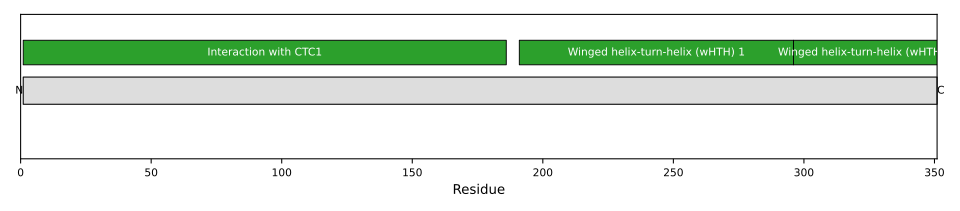
1: Component of the CST complex proposed to act as a specialized replication factor promoting DNA replication under conditions of replication stress or natural replication barriers such as the telomere duplex. The CST complex binds single-stranded DNA with high affinity in a sequence-independent manner, while isolated subunits bind DNA with low affinity by themselves. Initially the CST complex has been proposed to protect telomeres from DNA degradation (PubMed:19854130). However, the CST complex has been shown to be involved in several aspects of telomere replication. The CST complex inhibits telomerase and is involved in telomere length homeostasis; it is proposed to bind to newly telomerase-synthesized 3' overhangs and to terminate telomerase action implicating the association with the ACD:POT1 complex thus interfering with its telomerase stimulation activity. The CST complex is also proposed to be involved in fill-in synthesis of the telomeric C-strand probably implicating recruitment and activation of DNA polymerase alpha (PubMed:22763445, PubMed:22964711). The CST complex facilitates recovery from many forms of exogenous DNA damage; seems to be involved in the re-initiation of DNA replication at repaired forks and/or dormant origins (PubMed:25483097). Required for efficicient replication of the duplex region of the telomere. Promotes efficient replication of lagging-strand telomeres (PubMed:22863775, PubMed:22964711). Promotes general replication start following replication-fork stalling implicating new origin firing (PubMed:22863775). May be in involved in C-strand fill-in during late S/G2 phase independent of its role in telomere duplex replication (PubMed:23142664)
2: Component of the CST complex, a complex that binds to single-stranded DNA and is required to protect telomeres from DNA degradation. The CST complex binds single-stranded DNA with high affinity in a sequence-independent manner, while isolated subunits bind DNA with low affinity by themselves. In addition to telomere protection, the CST complex has probably a more general role in DNA metabolism at non-telomeric sites