Non-homologous end-joining factor 1 (Protein cernunnos) (XRCC4-like factor)
1_MEELE 6_ QGLLM 11_ QPWAW 16_ LQLAE 21_ NSLLA 26_ KVFIT 31_ KQGYA 36_ LLVSD 41_ LQQVW 46_ HEQVD 51_ TSVVS 56_ QRAKE 61_ LNKRL 66_ TAPPA 71_ AFLCH 76_ LDNLL 81_ RPLLK 86_ DAAHP 91_ SEATF 96_ SCDCV 101_ ADALI 106_ LRVRS 111_ ELSGL 116_ PFYWN 121_ FHCML 126_ ASPSL 131_ VSQHL 136_ IRPLM 141_ GMSLA 146_ LQCQV 151_ RELAT 156_ LLHMK 161_ DLEIQ 166_ DYQES 171_ GATLI 176_ RDRLK 181_ TEPFE 186_ ENSFL 191_ EQFMI 196_ EKLPE 201_ ACSIG 206_ DGKPF 211_ VMNLQ 216_ DLYMA 221_ VTTQE 226_ VQVGQ 231_ KHQGA 236_ GDPHT 241_ SNSAS 246_ LQGID 251_ SQCVN 256_ QPEQL 261_ VSSAP 266_ TLSAP 271_ EKEST 276_ GTSGP 281_ LQRPQ 286_ LSKVK 291_RKKPR
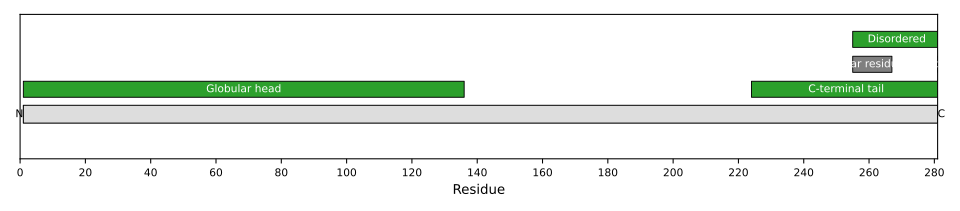
1: DNA repair protein involved in DNA non-homologous end joining (NHEJ); it is required for double-strand break (DSB) repair and V(D)J recombination and is also involved in telomere maintenance (PubMed:16439204, PubMed:16439205, PubMed:17317666, PubMed:17470781, PubMed:17717001, PubMed:18158905, PubMed:18644470, PubMed:20558749, PubMed:26100018, PubMed:28369633). Plays a key role in NHEJ by promoting the ligation of various mismatched and non-cohesive ends (PubMed:17470781, PubMed:17717001, PubMed:19056826). Together with PAXX, collaborates with DNA polymerase lambda (POLL) to promote joining of non-cohesive DNA ends (PubMed:25670504, PubMed:30250067). May act in concert with XRCC5-XRCC6 (Ku) to stimulate XRCC4-mediated joining of blunt ends and several types of mismatched ends that are non-complementary or partially complementary (PubMed:16439204, PubMed:16439205, PubMed:17317666, PubMed:17470781). In some studies, has been shown to associate with XRCC4 to form alternating helical filaments that bridge DNA and act like a bandage, holding together the broken DNA until it is repaired (PubMed:21768349, PubMed:21775435, PubMed:22228831, PubMed:22287571, PubMed:26100018, PubMed:27437582, PubMed:28500754). Alternatively, it has also been shown that rather than forming filaments, a single NHEJ1 dimer interacts through both head domains with XRCC4 to promote the close alignment of DNA ends (By similarity). The XRCC4-NHEJ1/XLF subcomplex binds to the DNA fragments of a DSB in a highly diffusive manner and robustly bridges two independent DNA molecules, holding the broken DNA fragments in close proximity to one other (PubMed:27437582, PubMed:28500754). The mobility of the bridges ensures that the ends remain accessible for further processing by other repair factors (PubMed:27437582). Binds DNA in a length-dependent manner (PubMed:17317666, PubMed:18158905)