DNA-directed RNA polymerase I subunit RPA2 (RNA polymerase I subunit 2) (EC 2.7.7.6) (DNA-directed RNA polymerase I 135 kDa polypeptide) (RPA135)
1_MDPGS 6_ RWRNL 11_ PSGPS 16_ LKHLT 21_ DPSYG 26_ IPREQ 31_ QKAAL 36_ QELTR 41_ AHVES 46_ FNYAV 51_ HEGLG 56_ LAVQA 61_ IPPFE 66_ FAFKD 71_ ERISF 76_ TILDA 81_ VISPP 86_ TVPKG 91_ TICKE 96_ ANVYP 101_ AECRG 106_ RRSTY 111_ RGKLT 116_ ADINW 121_ AVNGI 126_ SKGII 131_ KQFLG 136_ YVPIM 141_ VKSKL 146_ CNLRN 151_ LPPQA 156_ LIEHH 161_ EEAEE 166_ MGGYF 171_ IINGI 176_ EKVIR 181_ MLIMP 186_ RRNFP 191_ IAMIR 196_ PKWKT 201_ RGPGY 206_ TQYGV 211_ SMHCV 216_ REEHS 221_ AVNMN 226_ LHYLE 231_ NGTVM 236_ LNFIY 241_ RKELF 246_ FLPLG 251_ FALKA 256_ LVSFS 261_ DYQIF 266_ QELIK 271_ GKEDD 276_ SFLRN 281_ SVSQM 286_ LRIVM 291_ EEGCS 296_ TQKQV 301_ LNYLG 306_ ECFRV 311_ KLNVP 316_ DWYPN 321_ EQAAE 326_ FLFNQ 331_ CICIH 336_ LKSNT 341_ EKFYM 346_ LCLMT 351_ RKLFA 356_ LAKGE 361_ CMEDN 366_ PDSLV 371_ NQEVL 376_ TPGQL 381_ FLMFL 386_ KEKLE 391_ GWLVS 396_ IKIAF 401_ DKKAQ 406_ KTSVS 411_ MNTDN 416_ LMRIF 421_ TMGID 426_ LTKPF 431_ EYLFA 436_ TGNLR 441_ SKTGL 446_ GLLQD 451_ SGLCV 456_ VADKL 461_ NFIRY 466_ LSHFR 471_ CVHRG 476_ ADFAK 481_ MRTTT 486_ VRRLL 491_ PESWG 496_ FLCPV 501_ HTPDG 506_ EPCGL 511_ MNHLT 516_ AVCEV 521_ VTQFV 526_ YTASI 531_ PALLC 536_ NLGVT 541_ PIDGA 546_ PHRSY 551_ SECYP 556_ VLLDG 561_ VMVGW 566_ VDKDL 571_ APGIA 576_ DSLRH 581_ FKVLR 586_ EKRIP 591_ PWMEV 596_ VLIPM 601_ TGKPS 606_ LYPGL 611_ FLFTT 616_ PCRLV 621_ RPVQN 626_ LALGK 631_ EELIG 636_ TMEQI 641_ FMNVA 646_ IFEDE 651_ VFAGV 656_ TTHQE 661_ LFPHS 666_ LLSVI 671_ ANFIP 676_ FSDHN 681_ QSPRN 686_ MYQCQ 691_ MGKQT 696_ MGFPL 701_ LTYQD 706_ RSDNK 711_ LYRLQ 716_ TPQSP 721_ LVRPS 726_ MYDYY 731_ DMDNY 736_ PIGTN 741_ AIVAV 746_ ISYTG 751_ YDMED 756_ AMIVN 761_ KASWE 766_ RGFAH 771_ GSVYK 776_ SEFID 781_ LSEKI 786_ KQGDS 791_ SLVFG 796_ IKPGD 801_ PRVLQ 806_ KLDDD 811_ GLPFI 816_ GAKLQ 821_ YGDPY 826_ YSYLN 831_ LNTGE 836_ SFVMY 841_ YKSKE 846_ NCVVD 851_ NIKVC 856_ SNDTG 861_ SGKFK 866_ CVCIT 871_ MRVPR 876_ NPTIG 881_ DKFAS 886_ RHGQK 891_ GILSR 896_ LWPAE 901_ DMPFT 906_ ESGMV 911_ PDILF 916_ NPHGF 921_ PSRMT 926_ IGMLI 931_ ESMAG 936_ KSAAL 941_ HGLCH 946_ DATPF 951_ IFSEE 956_ NSALE 961_ YFGEM 966_ LKAAG 971_ YNFYG 976_ TERLY 981_ SGISG 986_ LELEA 991_ DIFIG 996_ VVYYQ 1001_ RLRHM 1006_ VSDKF 1011_ QVRTT 1016_ GARDR 1021_ VTNQP 1026_ IGGRN 1031_ VQGGI 1036_ RFGEM 1041_ ERDAL 1046_ LAHGT 1051_ SFLLH 1056_ DRLFN 1061_ CSDRS 1066_ VAHVC 1071_ VKCGS 1076_ LLSPL 1081_ LEKPP 1086_ PSWSA 1091_ MRNRK 1096_ YNCTL 1101_ CSRSD 1106_ TIDTV 1111_ SVPYV 1116_ FRYFV 1121_ AELAA 1126_MNIKV
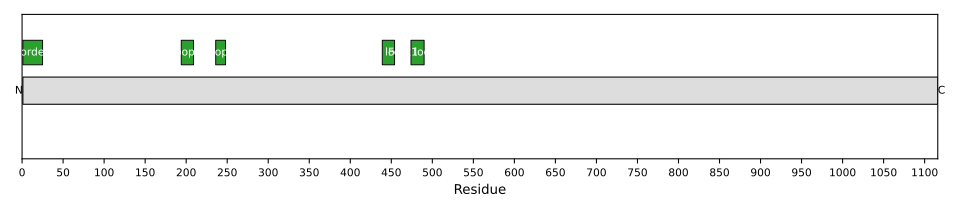
1: Catalytic core component of RNA polymerase I (Pol I), a DNA-dependent RNA polymerase which synthesizes ribosomal RNA precursors using the four ribonucleoside triphosphates as substrates. Transcribes 47S pre-rRNAs from multicopy rRNA gene clusters, giving rise to 5.8S, 18S and 28S ribosomal RNAs (PubMed:11250903, PubMed:11283244, PubMed:16858408, PubMed:34671025, PubMed:34887565, PubMed:36271492). Pol I-mediated transcription cycle proceeds through transcription initiation, transcription elongation and transcription termination stages. During transcription initiation, Pol I pre-initiation complex (PIC) is recruited by the selectivity factor 1 (SL1/TIF-IB) complex bound to the core promoter that precedes an rDNA repeat unit. The PIC assembly bends the promoter favoring the formation of the transcription bubble and promoter escape. Once the polymerase has escaped from the promoter it enters the elongation phase during which RNA is actively polymerized, based on complementarity with the template DNA strand. Highly processive, assembles in structures referred to as 'Miller trees' where many elongating Pol I complexes queue and transcribe the same rDNA coding regions. At terminator sequences downstream of the rDNA gene, PTRF interacts with Pol I and halts Pol I transcription leading to the release of the RNA transcript and polymerase from the DNA (PubMed:11250903, PubMed:11283244, PubMed:16858408, PubMed:34671025, PubMed:34887565, PubMed:36271492). Forms Pol I active center together with the largest subunit POLR1A/RPA1. Appends one nucleotide at a time to the 3' end of the nascent RNA, with POLR1A/RPA1 contributing a Mg(2+)-coordinating DxDGD motif, and POLR1B/RPA2 participating in the coordination of a second Mg(2+) ion and providing lysine residues believed to facilitate Watson-Crick base pairing between the incoming nucleotide and the template base. Typically, Mg(2+) ions direct a 5' nucleoside triphosphate to form a phosphodiester bond with the 3' hydroxyl of the preceding nucleotide of the nascent RNA, with the elimination of pyrophosphate. Has proofreading activity: Pauses and backtracks to allow the cleavage of a missincorporated nucleotide via POLR1H/RPA12. High Pol I processivity is associated with decreased transcription fidelity (By similarity) (PubMed:11250903, PubMed:11283244, PubMed:16809778, PubMed:16858408, PubMed:34671025, PubMed:34887565, PubMed:36271492)