Protein lin-28 homolog A (Lin-28A) (Zinc finger CCHC domain-containing protein 1)
1_MGSVS 6_ NQQFA 11_ GGCAK 16_ AAEEA 21_ PEEAP 26_ EDAAR 31_ AADEP 36_ QLLHG 41_ AGICK 46_ WFNVR 51_ MGFGF 56_ LSMTA 61_ RAGVA 66_ LDPPV 71_ DVFVH 76_ QSKLH 81_ MEGFR 86_ SLKEG 91_ EAVEF 96_ TFKKS 101_ AKGLE 106_ SIRVT 111_ GPGGV 116_ FCIGS 121_ ERRPK 126_ GKSMQ 131_ KRRSK 136_ GDRCY 141_ NCGGL 146_ DHHAK 151_ ECKLP 156_ PQPKK 161_ CHFCQ 166_ SISHM 171_ VASCP 176_ LKAQQ 181_ GPSAQ 186_ GKPTY 191_ FREEE 196_ EEIHS 201_PTLLP
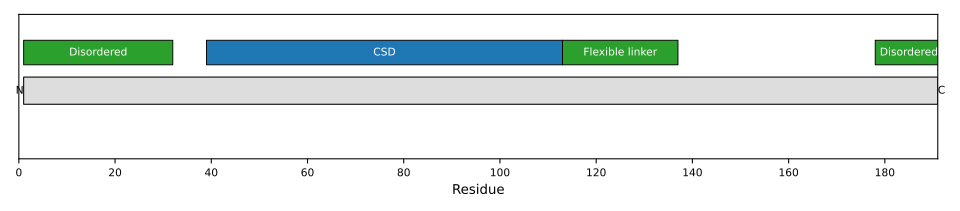
1: RNA-binding protein that inhibits processing of pre-let-7 miRNAs and regulates translation of mRNAs that control developmental timing, pluripotency and metabolism (PubMed:21247876). Seems to recognize a common structural G-quartet (G4) feature in its miRNA and mRNA targets (Probable). 'Translational enhancer' that drives specific mRNAs to polysomes and increases the efficiency of protein synthesis. Its association with the translational machinery and target mRNAs results in an increased number of initiation events per molecule of mRNA and, indirectly, in mRNA stabilization. Binds IGF2 mRNA, MYOD1 mRNA, ARBP/36B4 ribosomal protein mRNA and its own mRNA. Essential for skeletal muscle differentiation program through the translational up-regulation of IGF2 expression. Suppressor of microRNA (miRNA) biogenesis, including that of let-7, miR107, miR-143 and miR-200c. Specifically binds the miRNA precursors (pre-miRNAs), recognizing an 5'-GGAG-3' motif found in pre-miRNA terminal loop, and recruits TUT4 and TUT7 uridylyltransferases (PubMed:18951094, PubMed:19703396, PubMed:22118463, PubMed:22898984). This results in the terminal uridylation of target pre-miRNAs (PubMed:18951094, PubMed:19703396, PubMed:22118463, PubMed:22898984). Uridylated pre-miRNAs fail to be processed by Dicer and undergo degradation. The repression of let-7 expression is required for normal development and contributes to maintain the pluripotent state by preventing let-7-mediated differentiation of embryonic stem cells (PubMed:18951094, PubMed:19703396, PubMed:22118463, PubMed:22898984). Localized to the periendoplasmic reticulum area, binds to a large number of spliced mRNAs and inhibits the translation of mRNAs destined for the ER, reducing the synthesis of transmembrane proteins, ER or Golgi lumen proteins, and secretory proteins. Binds to and enhances the translation of mRNAs for several metabolic enzymes, such as PFKP, PDHA1 or SDHA, increasing glycolysis and oxidative phosphorylation. Which, with the let-7 repression may enhance tissue repair in adult tissue (By similarity)